 EN
EN
Sustainability and Environmental Performance
The primary raw material for paper buckets is a renewable source of plant fiber. Paper is considered environmentally friendly packaging material because it is biodegradable, recyclable, and compliant with international green packaging standards. Globally, environmental protection organizations and container research institutes agree on the non-harmful nature of paper packaging because of its short decomposition time and no microplastic pollution B. In contrast, machines that produce buckets made of plastic use raw materials that are synthetic and derived from petroleum. While plastics are recyclable, the energy intensive and complex processes required for recycling them, coupled with the fact that plastic buckets are non-biodegradable, presents a persistent environmental burden. As global environmental regulations become more stringent, the advantages of paper bucket production lines become more evident in helping businesses pass environmental audits and in facilitating compliance with market access standards. For many years, RUIDA has been answerable in paper container machinery and production lines, ensuring that RUIDA machinery is compatible with environmentally friendly paper materials for the designed purpose of assisting customers in achieving low carbon production goals.
Operational Stability and Production Efficiency
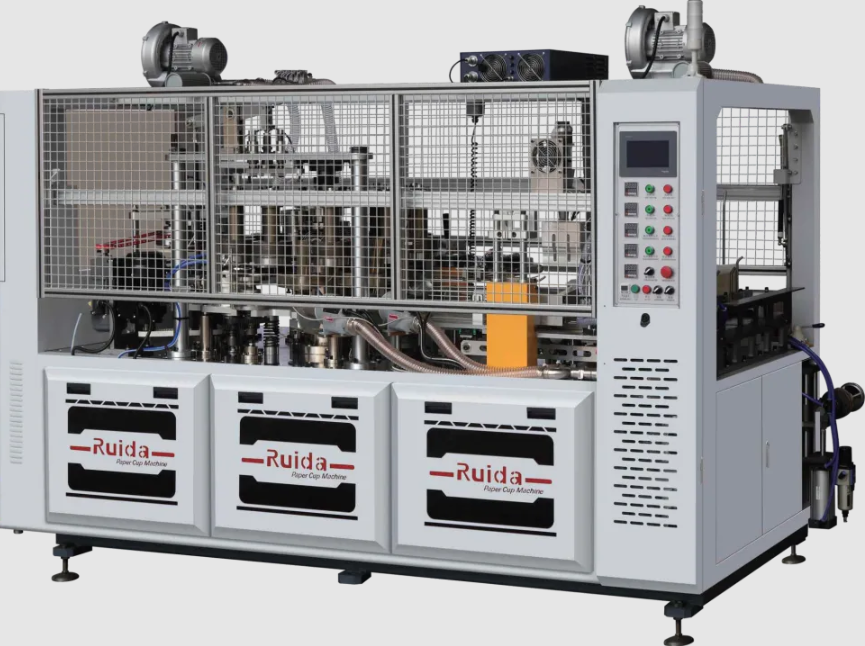
Modern paper bucket machines feature highly integrated automated control systems that manage processes like paper feeding and sealing in one pass. With production speeds of 60 to 80 pieces per minute, high-speed models of these machines achieve remarkable outputs. The machines operate quietly and have low failure rates due to advanced processing methods. In contrast, production of plastic buckets employs either blow molding or injection molding. These processes are lengthy and have high per unit energy costs. In practice, plastic manufacturing seems to have more equipment problems, including uneven melting and mold scaling, hindering continuous production cycles. With almost 25 years of manufacturing experience, RUIDA has fine-tuned paper bucket machines to ensure highly stable, long-term efficient production.
Cost Efficiency and Long Term Economic Value
The investment costs of paper bucket machines are justified due to low operational costs. Paper raw materials are low-cost and low-maintenance. The lack of high temperature heating and cooling systems eliminates a large cost burden from water and electricity. The paper products lose due to production is low and can be recycled to further reduce costs. The costs of plastic products are reduced due to equipment consuming high amounts of energy and large breaks to equipment. In the long run, paper bucket production lines are more cost effective and provide greater returns to businesses than plastic. RUIDA has excellent sell support systems and provide complete equipment support services, not only to reduce costs to the customer, but to work with the customer to improve economic benefits. They also reduce maintenance costs to customers.
Adaptability of Paper Buckets as a Product
Paper buckets produced by paper buckets machines look good, are good insulators, and have a range of specifications. They can be customized to a range of sizes and designs and used for a variety of purposes including food packaging and packaging of other daily use commodities. They are made out of paper which is is a clean and safe material that is inoffensive and does not release toxins and other harmful substances to food when in contact with it. Plastic buckets on the other hand, are offensive with their smell, are poor conductors, and have a limited use in food. They have a good seal, are corrosion resistant, and are better suited to contain some chemical liquids. Paper bucket machines by RUIDA utilize the latest technology, with precision processing, resulting in a high uniformity and stability of specifications of the products. They are able to fulfil user requirements of multiple applications resulting in high customer satisfaction worldwide.
Benefits Regarding Safety and Regulations
The molten paper bucket manufacturing process not only operates at room temperature, but also is not exposed to thermal toxic gas emissions, which reduces potential safety hazards during manufacturing. Bundled paper products also have food safety standards in many countries, and relevant certifications are easily available. The plastic bucket manufacturing process emits and requires controlled thermal gas emission devices to meet safety and environmental engineering controls. The manufacturing equipment operation and maintenance also pose high risks and are required to meet strict standards. RUIDA paper bucket machines have high design standards meeting international production safety standards and guaranteeing safe production for clients.
Conclusion and Equipment Selection Guide
Overall, we can say that paper bucket machines offer greater environmental protection, are more cost-effective, safer, and more flexible in applications than their plastic counterparts. They truly encapsulate the expected direction that the global packaging industry is heading toward. For businesses that want to continue their sustainable development and want to protect their long-term interests, investing in paper bucket production equipment is the most rational choice. RUIDA is an experienced, professional manufacturer in the paper container machinery industry. RUIDA enjoys independent research and development. They have their own machinery production capabilities. RUIDA exports paper bucket machinery and auxiliary machinery to more than 70 countries. This means that RUIDA is able to offer customers reliable machinery and complete service packages. RUIDA machinery guarantees reliable quality and efficient production and allows companies to preserve their sustainable development potential. With RUIDA machinery, companies are able to establish their long term development goals.