
 EN

What Is Bucket Machine and Its Functions?
In paper-packaging production, a bucket machine usually means equipment that forms cup- or bucket-shaped paper containers from prepared paper blanks. The phrase can mean very different equipment in general web searches, so buyers should define the product, material, and forming process before comparing machines. For food-packaging applications, the practical question is not simply “What is a bucket machine?” but whether the forming process can make the required container shape consistently.
From a packaging-equipment selection perspective, a bucket machine is usefully understood as one station or a coordinated set of stations that turns printed, die-cut, and suitably coated paperboard into a usable container. A supplier should confirm the intended container drawing and material before promising a configuration. That distinction matters when a project also includes a machine paper bag line or a paper cup business: these products may share converting principles, but their tooling and production checks are not interchangeable.
What does a bucket machine do?
The core job of a bucket machine is to control a repeatable forming sequence. Depending on the container design, the sequence commonly includes blank feeding, side-seam joining, body forming, bottom forming, heating or pressing, rim finishing, inspection, and discharge. Some machines are designed around a narrow family of shapes; others may be configured for related paper cups or food containers. The exact stations, heating method, and tooling should be verified for the proposed model rather than assumed from the product name.
A useful way to evaluate a bucket machine is to follow the material through the process. Paper blanks must arrive in the correct orientation. The body needs to hold its shape while the seam is joined. The bottom must be seated and formed under conditions appropriate to the material. Finally, the finished container must leave the machine without crushing, contamination, or loss of shape. When one stage is unstable, the symptom often appears later as a weak seam, an uneven rim, or a container that does not stack well.
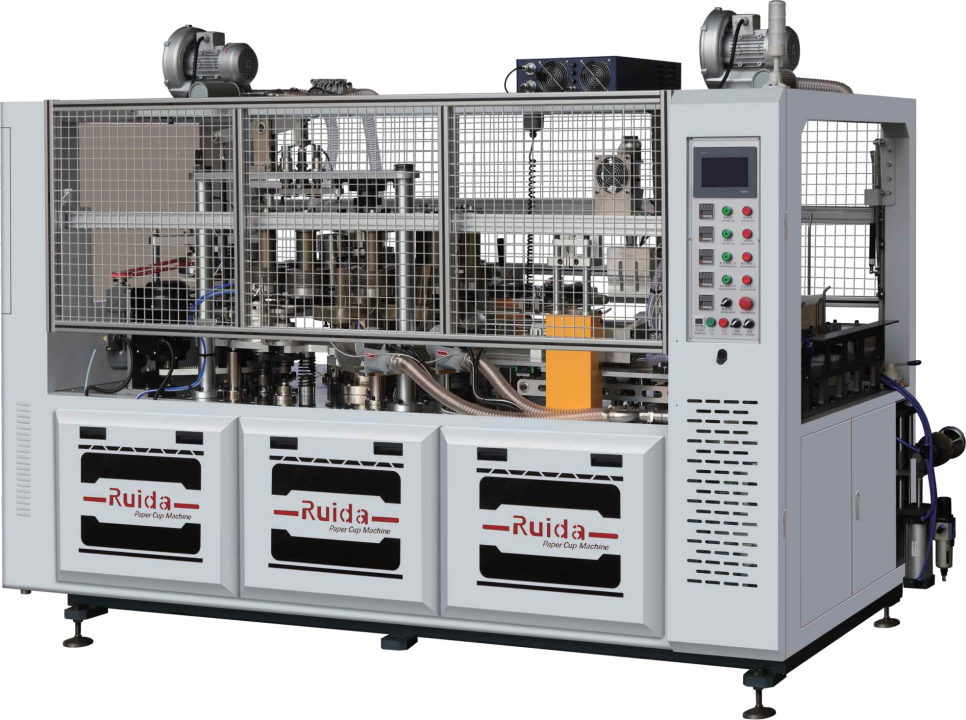 A paper-container forming workflow: feeding, shaping, bottom forming, and rim finishing.
Main functions in the forming process
1. Blank feeding and separation
A bucket machine begins by taking individual blanks from a stack and presenting them to the forming section. Reliable separation is important because doubled blanks or poor alignment can interrupt the cycle. Buyers should ask what paper range the feeder is intended to handle and how the machine responds to a feed fault. This is especially relevant when the same factory is considering a machine paper bag process, where paper stiffness and print finish may create different feeding behavior.
2. Body shaping and side-seam joining
The next function of a bucket machine is to turn a flat blank into a cylindrical, tapered, or otherwise shaped body. The seam may be joined by heat, an adhesive-related process, or another method compatible with the material and container design. The right question is not whether one method is universally better. It is whether the seam process matches the paperboard, coating, production environment, and end-use requirements.
3. Bottom forming, heating, and pressing
For containers with a formed base, the bucket machine positions the bottom piece, folds or engages the material, and applies the required forming action. Temperature, dwell time, pressure, and alignment are process variables rather than generic performance claims. If the container will hold food or liquids, the buyer should ask how the proposed material and base construction will be validated in their own application.
4. Rim finishing and shape control
A rim or top-edge operation gives the container a finished profile and can influence stiffness and handling. At this stage, a bucket machine must maintain alignment from earlier stations. A visually acceptable container can still cause trouble downstream if rims vary enough to affect lids, stacking, counting, or packing. For that reason, samples should be checked against the actual lid, carton, and filling workflow whenever possible.
5. Discharge, counting, and production monitoring
After forming, the bucket machine discharges containers for collection or connection to downstream handling. Controls may manage variables such as speed, paper feed, and process temperature, but the available functions differ by model. Discuss how operators will monitor rejects, stop the machine safely, clear a jam, and record recurring defects. A stable line depends on the working routine as much as the nominal equipment layout.
Where does it fit in a paper cup business?
In a paper cup business, a bucket machine can support a product range that includes larger cups, tubs, or bucket-style paper containers, provided the design and material are compatible. It does not automatically replace a standard paper-cup former or a machine paper bag system. Each product family has its own blank geometry, forming sequence, tooling, and quality criteria.
Rather than comparing only stated output, map the complete workflow: blank supply, printing and die cutting, forming, inspection, packing, and changeover. This turns an abstract bucket machine decision into a practical line-integration discussion. It also helps identify whether the constraint is actually forming capacity, material readiness, labor at packing, or a mismatch between the container design and the intended market.
Questions to ask before choosing a bucket machine
- Which container drawings, diameters, heights, and bottom profiles must the bucket machine produce?
- What paperboard grade, coating, print treatment, and blank tolerance will be used?
- Which seam and bottom-forming method is appropriate for the application?
- What sample checks will define acceptable seam quality, shape, and stackability?
- How often will tooling change, and what setup information must operators receive?
- How will the machine connect with inspection, counting, and packing steps?
These questions are more useful than a generic speed comparison because they expose the conditions behind repeatable output. They are also a sound basis for a supplier discussion: share container samples, drawings, material specifications, and the expected production rhythm before finalizing a bucket machine configuration.
Conclusion
A bucket machine for paper packaging is a forming system that feeds paper blanks, creates the container body, forms and secures the bottom, finishes the rim, and discharges finished pieces. Its value lies in controlled repeatability, not in a label alone. Whether the project is an extension of a paper cup business or a separate packaging line, confirm the container design, material, tooling, quality checks, and downstream workflow. That preparation gives both buyer and supplier a clearer path to evaluating the right bucket machine.
 ONLINE