
 EN

What Is Machine For Paper Cup Production Setup?
A machine for paper cup production is not only the forming unit on a factory floor. It is the connected manufacturing setup that turns approved paperboard into finished cups: material preparation, optional printing, blank cutting, side-seam forming, bottom insertion and sealing, rim curling, inspection, and packing. From a packaging-equipment technical advisor’s viewpoint, a useful machine for paper cup production starts with the cup specification and paper structure, then works back to the configuration and line rhythm.
That distinction matters during purchasing. Two projects can both require cup-forming equipment, yet need different tooling, material checks, automation options, or upstream equipment. A stable single cup format creates one set of priorities; multiple sizes, printed artwork, or frequent changes create another. This article offers a setup framework rather than a promise about output, because the final configuration should be confirmed against your actual cup samples and operating conditions.
What equipment belongs in a paper cup production setup?
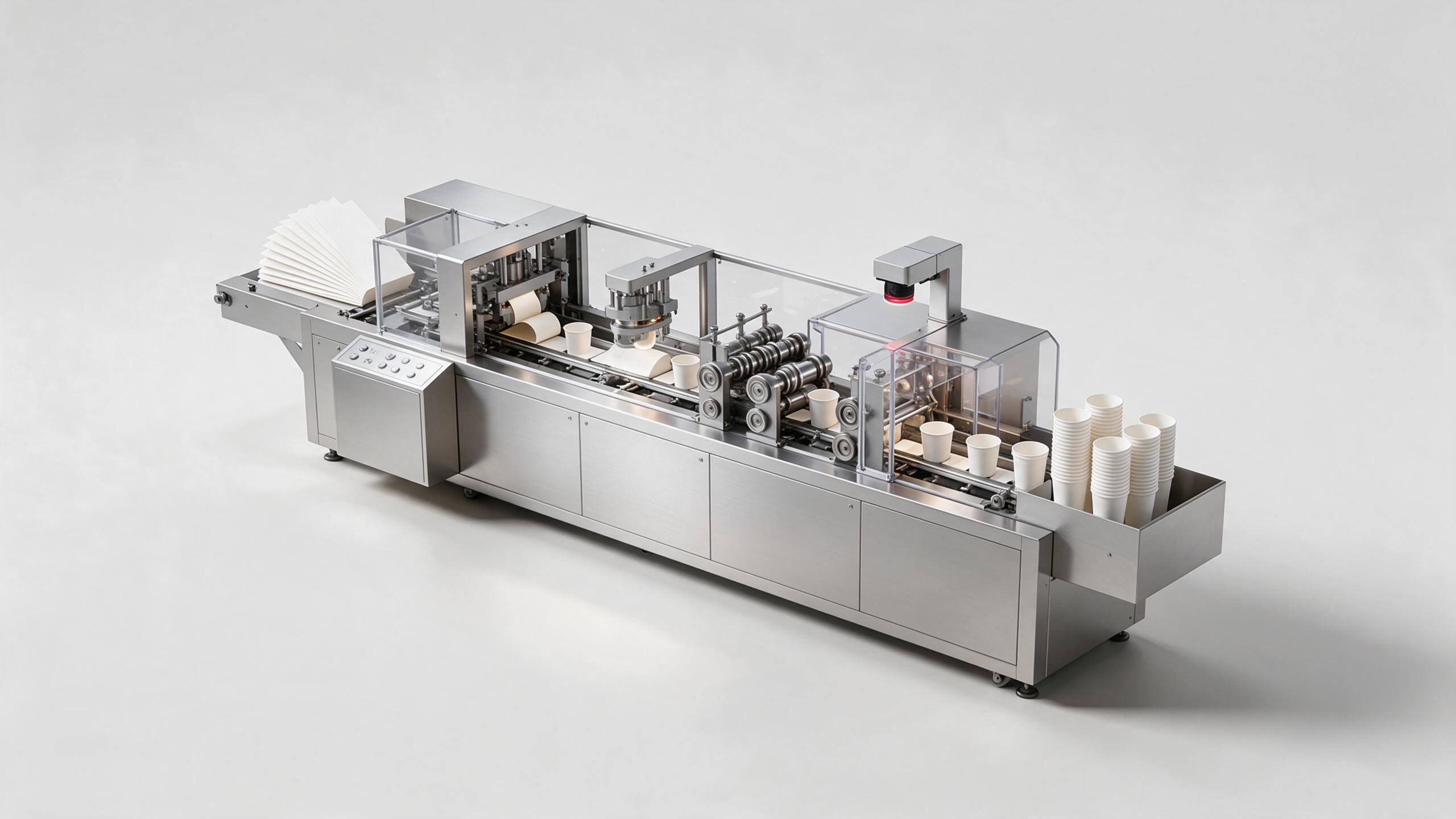
The core machine for paper cup production is the cup-forming machine. It receives a prepared sidewall blank, shapes it into a body, joins the side seam, inserts the bottom disc, seals the bottom area, and forms the rim. Depending on the project, the line may also need paper handling, printing, die-cutting, inspection, counting, and packing equipment.
A practical way to describe the production system is as a sequence of handoffs, not a single purchase. The paperboard must reach the forming stage in a condition compatible with the cup design. The forming station must match the target diameter, height, bottom shape, and material structure. Downstream handling must keep pace with actual, not assumed, output.
- Paperboard and blank preparation: confirm the supplied material, coating or barrier layer, blank dimensions, and storage conditions.
- Printing stage when artwork is required: printed graphics are typically handled before the blanks are formed.
- Die cutting: sidewall blanks and bottom discs must be cut to the dimensions agreed for the cup format.
- Forming and sealing: the main machine for paper cup production forms the body and joins critical seams.
- Rim finishing, inspection, and packing: these steps help define the usable line rhythm and acceptance check.
Start with the cup, not the speed claim
Before comparing forming equipment, write down the cup application and physical requirements. Include volume, top and bottom diameter, height, paperboard grade, barrier material, single-wall or other construction, print coverage, and whether the job will run one format or several. If the paper material and cup shape are already confirmed, equipment discussions become more meaningful.
It is tempting to begin with a rate figure. However, the proposed former should be assessed against the whole condition set: tooling, paper stiffness, blank accuracy, seam behavior, operator routine, changeover frequency, inspection method, and downstream capacity. In other words, move from a promised quantity to the conditions under which the line can be checked.
How the forming section works
In the central forming unit, a sidewall blank is wrapped into a cylindrical body and its overlap is joined. A bottom disc is then introduced and joined to the body. The rim is rolled or curled to create the familiar drinking edge. The sequence sounds straightforward, but the setup is material-sensitive. Paperboard construction and barrier layers can affect how the side seam and bottom seam respond during forming.
For that reason, the first technical discussion for the forming setup should identify the seam method, the material to be trialed, the cup geometry, and the quality checks expected at acceptance. A sealer paper cup discussion should be specific: is the concern the side seam, the bottom joint, heat settings, dwell, alignment, or the test method? Calling every issue a “sealing problem” makes troubleshooting slower.
Ask the supplier to define what sample material will be used for trials and what evidence will be reviewed. This can include visual seam checks, dimensional checks, and the handling or leak-test approach agreed by both sides. The correct test and threshold depend on the cup application, so they should be documented rather than assumed.
Where printing and flexo plate preparation fit
Not every machine for paper cup production needs an upstream printing cell. Plain cups can move directly from suitable stock and blank preparation into forming. For branded or multi-color cups, artwork is normally applied before die cutting and forming. This is where a flexo plate making machine may enter the wider workflow: it supports preparation of plates for a flexographic printing process, rather than replacing the cup former.
When planning a flexo plate making machine, separate the printing question from the forming question. Confirm artwork repeat, registration expectations, substrate suitability, drying or curing requirements where applicable, blank layout, and how printed rolls or sheets will be handed to the converting stage. A cup-forming machine cannot correct a print-registration issue created upstream, and an upstream print cell cannot compensate for unsuitable forming tooling.
Build the line around real production rhythm
The forming machine is only one rhythm in a larger process. Paper preparation, printing, die cutting, forming, inspection, and packing should be reviewed as connected capacities. If one stage pauses frequently, the nominal rate of another stage does not describe finished, accepted cups. This is especially important when several cup sizes are planned.
Instead of asking only, “How fast is the machine for paper cup production?” ask these questions:
- Which cup dimensions and materials are covered by the proposed tooling?
- What changeover actions are required between cup formats, and who performs them?
- Which seam and dimensional checks are part of the acceptance plan?
- What is the expected handoff between the former, inspection, counting, and packing stations?
- Which spare, training, maintenance, and remote-support boundaries should be clarified before delivery?
These questions turn a machine for paper cup production from a catalog category into an implementable project. They also reveal whether a simple standalone former is sufficient or whether a broader set of coordinated equipment is needed.
A setup checklist before you request a quotation
Prepare a concise technical brief before sourcing a machine for paper cup production. The brief should include drawings or samples, the intended paperboard and barrier structure, cup application, artwork needs, production schedule, factory utilities, target markets, inspection expectations, and preferred packaging method. If a sealer paper cup requirement is central, describe the specific seam concern and the intended verification method.
For projects with printed cups, add the print file workflow and clarify whether a flexo plate making machine is part of your own operation or an outside printing partner’s process. This prevents a common planning gap: treating printed blanks as if they will arrive with no effect on forming alignment or scheduling.
Finally, request a discussion that connects the proposed machine for paper cup production to your cup sample, not only to a generic size range. The goal is not to select one configuration by slogan. It is to establish what will be run, how it will be checked, and which responsibilities must be confirmed before production begins.
Frequently Asked Questions
Is a paper cup forming machine the whole production line?
No. The former is the central machine for paper cup production, but the full setup can also include material preparation, printing, die cutting, inspection, and packing. The exact scope depends on whether cups are plain or printed and how finished goods will be handled.
Do I need a flexo plate making machine for paper cups?
Only if your printing workflow requires flexographic plates to produce artwork before blanks are formed. A flexo plate making machine is an upstream printing consideration; it is not a substitute for the forming machine.
What should I check for a sealer paper cup issue?
First identify whether the concern is at the side seam, bottom joint, material compatibility, alignment, or the agreed test method. Then review those conditions with the cup sample and the proposed forming process.
 ONLINE