
 EN

What Unique Features Drive Cup Manufacturing Machine?
A cup manufacturing machine is not differentiated by one headline specification. What matters is how consistently it carries out a connected sequence of actions: feeding prepared paper blanks, forming the cup wall, joining the seam, fitting and sealing the bottom, reinforcing the lower joint, and finishing the rim. From a packaging-equipment selection perspective, the useful question is not simply “How fast is it?” but “Which features keep this sequence aligned with our cup design, material, production rhythm, and operator workflow?”
That distinction matters. A machine that looks suitable on a quotation can still need more setup work than expected when the paper structure, cup geometry, changeover frequency, or quality checks have not been discussed. The sections below explain the features buyers should connect to their own production conditions before selecting a cup-forming solution.
Start with the feature chain, not a single machine claim
Most paper cup production follows a recognizable flow: a prepared blank is fed and wrapped into a body, the side seam is joined, a bottom disc is fitted and sealed, the lower joint is knurled or reinforced, and the rim is curled. A cup manufacturing machine earns its distinction when its stations work together reliably for the intended paper, coating, cup profile, and operating pace.
For procurement teams, this is a practical way to compare proposals. Ask the supplier to map each feature to a production step and an acceptance check. For example, how is blank feeding monitored? What is the planned response to a missed blank or a malformed cup? Which adjustments are expected when paper stiffness or coating behavior changes? The answers are more useful than a generic list of automation labels.
1. Controlled blank feeding and cup-body forming
Stable forming begins before the blank reaches the mold. A well-considered cup manufacturing machine should give the operator a clear way to set, observe, and troubleshoot blank delivery. Alignment affects whether the body wraps cleanly around the forming tool and whether the side seam lands in the intended position.
This becomes especially important when a producer plans to run more than one blank size or paper grade. Paper behavior can vary between batches, so material compatibility should be discussed as a verification item rather than assumed from a cup diameter alone. Helpful questions include:
- What blank dimensions, paper weights, and coatings are planned for the trial?
- Which feed adjustments are operator-accessible, and which need a technician?
- How does the control screen indicate a feed interruption or alignment issue?
- What sample criteria will show that the side seam is forming as intended?
2. Heat and seam control that match the material
Seam joining is where material behavior and machine settings meet. Depending on the cup stock and coating system, heat, pressure, dwell, and alignment can all influence the finished joint. A capable cup manufacturing machine supports repeatable setup and makes it easier to verify that process conditions are being held, rather than asking operators to rely only on visual judgment.
A general heat-control feature should not be treated as proof that every material will run the same way. In practice, the correct settings depend on the validated paper and coating combination. Buyers should request a documented trial plan using representative blanks and define what will be inspected: seam appearance, bottom attachment, rim condition, dimensional consistency, and handling performance. For food-contact applications, also verify the complete material and market-compliance documentation separately; equipment capability alone does not establish packaging compliance.
3. Bottom sealing, knurling, and rim finishing features
The bottom joint and rim are highly visible parts of a finished cup, and they are often where a production team first notices a mismatch between settings and material. A cup manufacturing machine with coordinated bottom insertion, sealing, knurling, and curling stations helps the team build a controlled inspection routine around these steps.
Bottom knurling is commonly used to reinforce the bond between the side wall and bottom after sealing. Rim curling creates the finished lip. A station name alone does not tell the whole story. Compare how adjustments are made, whether wear points are accessible, and how operators isolate an issue. A practical acceptance conversation can cover sample inspection frequency, tooling condition, cleaning access, and the escalation path for repeated defects.
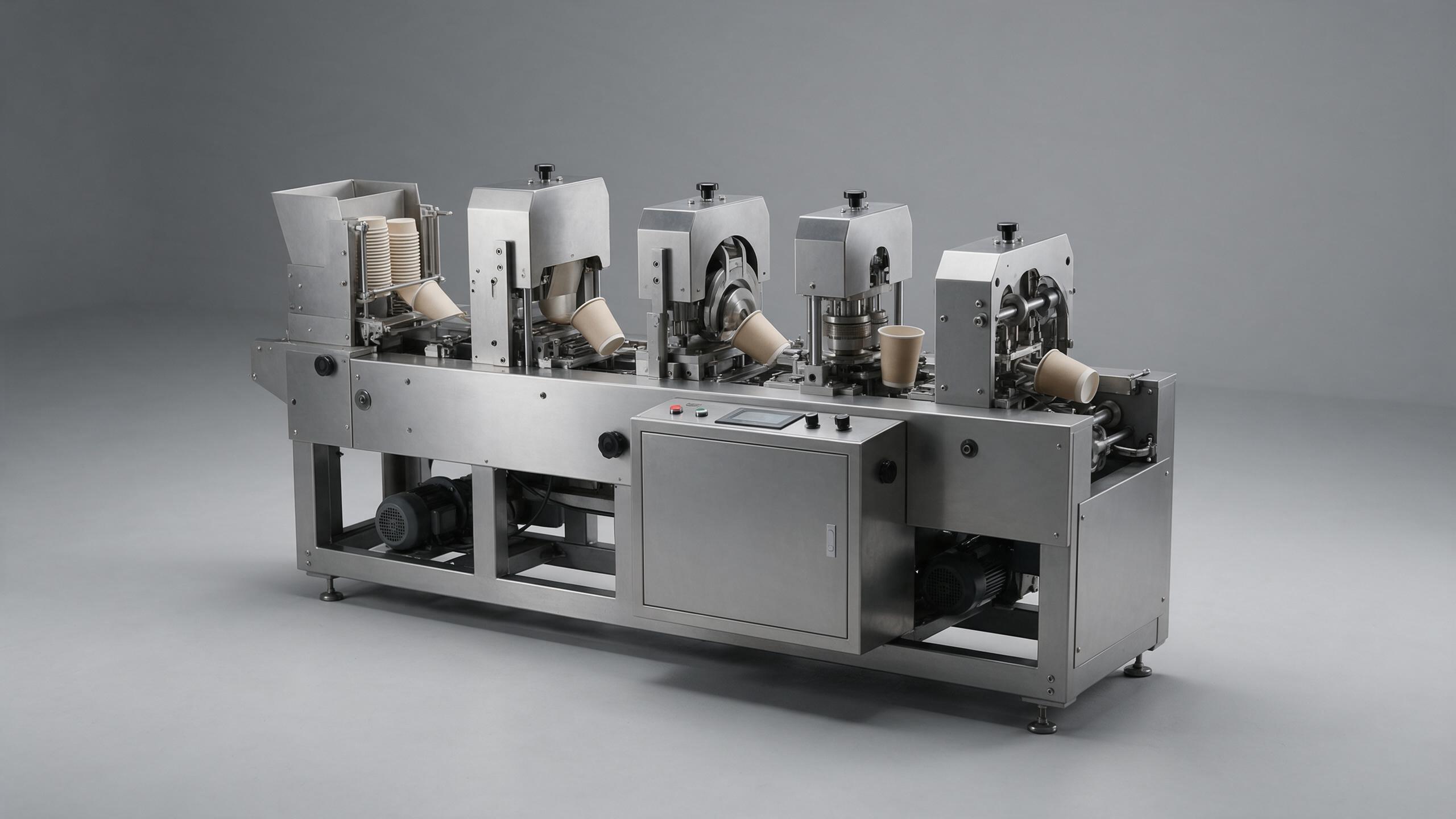
4. Production rhythm and a high speed cup manufacturing machine
A high speed cup manufacturing machine can be relevant when demand is steady and the upstream supply of prepared blanks, utilities, labor, inspection, and packing can keep pace. Still, peak-cycle speed is only one part of the line rhythm. If collection, counting, packing, or quality removal cannot match the forming rate, the usable output may be constrained elsewhere.
Before comparing speed claims, separate the discussion into operating conditions: target cup size, paper specification, planned shift pattern, expected stoppages, changeover frequency, and the way rejects are counted. That makes “high speed” a testable production target. It also avoids a common procurement mistake: choosing the highest stated cycle rate when the business actually needs predictable output across several cup formats.
5. Changeover design for multiple cup formats
Mold and tooling changes are a core differentiator for plants that make several sizes or shapes. The question is not whether a cup manufacturing machine can theoretically make another cup; it is whether the changeover steps, tools, settings, training, and trial materials are planned well enough for the production schedule.
Ask for a changeover checklist that names the parts to be exchanged, the adjustments to be confirmed, the first-piece inspection points, and the person responsible for sign-off. A clear checklist is valuable even for a single cup size because it preserves operating knowledge when staffing changes. If frequent changes are likely, observe a representative changeover during technical review rather than relying on a broad statement about flexibility.
6. What changes for an ice cream cup manufacturing machine?
An ice cream cup manufacturing machine should be assessed through the intended frozen-dessert cup design and supply chain, not just through the end use named on the machine. Cup capacity, wall stiffness, nesting behavior, print coverage, coating compatibility, and rim feel may all need review. The material must also be evaluated against the relevant food-contact requirements for the destination market.
For this application, build the technical conversation around actual samples: the supplied blank, finished cup drawing, stacking expectations, filling and handling conditions, and required inspection criteria. If a cup will be handled in a cold or moisture-exposed environment, make those conditions part of the material and finished-cup validation. That gives the supplier and buyer a shared basis for setting up the forming, sealing, and finishing stages.
7. Control visibility, maintenance access, and operator workflow
Automation is useful when it helps people understand and maintain the process. A cup manufacturing machine should help operators see normal operating status, recognize an abnormal condition, and perform routine checks without unnecessary disassembly. Clear alarms, accessible inspection points, documented lubrication or cleaning routines, and a defined spare-parts discussion can reduce ambiguity during daily operation.
During technical evaluation, walk through one normal production start, one planned stop, and one representative fault scenario. This does not require a supplier to promise zero downtime. It does show whether the control logic, operator instructions, maintenance access, and support boundaries are understandable for the planned team.
A buyer checklist for unique machine features
- Provide the cup drawing, target size range, blank specification, coating details, and intended application.
- Link every quoted feature to a forming, sealing, quality, changeover, or maintenance requirement.
- Define a representative trial with agreed samples and inspection points.
- Review the line rhythm beyond the forming station, including collection, inspection, packing, and operator coverage.
- Confirm changeover steps and training needs if multiple formats are planned.
- Separate equipment validation from material and market-compliance verification.
- Document routine maintenance access, wearing parts, and the technical-support handoff.
The practical takeaway
The unique features that matter in a cup manufacturing machine are the ones that make your actual production conditions easier to control: stable feeding, material-aware seam settings, coordinated bottom and rim finishing, production-rhythm visibility, deliberate changeover design, and understandable maintenance routines. A high stated speed can be useful, but it is not a substitute for a verified fit between the machine, the cup, the material, and the people who will operate it. Start with those conditions, then ask each supplier to show how the proposed configuration supports them.
 ONLINE