
 EN
EN
What Is a Paper Bucket Machine? Definition, Core Function, and Market Context
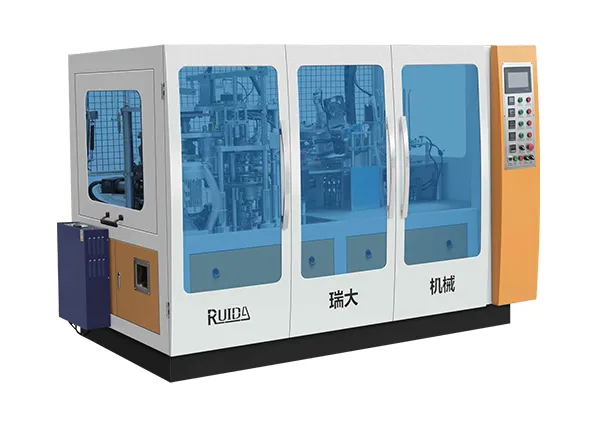
Why the Paper Bucket Machine Is Gaining Traction in Sustainable Packaging
The rise of paper bucket machines is transforming how we produce those biodegradable food containers that are becoming so popular right now. We're talking about a market worth around $740 billion according to Ponemon's research from last year. Most shoppers care deeply about going green these days too - Forbes reports that 80% actually put eco friendliness at the top of their list when making purchases. These machines work wonders replacing those old plastic lined options by taking regular recyclable paper and turning it into sturdy buckets using processes like rotary die cutting, glue application, and hydraulic shaping all rolled into one system. Big names in food service aren't just suggesting sustainability anymore either. They demand compostable packaging as part of their environmental, social, and governance commitments which has definitely sped up the move toward automation. The good news? These new systems get rid of those pesky wax and plastic coatings while still standing up against greasy foods. All this makes sense given what UNEP found out there about plastic restrictions spreading across 127 nations worldwide. And let's not forget McKinsey's finding that people are willing to shell out about 12% extra for containers that won't harm the planet.
Core Operational Principle: Integrated Rotary Die-Cutting, Gluing, and Forming
The paper bucket machine operates through three synchronized phases optimized for material efficiency and structural integrity:
- Rotary die-cutting precision-trims paper rolls into flat bucket templates using custom blades
- Automated gluing applies food-grade adhesives to critical seams via timed nozzles
- Hydraulic forming molds templates into 3D buckets at 60–100 units/minute
The continuous motion workflow basically cuts out all the manual handling stuff and gets dimensional accuracy down to around plus or minus 0.3mm. Some of the newer machines come equipped with closed loop moisture control systems plus infrared drying tech that makes the adhesive cure right away, which means we can create those waterproof seals without needing any chemicals. When manufacturers put all these processes together in one ISO certified system, they typically save about 40 percent on production costs compared to doing things manually according to Packaging Digest from last year. Plus, the system maintains consistent wall thickness throughout and creates completely leak proof results even when working with recycled paperboard materials ranging from 125 to 400 GSM thickness.
How a Paper Bucket Machine Works: A Step-by-Step Process Breakdown
Material Unwinding and Precision Feeding
The process begins with unwinding a pre-treated paper roll mounted on the machine. A tension control system maintains consistent material flow, while optical sensors ensure millimeter-accurate alignment—preventing wrinkles or misfeeds that compromise structural integrity. Advanced models include automated roll changers to minimize downtime between batches.
Die-Cutting, Creasing, and Glue Application in Continuous Motion
Rotary die cutters form paper into flat blanks and at the same time create those exact crease lines needed for proper folding. The equipment comes with a hot melt adhesive system that puts down food grade glue on the seams pretty fast actually over 120 meters per minute when everything's running smoothly. These days manufacturers can control how much glue gets spread out to within about half a millimeter either way. That kind of precision means we get good seals that won't leak but also aren't soaked through with excess adhesive. Putting all these systems together removes those annoying stop and start moments during production runs so the whole line keeps moving steadily from start to finish.
Forming, Folding, and Final Sealing into Rigid Paper Buckets
The hydraulic forming molds push those glued blanks into three dimensional shapes, typically operating around 80 psi pressure range. These machines have programmable robotic arms that actually fold the creased parts inward. Before everything gets compressed for good, there are these infrared sensors checking if the shape looks right. For drying, they blow hot air across the pieces which helps them cure pretty much instantly. Most systems can get them fully rigid within five seconds or so. Once done, the finished buckets drop down onto conveyor belts where they stack themselves automatically. Commercial grade setups usually manage about 50 units per minute, though actual speeds vary depending on the specific model and how busy the production line happens to be.
Key Technical Variants of Paper Bucket Machines: Automation Level and Capability
Semi-Automatic vs. Fully Automatic Paper Bucket Machines: Performance and ROI Comparison
There are basically two types of paper bucket machines out there: semi automatic ones and fully automatic versions. The semi automatic kind still needs workers to feed materials in and take buckets out when they're done. These machines cost less initially which is great for smaller operations that don't need massive production volumes day after day. But they do rely heavily on staff throughout the process. On the other hand, fully automatic systems handle almost everything from start to finish without much human help at all. They can unwind the material, form it into buckets, seal them properly, then stack them ready for shipping. Because these machines run with so little interference, they produce more units per hour, maintain better quality control, and generally give manufacturers peace of mind knowing their products meet strict specifications consistently.
The ROI comparison reveals strategic tradeoffs:
- Semi-automatic units reduce capital expenditure by 40–60%, but increase per-unit labor costs and average 5–8% material waste due to manual variability
- Fully automatic systems achieve 3–5 higher production speeds and cut long-term operational costs by up to 70% through labor reduction, while maintaining waste below 2% via precision controls
High-volume operations (10,000+ units daily) typically recover the automation premium within 18–24 months. Smaller facilities may prioritize semi-automatic flexibility—but must weigh scalability limitations against long-term efficiency gains.
Critical Specifications and Features to Evaluate in a Paper Bucket Machine
Speed, Dimensional Flexibility, and Material Compatibility Benchmarks
When evaluating paper bucket machines, production benchmarks should be at the top of anyone's checklist. The speed metric, usually expressed as units per minute (UPM), plays a big role in overall throughput. Top performers can hit over 60 UPM when running large batches, which makes all the difference in busy manufacturing environments. Machines need dimensional flexibility too since they have to handle various products. Most modern equipment allows adjustments without tools for different sizes - typically between 80mm to 300mm diameter and 50mm to 250mm height ranges. What about materials? Good machines work reliably with paper weights ranging from around 180gsm up to 350gsm, covering everything from standard grades to specialized options like coated surfaces, recycled content, and those special food grade barriers. Getting any of these specs wrong creates problems down the line. Machines that fall short on specs often cut output by nearly a third, and mixing incompatible materials leads to roughly 20% extra waste that nobody wants to deal with. Smart manufacturers focus on these key metrics because they affect day-to-day operations, room for growth, and meeting those increasingly important sustainability standards.
FAQ
What is a paper bucket machine?
A paper bucket machine is a type of equipment that converts recyclable paper into sturdy, biodegradable buckets through processes like rotary die cutting, gluing, and hydraulic forming.
Why are paper bucket machines popular for sustainable packaging?
The machines offer a solution to the increasing demand for eco-friendly packaging by replacing plastic-lined containers with biodegradable paper buckets, meeting both consumer preferences and regulatory standards globally.
What are the main types of paper bucket machines?
The two main types are semi-automatic and fully automatic machines, which differ in their automation levels, labor dependence, and initial cost versus long-term efficiency.
What factors should I consider when choosing a paper bucket machine?
Consider factors like production speed (UPM), dimensional flexibility, material compatibility, initial cost, and the potential ROI based on your operation's scale and needs.
Table of Contents
- What Is a Paper Bucket Machine? Definition, Core Function, and Market Context
- How a Paper Bucket Machine Works: A Step-by-Step Process Breakdown
- Key Technical Variants of Paper Bucket Machines: Automation Level and Capability
- Critical Specifications and Features to Evaluate in a Paper Bucket Machine
- FAQ