
 EN
EN
How Paper Bowl Machines Work: Core Mechanisms and Production Process
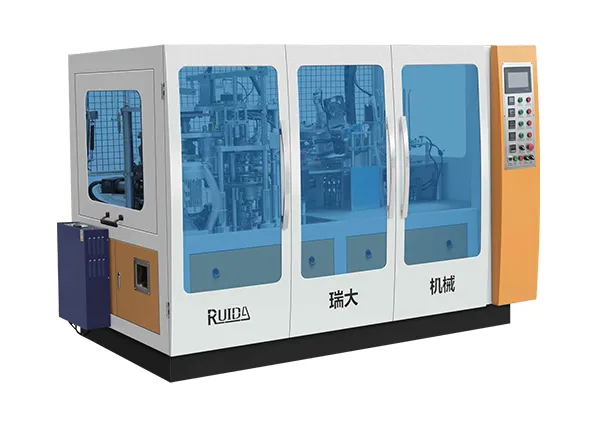
Key Components: Feeding, Forming, Heating, and Ejection Systems
Modern paper bowl machines take food grade pulpboard and turn it into those handy containers we see everywhere these days, all thanks to four carefully timed systems working together. Let's start with how they handle the raw material first. The feeding system basically unwinds big rolls of pulpboard while keeping everything nice and flat through those tension controlled rollers. Nobody wants crumpled bowls after all! Next comes the real heavy lifting part. Steel dies in the forming area apply hydraulic pressure of around 60 tons to shape those bowls just right. This makes sure the walls are thick enough but still consistent across every single bowl produced. Then there's the heating stage where infrared elements kick in at about 180 degrees Celsius to make those water based adhesives work properly for sealing. Temperature sensors keep things pretty accurate too, staying within plus or minus 5 degrees. Lastly, when the bowls are done, pneumatic ejectors pop them off onto conveyor belts gently so nothing gets squished during removal. Each complete cycle takes less than three seconds which is pretty impressive considering all these steps involved. What this means for manufacturers is continuous production at high precision levels with very little need for someone standing around watching everything happen minute by minute.
From Pulpboard Sheet to Finished Bowl – A Step-by-Step Workflow
Pulpboard sheets start their journey through the production line where they get cut into bowl shapes using those fancy rotary dies that spin around at crazy speeds, probably somewhere above 100 times each minute. These blank pieces then go into special molds that press out the sides while gluing on those pre-cut bottom parts with pretty accurate application techniques. Next comes heated rollers that bend the edges inward to create those reinforced rims we see on finished products, after which everything gets exposed to UV light so the glue sets almost instantly. The whole operation includes some smart inspection systems too. Every single bowl gets checked visually along the way, and any duds get tossed aside within half a second flat. When all is said and done, these completed bowls just stack themselves neatly into groups of fifty ready for shipping. It's amazing really how fast this whole thing works from start to finish. We're talking about going from plain old cardboard sheets to fully packed bowls in under fifteen seconds apiece, with material waste sitting at just 1.5%, meeting most sustainability standards set by industry experts today.
Types of Paper Bowl Machines: Semi-Automatic vs. Fully Automatic
Capacity, Speed, and Labor Requirements Compared
Semi-automatic paper bowl machines deliver 800–1,500 bowls per hour but require manual loading, unloading, and constant operator supervision–making them ideal for flexible, lower-volume production. Fully automatic models produce 3,000–5,000+ bowls per hour using robotic arms and integrated conveyors, reducing labor requirements by up to 70%.
When to Choose Each Type Based on Business Scale and Output Goals
Choose semi-automatic machines if you're a startup or SME with daily demand under 20,000 units, frequently customize products, or operate with limited electrical capacity (220V).
Opt for fully automatic systems when your daily output exceeds 50,000 bowls, labor costs exceed $15/hour, or you anticipate annual growth of 20% or more.
Mid-sized manufacturers producing 5,000–15,000 bowls daily often realize optimal ROI with hybrid setups–using semi-automatic lines for specialty or seasonal designs while reserving automated systems for high-volume standard items.
Critical Selection Criteria for a Reliable Paper Bowl Machine
Selecting the right paper bowl machine requires aligning technical capabilities with long-term operational and compliance goals. Prioritize these evidence-backed criteria.
Material Compatibility, Bowl Size Range, and Customization Flexibility
Confirm compatibility with FDA-compliant food-grade pulpboard and water-based adhesives–non-compliant materials contributed to 23% of packaging recalls in 2023. Machines should support bowl diameters from 3 to 9 inches and variable depths. Look for:
- Interchangeable molds enabling rapid size or style changes
- Embossing modules for custom branding
- Adjustable adhesive dispensers calibrated for different board weights and glue viscosities
Certifications, After-Sales Support, and Spare Parts Availability
Insist on ISO 9001-certified equipment–studies show such machines average 30% longer service life. Evaluate supplier support rigorously:
- Guaranteed 48-hour response time for technical issues
- On-site training programs for maintenance staff
- Local inventory of critical spares–including heating elements, forming dies, and sensor assemblies
Manufacturers with regional warehouses reduce unplanned downtime by 41% compared to those relying on international parts logistics.
ROI and Operational Efficiency: Cost Savings and Payback Timeline
When figuring out return on investment for a paper bowl machine, it's all about weighing what gets spent initially versus what gets saved over time. The automation aspect alone can slash manual labor needs by somewhere between 60% and 80%. Then there's the precision forming that really trims down pulpboard waste, cutting it back around 15 to 25 percent. Plus those energy efficient infrared heaters actually bring down electricity bills quite a bit. Looking at industry trends, many mid size businesses seem to get their money back within one to three years. Take a $200k machine for instance. If it saves roughly $150k each year, then mathematically speaking, the break even point comes pretty fast, maybe around 1.3 years or so according to some calculations I've seen floating around.
Beyond direct cost savings, ROI compounds through:
- Higher Throughput: Automated lines produce 2–4× more units per hour than semi-automatic alternatives
- Quality Consistency: Precision ejection and sealing reduce defects by 30–50%, lowering customer returns and rework
- Scalability: Modular, fully automatic platforms adapt seamlessly to demand surges–without adding headcount
Use this formula to estimate recovery time:
Payback Period (Years) = Total Investment ÷ Annual Net Savings
Machines equipped with modular tooling systems and standard interfaces should be at the top of any manufacturer's list. The real value comes from how these design choices cut down on setup time between different production runs and make system upgrades much easier to implement. When companies can respond quickly to special customer requests, those custom jobs actually start generating extra income instead of holding things back. Sure, investing in automated solutions costs money upfront, but look at what they deliver over time: better product consistency, faster output rates, and a stronger position against competitors. For businesses serious about expanding their footprint in eco-friendly packaging markets, smart automation isn't just nice to have anymore.
FAQ
What is the main advantage of a fully automatic paper bowl machine?
Fully automatic machines offer higher output rates, reduced labor requirements through robotic arms and integrated conveyors, and scalability for high-volume operations.
When should a business consider a semi-automatic machine?
A business should consider a semi-automatic machine if they have daily demand under 20,000 units, frequently customize products, or have limited electrical capacity.
What material considerations should be made for a paper bowl machine?
Ensure the machine is compatible with FDA-compliant food-grade pulpboard and water-based adhesives, and that it supports a range of bowl sizes and customizable features.
How long does it typically take to see ROI from a paper bowl machine?
Many mid-size businesses see ROI within one to three years, with cost savings from reduced labor, material waste, and energy consumption.