
 EN
EN

Core Performance Attributes of Advanced Paper Bowl Machine
For a packaging-equipment buyer, an advanced paper bowl machine is not defined by its highest advertised speed. Its practical value comes from how reliably it turns the chosen paper stock into acceptable bowls through a full shift. The right paper bowl machine keeps feeding, forming, sealing, inspection, discharge, and operator recovery aligned with the product specification.
This matters especially when bowl diameter, depth, paper grade, coating, print treatment, and changeover frequency vary. A technical review should therefore ask what the paper bowl machine can repeat under agreed conditions, not simply what it can achieve in a short demonstration.
1. Stable throughput is the first performance attribute
Throughput is useful only when it is measured alongside usable output. A capable paper bowl machine should sustain a predictable production rhythm while limiting stoppages, rejected bowls, and manual corrections. Ask a supplier to define the bowl format, material construction, operating conditions, and acceptance method behind any output claim.
The strongest evaluation compares three numbers: total cycles, accepted bowls, and reasons for interruption. On a well-matched paper bowl machine, the gap between total cycles and accepted output should be visible and explainable. That reveals whether the real constraint is paper feeding, bottom insertion, heating or ultrasonic sealing, forming, rim treatment, collection, or downstream handling.
Speed also has a trade-off. Pushing a paper bowl machine to its upper limit may be reasonable for a stable, single-format program, but it can expose variation when paper batches or bowl sizes change. If your production plan includes several SKUs, evaluate stable speed after routine adjustments rather than relying on a peak figure.
2. Material and bowl-format compatibility protect quality
An advanced paper bowl machine must suit the material and geometry that your market requires. Bowl capacity alone is not enough. Sidewall stiffness, bottom shape, coating type, blank accuracy, and print coverage can all influence feeding, forming, and sealing behavior. Buyers should provide representative blanks early and request a trial with the intended configuration.
This is where an eco paper bowl device discussion should stay practical. The term does not establish that a line is sustainable on its own. It should lead to questions about the actual paper structure, coating system, scrap handling, energy use, and the finished bowl’s intended end-of-life route. A paper bowl machine can support a material strategy only when its process is compatible with that material.
Sealing deserves particular attention. A comparative study of paper-cup manufacturing reported an advantage for ultrasonic sealing consistency over hot-air sealing in its tested setting. That is a useful question to investigate, not a universal specification. The buyer should verify seal quality on their own paper, coating, bowl geometry, and leak-test criteria before approving a paper bowl machine.
3. Process control turns automation into repeatability
Automation is valuable when it helps operators recognize and correct variation. Look at how the paper bowl machine manages paper presence, bottom delivery, position, counting, and blockage conditions. Sensors, interlocks, alarms, and clear fault messages can reduce the time between an abnormal event and a controlled restart.
During a factory acceptance test, do not only watch the normal cycle. Ask to see what happens after a missed blank, a paper-feed interruption, a bottom shortage, or a collection backup. The useful paper bowl machine is one that returns to a stable condition through a clear, safe operating path. Controls should make the cause understandable rather than leave the team to infer it from an incomplete stop.
For a noodle paper bowl machine, this requirement becomes more important because deep or application-specific bowl geometries can make forming and collection more sensitive. The operating team should confirm the real bowl sample, stackability, rim integrity, and handoff to the next process rather than assuming that a general bowl demonstration proves fit.
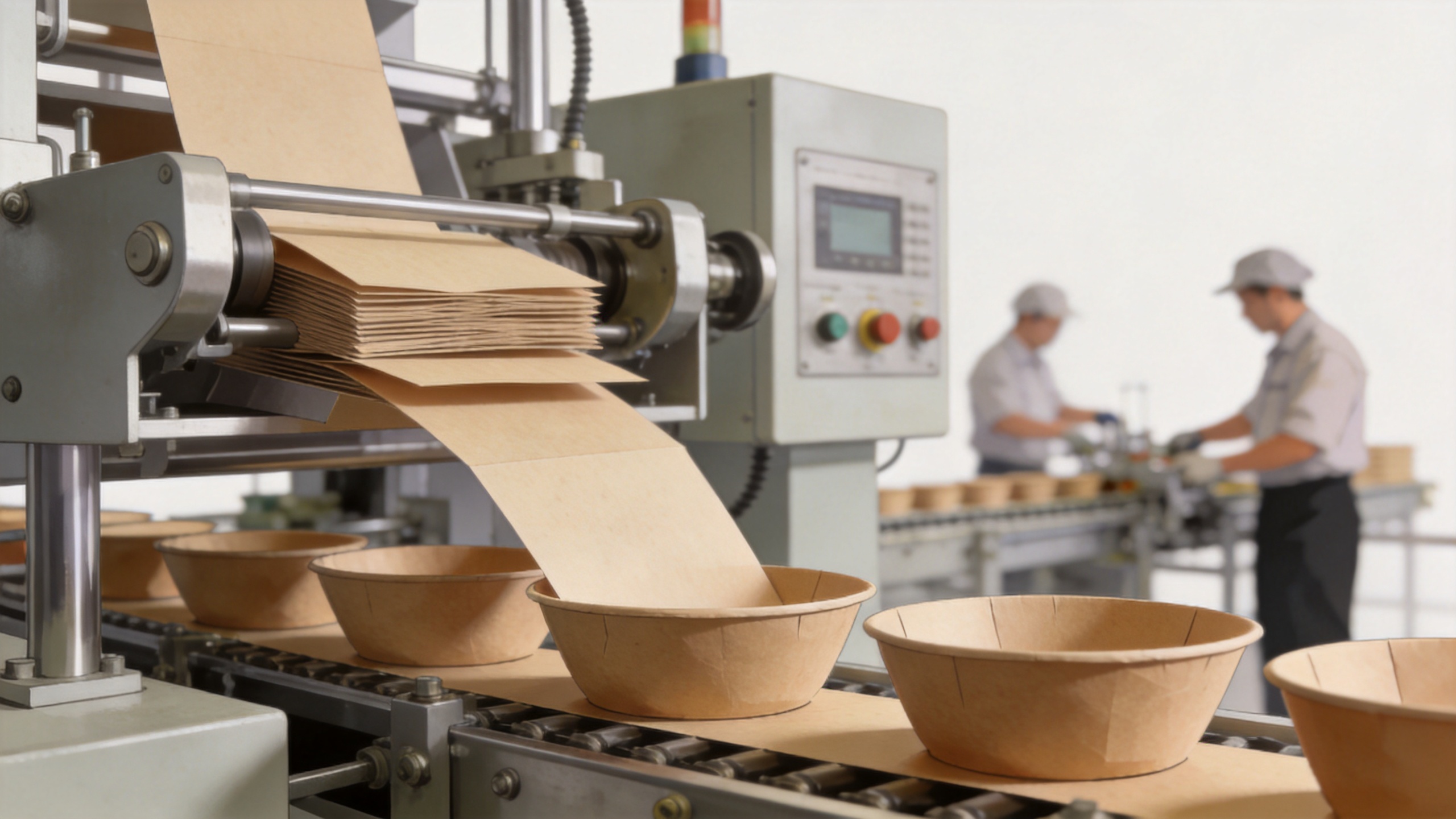
4. Forming and sealing consistency determine usable quality
A paper bowl machine is judged by the bowls it releases, not by its component list. Inspect samples across a run for side-seam integrity, bottom attachment, rim shape, print alignment where relevant, bowl symmetry, and resistance to leakage under the agreed method. Sampling should cover startup, steady operation, and post-adjustment operation.
Repeatability depends on coordinated motion and controlled setup. When a paper bowl machine needs frequent manual intervention to maintain the same edge, base, or seam condition, its nominal automation level may not translate into predictable production. Ask which adjustments are operator-set, which are recipe-based, and what training is required for each change.
5. Changeover and maintainability shape the real cost of ownership
Many buyers focus on cycle speed but overlook time lost between orders. A productive paper bowl machine should have a documented changeover path for the formats you plan to run. Review tooling changes, parameter adjustments, first-off inspection, and the number of bowls normally needed to re-establish acceptable output.
Maintenance access matters too. On every paper bowl machine, operators need safe access to cleaning points, wear parts, lubrication locations, and inspection areas. Ask for the preventive-maintenance schedule, recommended spare-parts list, fault-history records where available, and the support boundary for remote or on-site assistance. A simple operating path is often more valuable than an impressive feature list that is difficult to maintain.
6. Supplier evidence should support the machine review
Supplier credentials do not replace acceptance testing, but documented process control can improve the conversation. ISO describes ISO 9001 as a quality-management-system standard based on a process approach, PDCA, and risk-based thinking. For a buyer, that context is useful when asking how a paper bowl machine supplier controls design changes, assembly checks, inspection records, and corrective actions.
ZheJiang RUIDA Machinery Co.,Ltd presents its business around paper-cup and food-packaging equipment for global markets. For any proposed paper bowl machine, buyers should still request the specific configuration, bowl samples, test scope, delivery inclusions, training plan, and after-sales responsibilities in writing. That keeps supplier discussion anchored to the project rather than to general claims.
A practical acceptance checklist
- Run the selected paper bowl machine with representative paper, coating, print, and bowl dimensions.
- Record total cycles, accepted bowls, rejects, stoppages, and recovery actions.
- Inspect seam, bottom, rim, shape, and leak-test performance at startup, steady state, and after adjustments.
- Confirm the changeover steps, expected setup time, and first-off approval process for every planned format.
- Review alarms, guarding, access points, maintenance tasks, spare parts, and operator training requirements.
- Define written acceptance criteria before shipment, including what will be witnessed and how nonconformities will be resolved.
Choose performance that can be verified
The most suitable paper bowl machine is not necessarily the one with the longest feature list. It is the one that matches your material, bowl program, operating team, and acceptance criteria with repeatable output. Start with intended use, test the full operating path, and make verification conditions explicit. That approach turns an equipment comparison into a more reliable production decision.
 ONLINE