
 EN
EN

Paper bowl machine ideal for food container fabrication
When a food-packaging project moves from flat paper stock to finished bowls, the buying decision is rarely just about a speed number. A paper bowl machine has to match the bowl format, the material system, the product’s end use, and the checks your team can actually perform before production. From a food-packaging application perspective, that is the practical route to more consistent container fabrication.
The first useful question is not “Which machine is fastest?” It is “What must the finished bowl do?” Soup, noodles, salad, snacks, and other food applications can place different demands on stiffness, rim integrity, bottom forming, barrier material, and handling after forming. Once those needs are clear, the discussion about equipment becomes much more precise.
Start with the finished food container, not the machine brochure
A bowl drawing, a physical sample, or a clear specification sheet is a sound starting point for a paper bowl machine review. Record the top diameter, bottom diameter, height, target capacity, side-wall profile, rim style, paper grade, coating or barrier construction, printing condition, and intended food. A round bowl may look simple, but its side-wall blank, bottom geometry, and curling requirements still need to work together.
This is why a round paper bowl equipment discussion should include the actual bowl shape rather than only a nominal ounce size. Two bowls with similar capacities can have different geometry and material behavior. If the paper stock or barrier changes, the forming window may change as well. Confirming these conditions early is more reliable than assuming one fixed configuration suits every food container.
Match material behavior to the forming sequence
Paper bowl fabrication commonly brings several operations together: feeding a cut blank, forming the body, joining the side seam, inserting and forming the bottom, heating or sealing as appropriate to the material system, curling the rim, and ejecting or collecting the finished bowl. The exact arrangement differs by design, so buyers should ask the supplier to explain how each stage relates to the submitted sample.
For an automatic paper bowl machine, material compatibility deserves its own review. Coated and barrier papers can respond differently to heat, pressure, dwell time, and handling. The machine may provide the controlled sequence, but it does not by itself establish that a specific paper, coating, ink, adhesive, or finished bowl is suitable for food contact. Those material and market-compliance decisions need their own documented verification.
For example, U.S. requirements include 21 CFR 176.170 for components of paper and paperboard in contact with aqueous and fatty foods under its stated conditions. That reference is not a machine certification, nor does it replace destination-market advice. It is a useful reminder to define the intended food, contact conditions, and material documentation before treating a bowl as production-ready.
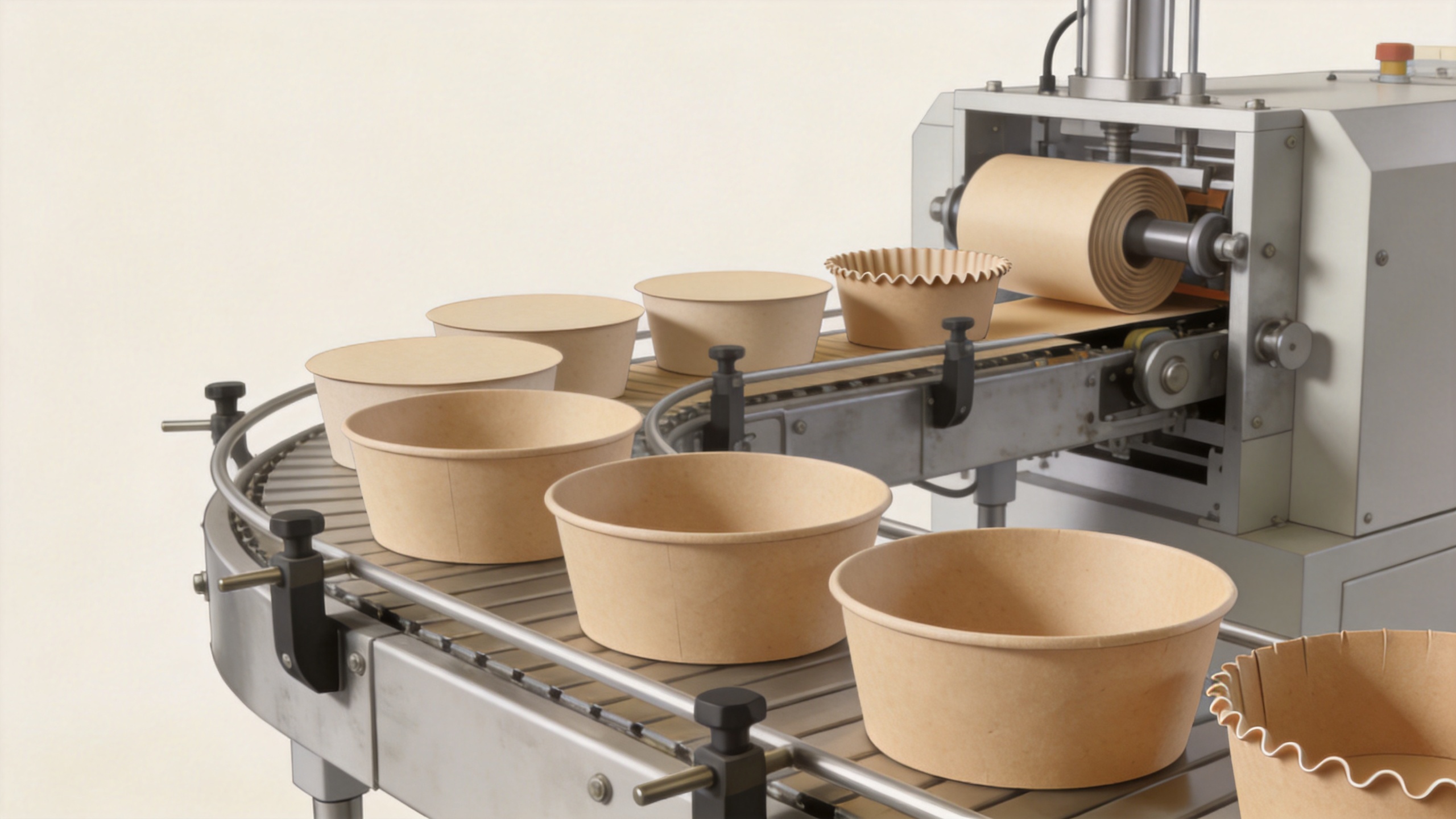
What to review in a paper bowl machine configuration
Once the application is defined, compare the configuration against the following practical questions:
- Tooling fit: Can the supplied tooling be reviewed against the bowl drawing and sample, including the wall, base, and rim geometry?
- Material range: Which paper and barrier constructions are proposed for trial, and what settings are expected to be adjusted?
- Sealing approach: Is the proposed seam and bottom-forming method appropriate for the submitted material system?
- Control and detection: Which process points are monitored, and how are rejects or abnormal conditions handled?
- Changeover: What parts, settings, and verification steps are involved when moving to another bowl size or paper specification?
- Maintenance access: Can routine cleaning, inspection, and replacement work be discussed before purchase?
A good paper bowl machine evaluation therefore ties configuration choices back to a known product requirement. It avoids turning a general feature list into an untested promise about output, scrap, or finished-bowl performance.
Use automation to make verification easier
An automatic paper bowl machine can help organize repetitive forming steps and reduce dependence on manual timing, but automation should be judged by how clearly the process can be checked. Ask which operating parameters are visible to the operator, how changeover settings are recorded, and how a team can compare an approved first-off bowl with later production samples.
Photoelectric sensing, programmable controls, and collection arrangements are often discussed in the market, yet their value depends on the full line and the bowl being made. A control feature is helpful only when the production team understands what it is monitoring and what action follows an alert. For this reason, ask for a demonstration plan based on your own paper and bowl sample whenever feasible.
Plan acceptance around the container’s intended use
Acceptance should focus on the finished container rather than a generic machine run. Before shipment or commissioning, agree on the sample, paper specification, visual criteria, dimensional checks, seam and base observations, rim finish, and the record format for trial settings. If the bowl will hold hot, wet, fatty, or dry foods, specify that intended use when discussing material documentation and appropriate testing with the relevant parties.
This changes the decision from “Does the machine run?” to “Can the paper bowl machine make the agreed bowl under documented conditions?” It also gives purchasing, technical, and production teams a shared reference for follow-up questions.
A practical request-for-quotation checklist
- Send a dimensioned bowl drawing, a finished sample, and the intended food application.
- Describe the paper, barrier, print, and food-contact documentation available for the target market.
- Ask how the proposed round paper bowl equipment will be matched to the wall, base, and rim geometry.
- Request a list of tooling, change parts, operator checks, and routine maintenance items.
- Define the trial and acceptance criteria before comparing quotations.
- Clarify what training, installation guidance, and spare-parts information will be needed for your production plan.
Choose the machine after the application is clear
For food container fabrication, the most useful paper bowl machine is one selected against a real bowl specification, a realistic material system, and a workable validation plan. This is especially important when assessing an automatic paper bowl machine: automation can support repeatability, but it cannot substitute for matching tooling, paper, process settings, and quality checks.
ZheJiang RUIDA Machinery focuses on paper-cup and food-packaging equipment discussions. When preparing an inquiry, share your bowl sample and operating requirements so the conversation can start with fit, verification points, and next-step technical confirmation rather than unsupported assumptions.
 ONLINE