
 EN

Cup Manufacturing Machine Future Directions
A cup line is no longer judged only by whether it can form a cup at a stated speed. For production teams planning the next investment cycle, a cup manufacturing machine is increasingly a connected part of a wider workflow: material preparation, forming, inspection, counting, packing, maintenance, and traceable production records. The future direction is not one universal feature. It is a more disciplined way to match automation to the cups, materials, labor model, and quality checks a plant actually needs.
From a packaging-equipment planning perspective, the useful first question is not “What is the fastest machine?” It is “Where does our present line lose time, consistency, or visibility?” The answer may point to a forming platform, a paper cup counting machine, a changeover method, or a application-specific process such as a dhoop cup making machine. Those are different problems and should be evaluated separately.
Future-ready cup production will be measured as a system
Traditional comparisons often begin and end with nominal output. That number still matters, but it does not describe the full operating picture. A cup manufacturing machine may run a stable demonstration with one paper grade and one cup format, while day-to-day production involves roll variation, tooling changes, operator handoffs, inspection decisions, and downstream accumulation.
Future-oriented projects therefore look at the whole line rhythm. Can blanks arrive consistently? Does the forming section provide a repeatable process window? Can finished cups move to counting and packing without creating a manual bottleneck? Can a supervisor see where rejects, stops, and changeover losses occur? A machine does not need every advanced option on day one, yet its controls and mechanical layout should make a later upgrade practical.
Direction 1: connected monitoring with useful operating context
Connected controls are likely to become more common in cup production, but a dashboard alone is not a business case. The more valuable use is to pair an event with context: which cup size was running, which material batch was loaded, what happened before the stop, and whether an adjustment restored stable output. That record helps maintenance and production teams discuss a problem using the same evidence.
When reviewing a cup manufacturing machine, ask suppliers to show which events can be recorded, how records can be exported, and who can access settings. Clarify whether condition-monitoring features are standard, optional, or dependent on an external system. Avoid treating predictive maintenance as a promise that breakdowns will disappear; it is a method for scheduling attention around observed conditions and recurring patterns.
- List the stops that currently create the most lost production time.
- Define the information an operator, technician, and production manager each need after a stop.
- Test whether the proposed controls can record those events without adding excessive manual data entry.
Direction 2: vision-assisted quality checks near the forming process
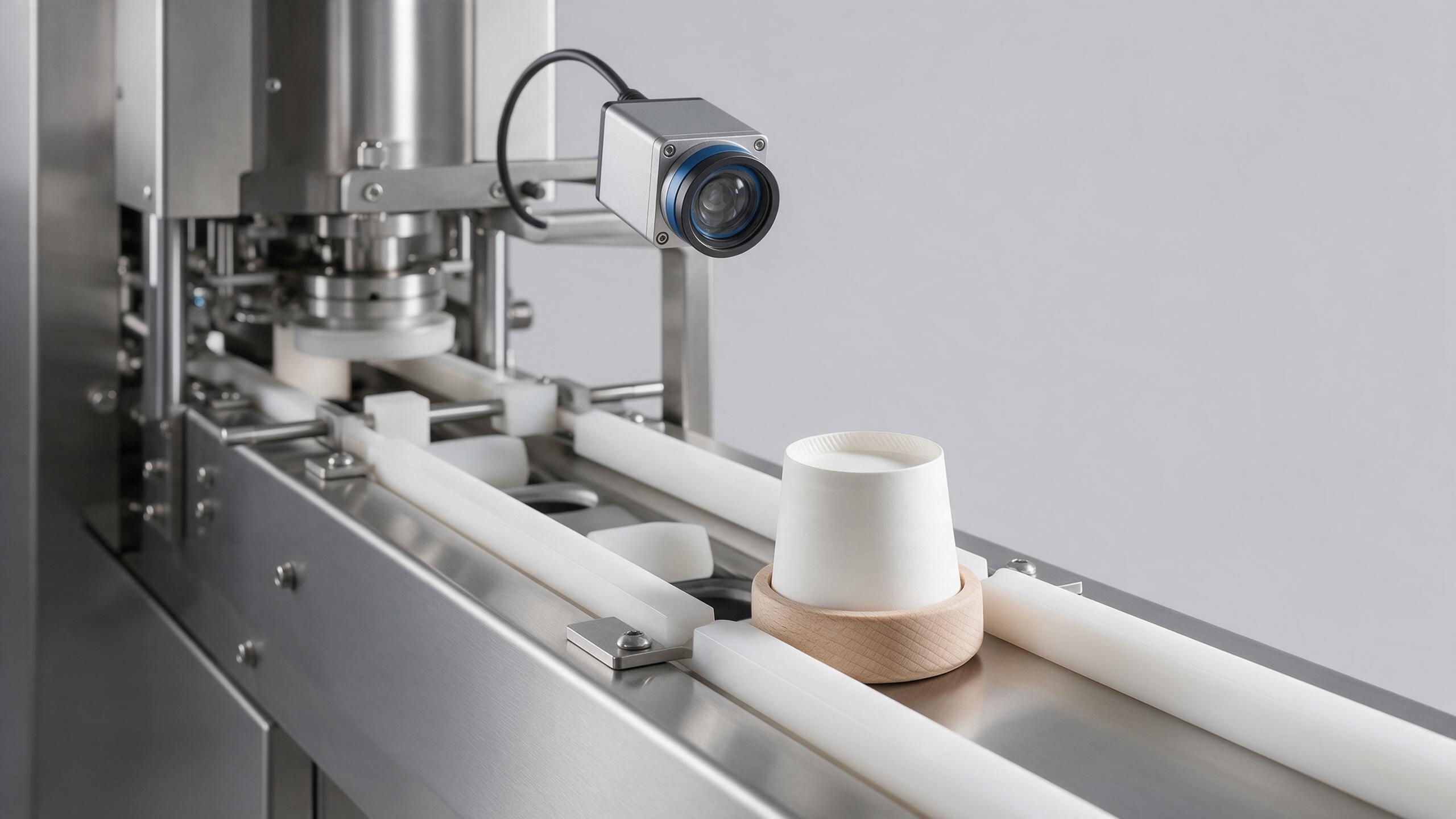
Inspection is moving closer to the process rather than being left entirely to a final manual check. Directional research on paper-cup inspection includes machine-vision approaches for finding visible defects such as stains or blemishes. In a production setting, the relevant question is narrower: which defect types matter for the intended cup, and how will a finding be confirmed and handled?
For a cup manufacturing machine, vision or sensor options should be assessed against real samples. A buyer can prepare acceptable and unacceptable cups, agree on the inspection target, and observe how the system reports or separates results. This is more useful than assuming an inspection feature covers every seal, print, rim, or material issue. The acceptance criteria, lighting conditions, camera placement, and reject route all influence the outcome.
Direction 3: flexible tooling and material-aware setup
Demand for different capacities, wall constructions, and substrate choices makes changeover discipline more important. Future-ready equipment should help a plant document the setup for each validated format: tooling identity, paper specification, heat-sealing conditions, inspection settings, and downstream packing method. That does not mean every line should make every cup. It means the formats selected for a line should have a controlled path from setup to validation.
Material awareness deserves particular attention. A change in paperboard, coating, print coverage, or blank quality can affect forming behavior. During supplier discussions, request a sample-run plan that identifies the materials to be evaluated, the checks to be performed, and the limits of the demonstration. This keeps a cup manufacturing machine comparison tied to the factory’s own product mix rather than to a generic sample.
Direction 4: counting and packing will become part of the capacity discussion
Counting is sometimes treated as a small downstream detail, but it can determine whether a stable forming section translates into shippable output. A paper cup counting machine may support pack accuracy, reduce repetitive manual counting, and make discrepancies easier to investigate. Its selection should be based on cup geometry, stack behavior, required pack quantity, handoff method, and the packaging operation that follows.
Ask where cups accumulate between forming and counting, how jams are detected, and what happens when a pack count is rejected. The goal is not simply to add automation. It is to avoid relocating a constraint from the cup manufacturing machine to the end of the line. A short line-layout review with actual cup samples often exposes issues that a speed comparison does not.
Direction 5: specialty cup processes need their own validation path
An application-specific cup project should not be treated as a minor variation of a conventional paper-cup project. For example, a dhoop cup making machine involves a distinct product purpose, material behavior, forming requirement, and handling process. Buyers should establish the product specification first, then verify the forming method, drying or curing needs where applicable, safety considerations, and packaging requirements with representative materials.
The same principle applies to any distinct format: identify the product’s critical characteristics, confirm what the equipment is designed to process, and plan trials around those characteristics. A broad cup manufacturing machine label is useful for discovery, but it is not enough to prove suitability for an application-specific product.
A procurement checklist for the next equipment cycle
- Map the current flow. Record material input, forming, inspection, counting, packing, and the handoffs between them.
- Choose the bottleneck to address first. It may be setup consistency, defect visibility, manual counting, or maintenance response rather than forming speed.
- Define trial conditions. Provide the intended cup formats and materials, then agree on observable acceptance checks before a demonstration.
- Review upgrade paths. Ask which controls, sensors, inspection modules, or downstream interfaces can be added later and what changes they require.
- Plan ownership. Specify who maintains tooling records, who responds to alerts, and how production feedback reaches the next setup.
What to carry forward
The next generation of cup production will favor lines that make operating conditions visible and make improvement easier to verify. For buyers, the practical direction is to compare a cup manufacturing machine as part of a production system, not as an isolated forming station. Start with the cups and materials you need to run, identify the constraint that affects the plant most, and validate any automation feature against that real workflow. This approach creates a clearer basis for choosing monitoring, inspection, counting, or specialty-forming capability as needs evolve.
 ONLINE