
 EN

Discovering Advanced Paper Bowl Machine Technology
A modern paper bowl machine is not simply a faster way to fold coated paper into a food container. It is a coordinated production system that turns cup stock into bowls through controlled feeding, heating, forming, bottom insertion, sealing, curling, inspection, and collection. For buyers planning a new line or upgrading an existing one, the useful question is not “What is the highest advertised speed?” It is “How consistently can this paper bowl machine make the bowl, material, and finish my market requires?”
That distinction matters for food-service formats ranging from soup and salad bowls to takeaway meal packaging. It also matters when a line will handle several sizes, coatings, or print designs. Experienced packaging teams look at the whole forming process, because a minor mismatch in blank quality, heat setting, or mechanical adjustment can show up later as leaks, uneven rims, difficult stacking, or excessive rejects.
What Defines Advanced Paper Bowl Machine Technology?
Advanced technology is more usefully understood as stronger process control rather than a single feature. A capable paper bowl machine coordinates each station so that the paper blank enters squarely, the side seam is formed consistently, the bottom is inserted at the right moment, and the rim is curled without crushing the finished bowl. The goal is repeatability from the first accepted bowl of a run to the last.
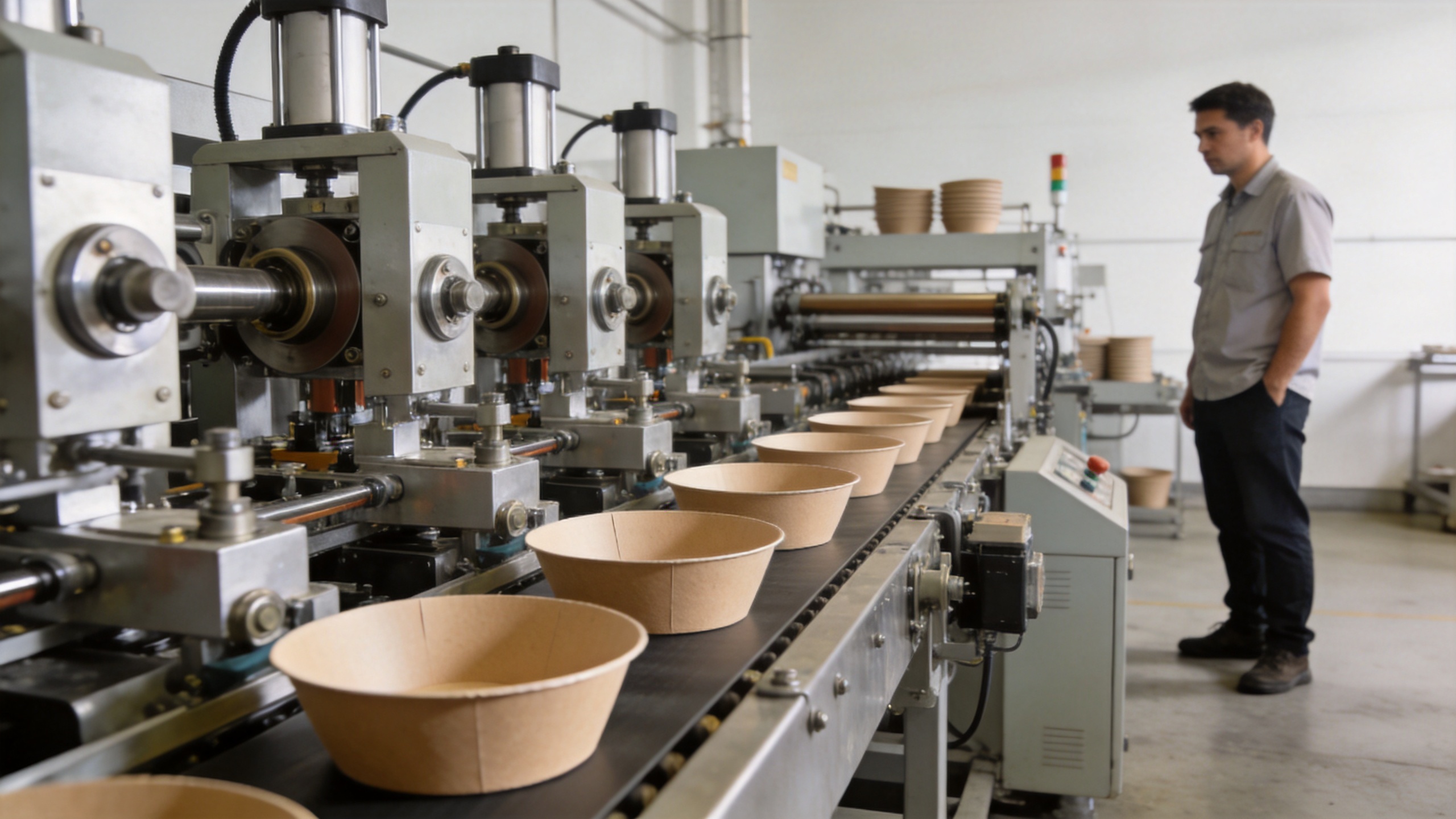
In a typical automated sequence, a magazine feeds pre-cut sidewall blanks into the forming section. The machine shapes the blank into a cylinder, creates the side seam, introduces the bottom blank, and then uses the specified sealing method and heat profile to join the components. Knurling and curling steps help create the familiar base texture and smooth drinking or handling rim. Sensors and timed motion help keep these steps synchronized. The exact configuration should be verified with the equipment supplier and the material being converted.
A well-specified paper bowl machine therefore gives operators practical controls: accessible adjustments, clear alarms, stable material guidance, and a repeatable recipe for each approved format. Automation should reduce routine variation; it does not remove the need for disciplined setup and inspection.
Core Technologies Worth Evaluating
Precision feeding and blank handling
Every finished bowl begins with a well-presented blank. Reliable feeding separates one blank at a time and moves it without skewing or scuffing the printed surface. When evaluating a paper bowl machine, ask to see how it handles the actual board weight, coating, and blank geometry you intend to use. A smooth demonstration with generic stock is useful, but a trial with representative production stock is more meaningful.
Seam and bottom sealing control
The side seam and bottom joint are functional quality points, not cosmetic details. Depending on material design and machine configuration, forming may use heat-based or ultrasonic-assisted sealing approaches. What matters is the validated combination of stock, coating, energy, dwell time, pressure, and alignment. A paper bowl machine should allow those settings to be documented and repeated, especially when a job changes from a light snack bowl to a deeper noodle format.
Food-contact compliance belongs to the complete packaging system, including paperboard, inks, coatings, adhesives where used, and the intended food application. Equipment can support controlled conversion, but it does not independently make an unverified material food compliant. This is particularly important as buyers review grease resistance and barrier choices for hot or oily foods.
Servo, PLC, and sensor-based coordination
Modern control systems can improve timing visibility and make fault finding more systematic. A PLC-guided paper bowl machine may help an operator identify a missed blank, abnormal position, or interrupted sequence before defects accumulate. The value is not the label “PLC” by itself. Ask whether the interface shows useful diagnostic information, whether recipes can be protected, and whether maintenance staff can reach common inspection points safely and quickly.
Technology Choices for Noodle and Specialty Formats
A noodle paper bowl machine often needs to accommodate a deeper profile and a format intended for hot, wet foods. That raises practical questions about seam consistency, bottom geometry, rim finish, and the behavior of the chosen stock under production conditions. Rather than assume one setting fits every bowl, run trials using the target blank, lid interface if applicable, and filling scenario. A paper bowl machine that is easy to tune and verify can be more productive over a month than one that only looks impressive during a short speed test.
Specialty concepts require the same discipline. A biscuit cup making machine serves a different forming and product-development context from paper-container equipment, yet the buyer’s evaluation habits are similar: define the finished product, validate the material or dough behavior, check cleaning and changeover needs, and establish measurable acceptance criteria. Avoid treating a novel product idea as an automatic extension of standard paper-bowl tooling.
A Practical Evaluation Workflow
- Define the finished bowl. List diameter, height, capacity, board grade, coating system, print orientation, intended food temperature, and acceptable visual finish.
- Map the production route. Identify which stations of the paper bowl machine affect your critical quality requirements: feeding, seam formation, bottom joining, knurling, curling, and collection.
- Run representative material trials. Inspect side seams, bottom attachment, rim uniformity, stackability, print appearance, and leak performance using an agreed test method.
- Review changeovers. Ask what is adjusted for each bowl size and how operators confirm the next format is stable. A short theoretical changeover is less useful than a documented, repeatable procedure.
- Plan maintenance access. Routine cleaning, lubrication, wear-part inspection, and safe access should be considered before the machine is installed.
This workflow converts a broad search for a paper bowl machine into a specific production decision. It also gives procurement, operations, and quality teams a shared language for reviewing supplier proposals.
Material Trends Need Careful Interpretation
Packaging buyers increasingly ask about renewable, recyclable, or compostable options. These claims should be assessed carefully. For example, ASTM D6868 is associated with labeling requirements for certain biodegradable plastic films or sheets attached to paper and other substrates; it is not a universal declaration that every paper bowl is compostable. A paper bowl machine should be matched to an approved material specification, while the brand owner validates the final packaging claim for the destination market.
The same principle applies to barrier materials. Process settings that work with one coating may not translate directly to another. Before changing stock, schedule a controlled trial, record settings, inspect results, and confirm that the new bowl still meets the agreed functional and regulatory requirements.
Moving from Machine Features to Production Confidence
A sound buying decision balances throughput with controllability. Look for a paper bowl machine that supports stable blank handling, consistent forming, understandable controls, and maintainable operation with your actual materials. Ask suppliers to discuss the conditions behind performance claims, not only the headline output figure.
ZheJiang RUIDA Machinery Co.,Ltd can be a useful starting point for discussing paper-container equipment requirements through ruida-machinery.com. Bring samples, drawings, and target quality criteria to the conversation. The more precisely the line is evaluated before purchase, the more confidently the paper bowl machine can be integrated into a repeatable packaging workflow.
 ONLINE