
 EN

How a Business Grew via Disposable Paper Cup Making Machine?
A business does not grow simply because it buys a disposable paper cup making machine. Growth begins when the owner turns a recurring cup requirement into a controlled production plan: which cups will be made, which paper will be used, who will operate the line, and how quality will be checked before delivery. That shift can reduce uncertainty around supply, make smaller production decisions faster, and create room to serve new customers—but only when the equipment matches the workflow.
From a procurement perspective, the useful question is not “What is the fastest machine?” It is “What production capability must this business own to support its next stage?” This article uses a realistic decision framework rather than an invented customer success story. Results depend on cup design, paper, staffing, maintenance, demand, and local requirements.
Start with the commercial bottleneck, not the machine brochure
Consider a food-packaging distributor that repeatedly buys standard hot-drink cups from outside suppliers. The owner sees three pressures: lead times make urgent orders difficult, margins are exposed to price changes, and new private-label enquiries cannot be tested quickly. A disposable paper cup making machine may be a sensible next step, but only if in-house forming solves a defined bottleneck.
Write the starting point on one page before comparing equipment:
- the cup sizes and shapes customers actually order;
- the paper grades, coatings, and print-ready blanks expected for those cups;
- weekly demand by cup type, including the likely mix rather than one optimistic total;
- the production hours, operator coverage, and floor space available; and
- the quality checks needed before cartons leave the facility.
This exercise often changes the conversation. A high output rating can be attractive, but it is not automatically the right answer for a company that changes cup sizes frequently or depends on several material batches. In fact, the business may gain more from repeatable set-up, sensible changeover procedures, and clear acceptance criteria than from choosing the headline speed.
Map the forming process to the growth plan
A disposable paper cup line typically brings several operations into one controlled sequence: feeding cup blanks, forming and sealing the side wall, placing and sealing the bottom, heating where the process requires it, knurling, curling, and collecting finished cups. The exact arrangement and suitability must be confirmed with the supplier for the intended cup and paper. Still, mapping these stages is useful because it reveals where a business can lose time or create avoidable rejects.
For example, a plan to add printed promotional cups needs more than a cup former. It needs compatible blanks, a reliable way to verify print orientation and seam quality, and a packing routine that prevents mixed lots. A plan to serve cafés may prioritize consistent rim formation and leak checks. A business pursuing several sizes needs a documented approach to tooling, changeovers, operator training, and first-piece inspection.
That is why a disposable paper cup making machine should be evaluated as part of a production system. The machine is a central asset, not the full business model.
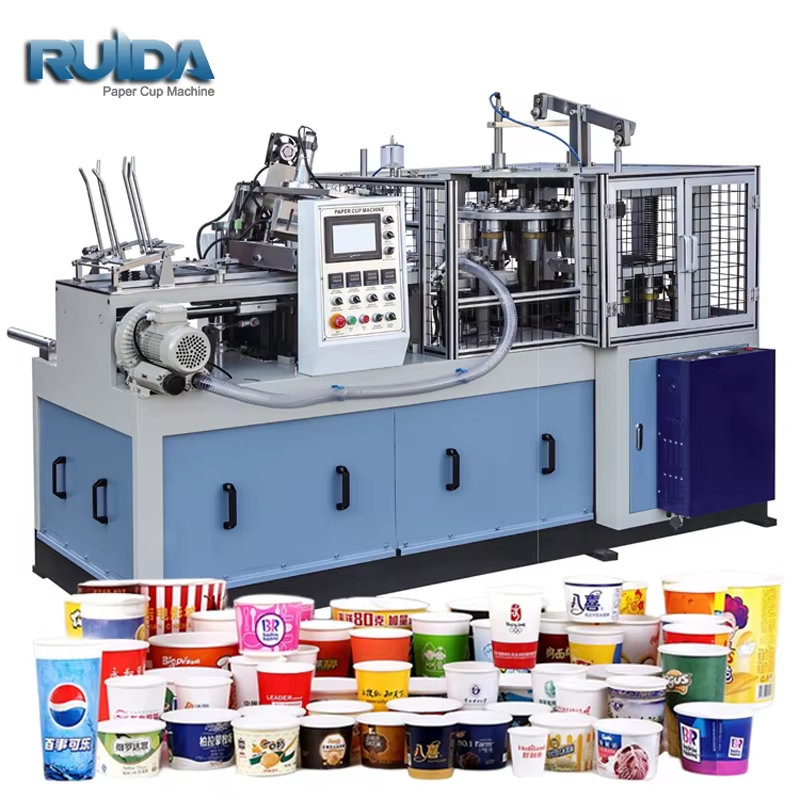 Quality checks and a defined operating routine are part of a controlled growth plan.
Where a high-speed option can help—and where it can complicate the job
A high speed disposable paper cup making machine can make sense when demand for a stable cup format is sufficiently regular and the business can support the surrounding rhythm: paper supply, operator response, inspection, packing, and maintenance. The important qualifier is “can support.” A faster former does not remove the need to prepare materials correctly or to investigate a seam, rim, or bottom issue before it becomes a larger batch problem.
During evaluation, ask the supplier to describe the conditions behind any output discussion. Which cup size, blank material, and process settings were used? What must be changed for another cup specification? What checks occur at start-up and after a changeover? Those questions are more useful than treating a catalogue number as a promised plant result.
For a growing business, the decision is often a trade-off between steady output and flexibility. If most orders use one or two confirmed cup formats, a high-speed configuration may support a simpler operating routine. If orders move across many sizes, the owner may value tooling access, training time, and repeatable changeovers more highly. Neither choice is universally better; it should follow the order mix.
Build quality and compliance questions into the purchase decision
Growth is fragile if returns, leakage complaints, or documentation gaps appear after new customers are won. Put the following checks into the supplier discussion and the internal launch plan:
- Material fit: confirm the intended paper, coating, blank dimensions, and cup design through samples and technical discussion.
- Acceptance samples: agree how seam appearance, bottom adhesion, rim finish, stacking, and leakage testing will be assessed for the target product.
- Safeguarding: review guards, emergency stops, instructions, and the site’s own safety obligations. In applicable U.S. workplaces, OSHA’s general machine requirements under 29 CFR 1910.212 are a useful prompt for a guarding review; local rules and a site assessment still control.
- Food-contact documentation: identify the destination market before production. For U.S. sales, the FDA explains that food-contact substances that are food additives must be authorized for their intended use before marketing. This is not a machine certification claim; it is a reason to verify the finished cup’s material documentation with the relevant parties.
- Records: create a simple first-piece, in-process, and packing record. It makes repeat orders easier to review and helps operators describe an issue precisely.
In other words, a cup-making investment supports growth when its operating boundaries are visible. Do not let a quotation become the complete scope. Include installation support, training, spare-parts planning, utility requirements, and the handoff from forming to packing in the discussion.
Use adjacent equipment only when it supports the same customer path
Some owners also consider a napkin production machine while building a broader food-service packaging offer. It can be a logical adjacent category if the same customers buy cups and napkins and the company has a clear plan for materials, converting, storage, and sales. It is not a mandatory companion to cup production.
The safer sequence is to first establish a repeatable cup workflow, measure where the sales team sees bundled demand, and then decide whether a napkin production machine fits the commercial case. Expanding categories too early can divide operator attention and working capital. Expanding after the core line has stable controls may create a more coherent offering for cafés, caterers, or distributors.
A practical launch checklist for a disposable paper cup making machine
| Decision area | Questions to settle before launch | Why it matters for growth |
|---|---|---|
| Order mix | Which cup formats are confirmed, and which are only enquiries? | Prevents capacity planning around uncertain demand. |
| Material and samples | Have paper blanks and target cups been checked together? | Links production capability to the actual product sold. |
| Operating routine | Who handles start-up, checks, changeovers, and escalation? | Turns a machine purchase into a repeatable process. |
| Acceptance criteria | What counts as an acceptable seam, rim, bottom, and packed lot? | Protects customer confidence as volume increases. |
| Support plan | What training, documentation, spares, and service boundaries are confirmed? | Reduces avoidable uncertainty after commissioning. |
What “growth” should mean after the machine arrives
The first objective is not to claim an immediate return. It is to establish controlled capability: a team can produce agreed cup formats, inspect them consistently, pack them correctly, and communicate limits honestly. Once that base is in place, the business can decide whether to shorten response times, test a private-label program, build a distributor offer, or add related products.
Review the project after the first production period using three headings: what has been confirmed, what still needs verification, and what action is next. Useful measures may include repeat-order reliability, usable output after inspection, changeover observations, material consistency, and the time needed to resolve an issue. The right measures are the ones that match the company’s stated commercial goal, not a generic promise.
Conclusion: turn equipment selection into a controlled capability
A disposable paper cup making machine can support a business that wants more control over cup supply and a foundation for carefully planned expansion. The investment becomes more credible when the buyer begins with confirmed cup demand, matches paper and tooling to that demand, defines quality checks, and plans the human workflow around the machine.
Before requesting a final proposal, prepare a concise brief with cup sizes, paper information, target markets, expected order mix, available utilities, and the support questions that matter to your team. That gives the supplier a clearer basis for technical discussion and gives the business a stronger basis for a growth decision.
 ONLINE