
 EN

How Disposable Paper Cup Making Machine Runs?
A disposable paper cup making machine turns pre-cut cup-wall blanks and bottom discs into finished cups through a timed series of forming, sealing, heating, shaping, and collection stations. The useful way to understand the process is not to focus on one advertised speed number. Start with the cup size, paperboard or coated-paper specification, sealing method, and the pace required from the downstream packing line. Those conditions determine whether the machine can run steadily and whether the finished cup is suitable for its intended use.
From an operator’s perspective, the machine is a chain: each station hands a partly formed cup to the next one. If one handoff drifts, the symptom may appear later as a weak bottom, an uneven rim, or a cup that will not stack cleanly. That is why a commercial disposable paper cup making machine should be commissioned as a process, rather than treated as a single black-box unit.
The basic working sequence
Most automatic cup formers follow the same broad sequence, although the number of stations, heating arrangement, and motion system vary by model. The machine indexes or continuously transfers the workpiece so that each operation happens in the correct position and at the correct dwell time.
- Blank feeding: A magazine or feeding mechanism separates one printed or plain sidewall blank at a time. Reliable separation matters because doubled blanks can create a poor seam or cause a jam.
- Sidewall forming and sealing: The blank is wrapped around a forming mandrel to create the cup body. Its overlap is sealed by the method specified for the material system, commonly heat-based or ultrasonic on compatible stock. Alignment at this point affects the cup’s roundness and seam appearance.
- Bottom feeding: A pre-cut bottom disc is introduced into the newly formed tube. The disc, body diameter, and timing must agree; otherwise the bottom can sit too high, too low, or off-center.
- Bottom heating and sealing: The sidewall and bottom edge are joined. Heat, pressure, dwell time, and the properties of the paper or coating all influence the bond. A forming machine cannot compensate indefinitely for unsuitable material or inaccurate blank dimensions.
- Knurling: A knurling station compresses and textures the lower joint to reinforce the connection between the wall and bottom. It is a key inspection point because an inconsistent pattern can indicate a timing, pressure, or material issue.
- Rim curling: The upper edge is curled to create a smoother drinking rim and a more stable shape. Depending on the design, this may use more than one forming stage. The curl should be even without tearing or crushing the cup wall.
- Discharge and collection: The finished cup leaves the forming area for counting, stacking, visual inspection, or transfer to packing equipment.
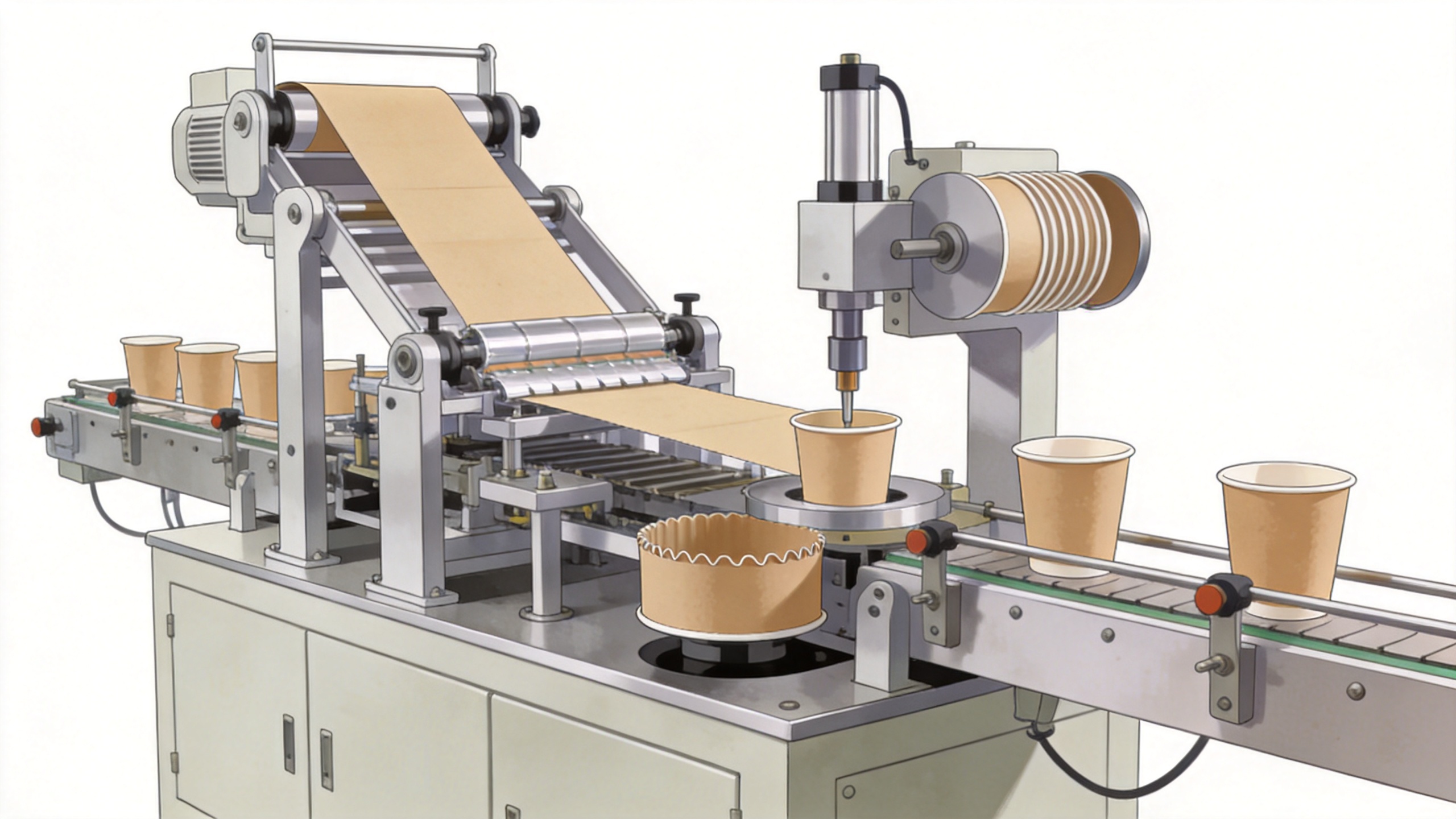
What keeps the machine running smoothly?
The process looks linear, but four control areas interact. First, the feeding system must deliver a single blank in the correct orientation. Second, the forming stations need stable mechanical timing. Third, the heating or sealing conditions must match the paperboard and coating. Finally, the finished cup must release and travel without being distorted before collection.
If paperstock changes, do not assume that yesterday’s settings will remain correct. Thickness, stiffness, moisture condition, print coverage, coating behavior, and blank accuracy can alter how the body wraps and how the seam responds. More accurately, not every leak or misshapen cup is caused by the disposable paper cup making machine itself. Check material, tooling, and operator setup before changing multiple machine settings at once.
Start-up checks before production
A controlled start-up prevents small problems from becoming a long run of waste. Before running production material, the operator or supervisor can use a short, repeatable check:
- Confirm that cup-wall blanks and bottom discs match the approved cup size and intended forming tooling.
- Inspect the feed magazine, transfer points, mandrels, and tooling for loose debris, wear, or misalignment.
- Verify guards, emergency stops, and the planned safe method for clearing jams before starting the machine.
- Warm sealing stations according to the equipment and material instructions, then make a small set of trial cups.
- Examine the side seam, bottom joint, knurl pattern, rim curl, cup height, and stackability before increasing the run rate.
- Record the validated settings and the material batch so the next shift has a usable baseline.
In practice, it is usually wiser to reach a stable trial condition before chasing maximum output. A higher index rate is not useful if it produces cups that require repeated sorting, rework, or stoppages.
Common defects and where to look first
| Observed issue | Likely area to inspect | Practical response |
|---|---|---|
| Open or uneven side seam | Blank overlap, forming alignment, sealing condition, material compatibility | Check blank placement and overlap first; then verify the approved sealing setup for the stock. |
| Bottom leakage or weak joint | Bottom-disc timing, heat/pressure, knurling, paper or coating condition | Inspect the bottom position and knurl pattern; avoid treating a material issue as a purely mechanical fault. |
| Incomplete or distorted rim curl | Curling tooling, cup height, wall stiffness, transfer alignment | Make a slow-speed sample, inspect both sides of the rim, and correct one setting group at a time. |
| Frequent feed jams | Blank separation, magazine adjustment, static, curled blanks, worn feed components | Confirm single-blank feeding and examine the blank condition before increasing air or mechanical force. |
| Cups do not stack consistently | Roundness, rim curl, discharge path, accumulated forming variation | Trace the first dimensional change upstream instead of adjusting the collection area alone. |
How a commercial disposable paper cup making machine fits a production line
A commercial disposable paper cup making machine is only one part of the production rhythm. The upstream supply of printed blanks and bottom discs needs to be organized so operators can reload without disrupting the line. Downstream, counting, sleeving, cartoning, and pallet preparation need enough capacity to accept the cups without creating back pressure at discharge.
This is where the decision shifts from single-machine parameters to the full line rhythm. A machine may form cups correctly during a short trial, yet still need adjustment if the planned pack-out process cannot keep pace or if changeovers between cup sizes are frequent. Ask suppliers and internal teams to define acceptance conditions around your actual cup design, material, inspection approach, and downstream handling—not just a headline rate.
Paper, food-contact requirements, and process boundaries
The cup former shapes and seals the components; it does not by itself establish food-contact compliance. For cups intended for food or beverages, the paperboard, coatings, inks, adhesives, and intended use need to be checked against the requirements of the destination market. In the United States, 21 CFR Part 176 addresses paper and paperboard components used in contact with aqueous and fatty foods, but the applicable assessment depends on the complete material system and use conditions.
That boundary matters when comparing a tissue making machine with cup-forming equipment. A tissue making machine is for a different converting or paper-production workflow; it does not replace the controlled blank-forming, sealing, and rim-finishing sequence required for paper cups. Keep the equipment scope clear when preparing a project specification.
A practical way to evaluate the process
Before choosing or commissioning a disposable paper cup making machine, write down five items: the cup volume and profile, the approved material stack, the target production schedule, the changeover expectation, and the inspection or acceptance method. Then request a trial that uses representative blanks and bottoms. Watch the actual sequence from feed through collection, and assess samples for seam integrity, bottom quality, rim consistency, shape, and stacking.
If the cup design and paperstock are already confirmed, this evaluation is much more meaningful. If they are not, clarify them first. A suitable operating setup is not a universal setting; it is the repeatable combination of tooling, material, sealing conditions, and handling discipline that produces an acceptable cup for your application.
 ONLINE