 EN

How a Factory Deployed Machine For Paper Cup Production?
Deploying a machine for paper cup production is less about placing equipment on a floor and more about connecting material preparation, forming, inspection, and handover into one controlled routine. From a packaging-equipment selection perspective, the first questions should be about the cup format, paper specification, and planned production rhythm—not a headline speed alone. This article sets out a practical deployment framework for a factory evaluating a machine for paper cup production.
Start with the production brief, not the machine layout
Before a machine for paper cup production is ordered, put the production brief into a document that production, purchasing, quality, and the supplier can read the same way. Record the cup sizes and shapes, paperboard grade and barrier treatment, artwork requirements, expected shift pattern, and the way finished cups will be counted and packed. If paper material and cup shape are already confirmed, this assessment is usually much more useful.
The brief should also state whether the factory plans a stable, single-format run or frequent changeovers. That choice affects tooling discussions, material staging, trial planning, operator instructions, and the acceptance plan. A machine for paper cup production can only be evaluated fairly when these conditions are visible.
Map the connected process before commissioning
A paper-cup line is a chain rather than an isolated forming station. General manufacturing references commonly describe a sequence that includes paperboard inspection, print preparation where branded artwork is required, cutting of cup blanks, forming, bottom sealing, rim finishing, inspection, and packing. The exact arrangement depends on the factory, but mapping these handoffs prevents a machine for paper cup production from becoming the only item reviewed in the project.
Printing and blank preparation
For decorated cups, the print workflow should be checked against the blank and forming workflow before installation. A flexo label printing machine may sit upstream in a packaging operation, but the factory should confirm artwork approval, registration expectations, drying or handling conditions, and how printed material is identified between steps. The goal is traceable material flow, not an assumption that two machines will automatically work together.
Bottom-stock readiness
Bottom material deserves its own checkpoint. When a project includes a paper cup bottom slitting machine, define the accepted bottom-stock dimensions, storage method, labeling, and inspection routine before trials begin. The forming team then has a documented material condition to compare with the cup body blank. This makes it easier to separate a material issue from a forming adjustment during startup.
Prepare the factory around the machine for paper cup production
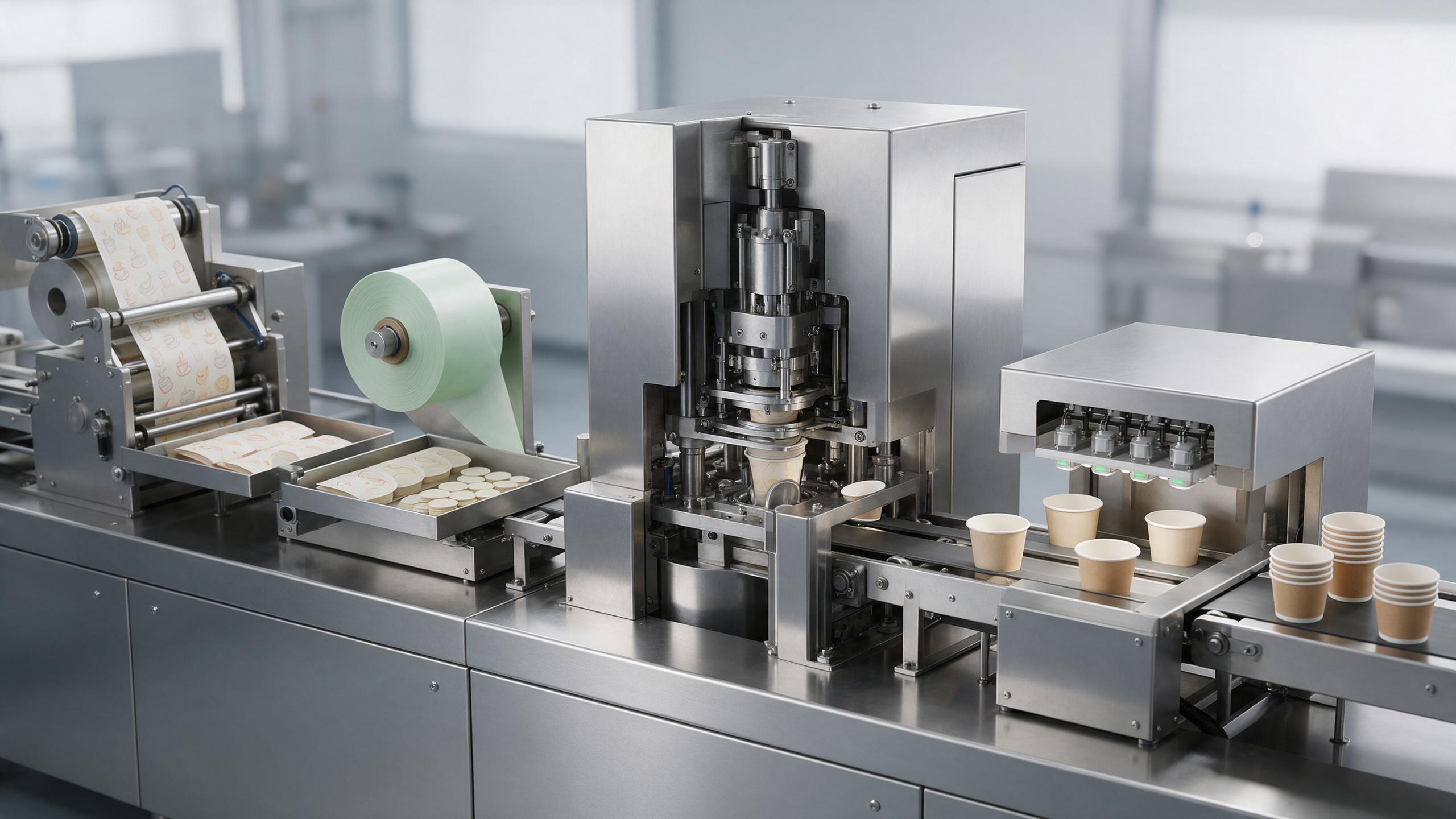
Site readiness should be reviewed in a walk-through, with the proposed machine for paper cup production treated as one part of the route. Confirm the usable floor area, operator access, material-in and cup-out paths, power and other utilities required by the agreed configuration, waste collection, lighting for inspection, and a safe place for tools and spare parts. The supplier’s final technical documentation should govern the actual requirements.
Assign an owner to each handoff. One person can confirm incoming paper and printed blanks; another can own first-piece checks; a maintenance contact can record lubrication, wear-part, and fault-reporting routines. This small administrative step turns a purchase into an operating process.
Use phased trials instead of a single demonstration
A practical deployment of a machine for paper cup production moves through staged trials. Begin with the agreed paper and cup format. Observe feeding, forming, seam and bottom sealing, rim finish, cup collection, and the transfer to packing. Then document what was changed and why. More precisely, not every output issue originates with the equipment; material condition, tooling, settings, and operating practice should be checked together.
| Trial stage | What to verify | Why it matters |
|---|---|---|
| Incoming material | Paper, coating or barrier treatment, printed blank identification, and bottom-stock condition | Provides a known starting condition for the trial |
| First-piece review | Cup dimensions, visual finish, side seam, bottom seal, and rim appearance | Sets the reference sample for the shift |
| Stable run | Operator actions, reject handling, collection, counting, and packing flow | Shows whether the surrounding workflow keeps pace |
| Handover | Settings record, maintenance items, spare-part list, and unresolved questions | Gives the operating team a usable starting point |
This approach does not imply a particular rate or reject level. It gives the factory a repeatable way to decide whether the machine for paper cup production is operating under the agreed conditions.
Build quality controls into the handoff
Quality checks should be agreed before the first production run, not after a customer complaint. Useful checks often include cup dimensions, visual printing condition where applicable, seam and bottom integrity, rim quality, and leakage testing appropriate to the factory’s own specification. For food-contact applications, relevant market rules and customer requirements should be reviewed separately. For example, U.S. current good manufacturing practice rules address the handling of single-service articles such as paper cups to protect against contamination; that is context for planning, not a substitute for local compliance review.
Keep samples, inspection records, and nonconformance notes close to the line. A machine for paper cup production is easier to tune when the team can compare an observed defect with the material batch, cup format, and settings record from the same run.
Make training and acceptance evidence part of the deployment
The acceptance discussion should name the sample format, material condition, visual criteria, test method, documentation, and people who can sign the result. From common purchasing omissions, acceptance boundaries are worth confirming early. Ask the supplier which configuration details, operating instructions, maintenance guidance, and support channels will be supplied for the agreed project.
Operator training should cover normal start-up, material loading, safe clearing of routine stoppages according to the approved procedure, first-piece inspection, changeover records, and escalation of defects. Maintenance personnel should receive the agreed documentation for routine checks and wear-part planning. Do not compare quotation figures alone; spare parts and support scope can influence later decisions as well.
A deployment checklist for the factory team
- Confirm cup formats, target applications, paper specification, and artwork workflow.
- Document how the flexo label printing machine, blank preparation, and forming stage will exchange material and records when printing is in scope.
- Define bottom-stock requirements and the inspection handoff for any paper cup bottom slitting machine in the process.
- Review layout, operator access, utilities, inspection space, and finished-cup handling with the agreed technical documents.
- Write first-piece, stable-run, and acceptance checks before the factory trial.
- Assign owners for material release, quality review, operator training, maintenance, and open technical questions.
- Keep the final settings, samples, and unresolved items in the production handover file.
Conclusion
A factory deploys a machine for paper cup production successfully when it manages the handoffs around the machine as carefully as the machine itself. Start with cup and material facts, connect printing and bottom-stock preparation where relevant, verify the forming and inspection workflow in phases, and leave the operating team with evidence they can use. You can first organize the cup format, paper material, and target output, then ask a supplier for configuration guidance that matches those conditions.
 ONLINE