
 EN

Why Machine For Paper Cup Production Is Gaining Traction?
Interest in a machine for paper cup production is growing because cup converters are being asked to balance demand changes, labor planning, material choices, and consistent forming. A machine for paper cup production is not simply a faster way to make a disposable item. It is part of a process that turns printed or plain cup stock into a food-service package that must match its intended drink, size, and delivery market.
From a food-packaging application perspective, the useful question is not whether every machine for paper cup production suits every project. The more practical question is which production conditions make a particular machine, tooling setup, and operating routine appropriate. That distinction helps buyers move beyond a headline speed figure and toward a workable line plan.
Demand is making production flexibility more valuable
Paper cups serve cafés, takeaway counters, offices, events, and food-service distributors. These outlets may require different volumes, cup sizes, rim formats, print designs, and delivery schedules. That variety creates a reason to examine a machine for paper cup production when outsourced supply becomes hard to coordinate or when a converter wants more control over lead times.
Published market forecasts also point to continuing interest in paper-cup demand. One third-party estimate placed the market at USD 14.6 billion in 2025 and projected 4.3% annual growth from 2026 to 2035. Forecasts differ by methodology, so that number should not be treated as a promise. Still, it helps explain why buyers are evaluating a machine for paper cup production as part of capacity planning rather than as a short-term purchase alone.
The attraction is especially clear when a producer must switch between beverage programs. Dedicated cup-forming equipment can support a more planned response to recurring orders if the cup range, paper specification, and changeover needs have been defined first. In other words, the opportunity is flexibility with discipline, not automatic capacity for every possible cup.
Automation addresses repeatable work, not every production risk
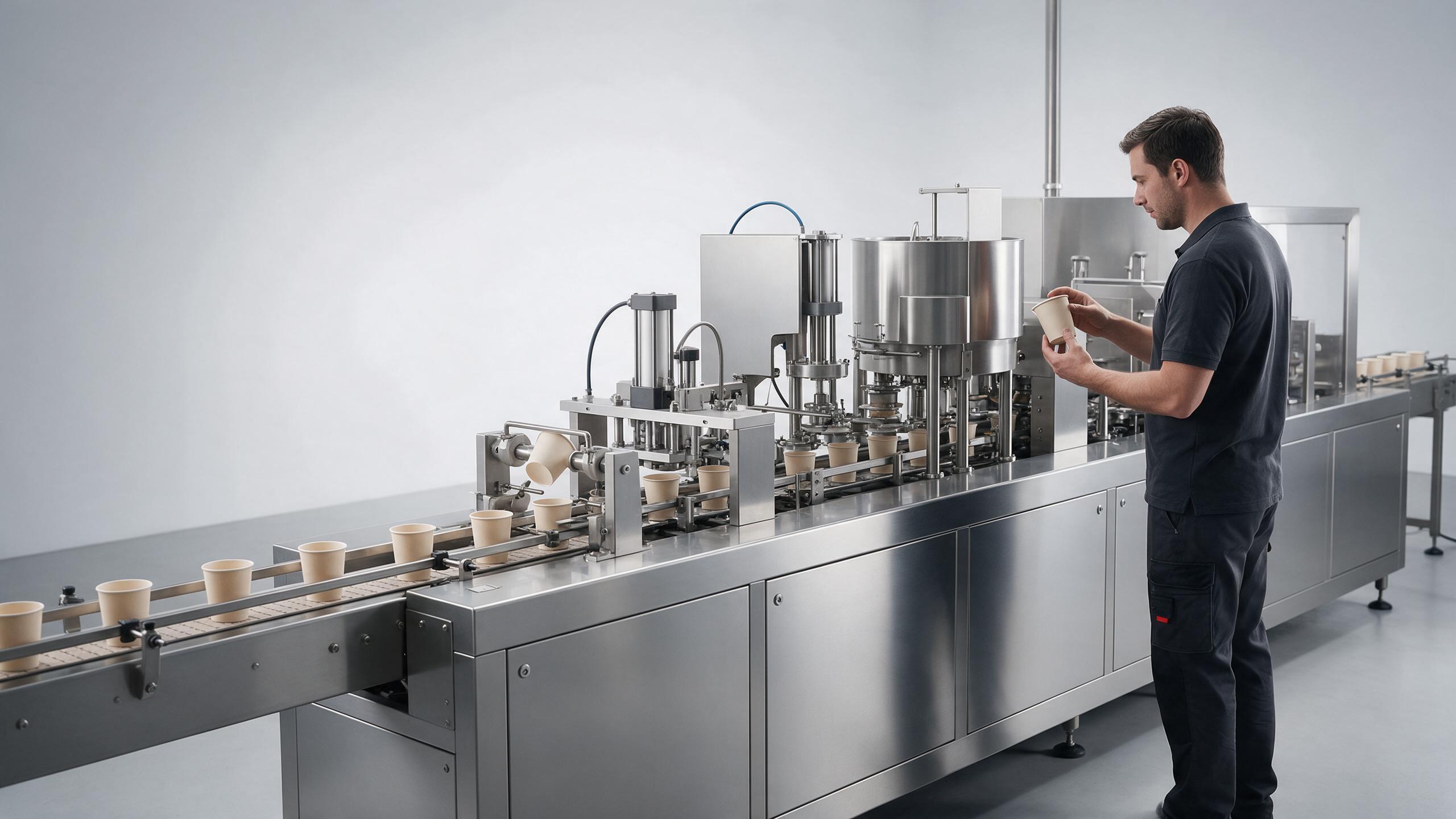
In a typical forming workflow, cup blanks are fed, the side seam is formed, the bottom is inserted and sealed, and the finished cup is collected for inspection and packing. A machine for paper cup production can make these repeated steps more consistent than a heavily manual process. It can also give the operator a clearer sequence for setup, checks, and exception handling.
However, automation does not replace process definition. Before selecting equipment, a buyer should state the target cup diameter, height, volume range, paperboard or coated-stock structure, intended beverage temperature, and expected order mix. Material behavior, tooling, heating or sealing conditions, and operator practice all influence the finished cup. More accurately, not every defect starts with the machine; incoming material and setup discipline matter too.
This is also why buyers researching paper-cup equipment often ask questions about cup sizes and output. Those are relevant questions, but they should be followed by questions about changeover, scrap control, inspection points, and downstream packing. A line that produces a cup quickly but creates avoidable interruptions may not fit the real operating rhythm.
Paper and cup design are now central selection inputs
For food-contact applications, a proposed cup-forming line should be reviewed alongside the approved material system and destination-market requirements. Requirements vary by market, so buyers should verify the documentation and tests relevant to their own paperboard, coating, inks, adhesives, and intended use. It is safer to treat compliance as a project verification task than to assume that one general statement applies everywhere.
Cup geometry matters just as much. A narrow coffee cup, a wider soup container, and a promotional cold-drink cup may call for different tooling and process confirmation. When discussing paper-cup production equipment, start with the final application: hot or cold use, lid fit, cup size, graphic coverage, and distribution conditions. That approach turns a vague equipment inquiry into a specification conversation.
The auxiliary phrase cup plate banane ka machine is often used by buyers who are exploring a broader disposable-tableware opportunity. The same planning rule applies: clarify whether the project is focused on cups, plates, or both before requesting a configuration. Equipment categories, tooling, and material behavior should not be assumed to be interchangeable.
Why buyers are looking beyond the lowest quotation
A low initial price can look attractive, yet the long-term value of equipment investment depends on the full operating picture. Buyers should compare the availability of format parts, the clarity of operating instructions, access for cleaning and routine inspection, electrical and air requirements, commissioning scope, and the plan for spare parts. These topics are not extras; they shape how a line performs after installation.
For a use and throw cup making machine, the commercial case also depends on how frequently the producer changes designs or sizes. A business with stable, high-repeat orders may value a streamlined setup. A business with varied customer programs may place more weight on planned changeovers and tooling management. Neither priority is universally right, but each changes what should be requested from a supplier.
This is where a machine for paper cup production gains traction: it allows a producer to connect capacity planning with product control. The decision becomes less about owning a machine and more about creating a repeatable route from approved material to an inspected cup.
A practical review checklist before requesting a proposal
Use the following checklist to structure a conversation about a machine for paper cup production:
- Define the cup sizes, shapes, volume range, and likely monthly order pattern.
- List the paperboard, coatings, printing condition, and food-contact documentation to be verified.
- Ask how the proposed cup-forming line is configured for the required forming and sealing conditions.
- Confirm which format parts are included, how changeover is managed, and what training is needed.
- Map inspection points for side seams, bottom sealing, rim quality, cup appearance, and packing.
- Compare installation requirements, routine maintenance access, spare-part planning, and acceptance criteria.
These questions make the request more useful for both technical and purchasing teams. They also reduce the risk of comparing quotations that appear similar but cover different responsibilities.
The reason traction is likely to continue
A machine for paper cup production is gaining attention because it sits at the intersection of food-service demand, packaging variation, labor repeatability, and supply responsiveness. The equipment is relevant when its configuration follows the actual cup program and when its performance is evaluated as part of a complete process.
For a prospective buyer, the next step is to assemble sample cup specifications, material details, expected order mix, and acceptance questions before discussing a machine for paper cup production. That preparation makes it easier to assess a proposed solution on its real fit, rather than on broad claims or a single headline number.
 ONLINE