
 EN

How Facilities Operate Disposable Paper Cup Making Machine?
A disposable paper cup making machine is only one part of a controlled production system. In a well-run facility, operators, material handlers, quality staff, and maintenance technicians coordinate the machine’s work from paper release through packing. The aim is not simply to make more cups. It is to produce cups with consistent shape, clean seams, dependable bottoms, and records that make problems easier to trace.
From an operator’s perspective, a disposable paper cup making machine operates more predictably when cup format, coated-paper condition, tooling, heat or sealing method, and planned output are discussed together. Exact station layouts and settings vary by model, so facilities should follow their approved machine manual and local safety procedure.
Start with a controlled production plan
Before a disposable paper cup making machine is started, the facility normally confirms the production order: cup size, blank artwork, paper grade and coating, bottom-stock requirements, packaging count, and inspection plan. This prevents a common mistake—treating a correct machine setting as sufficient when the incoming material or cup design has changed.
Paper blanks and bottom rolls should be identified and protected from contamination, crushing, or excessive moisture exposure. If a converting site also runs a paper bag manufacturing machine, the two processes may share paper-handling disciplines, but their forming tooling and quality risks are different. Operators should use the approved specification for the cup order rather than transfer a setting from a different paper-converting line.
A practical pre-start conversation covers three questions:
- Does the selected blank match the required cup diameter, height, and seam allowance?
- Are the bottom material, coating, and forming method compatible with the intended beverage or food-contact application?
- What samples, measurements, and leak checks will release the shift for production?
What happens at the forming stations?
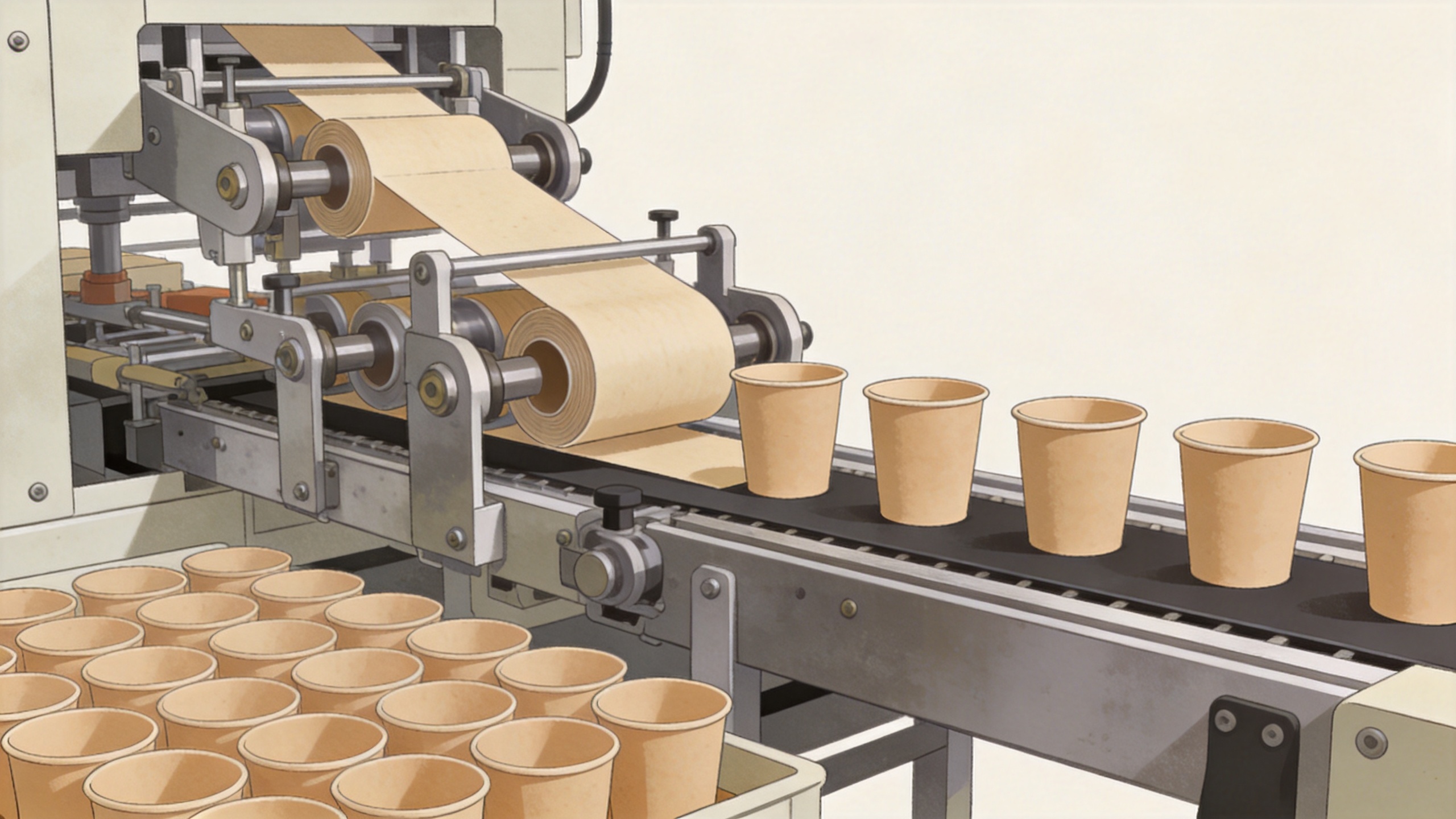
The exact design of a disposable paper cup making machine differs, yet the operating logic is broadly similar. A prepared sidewall blank is fed into the machine, formed into a cylindrical body, and joined at the side seam. A bottom piece is then positioned and joined to the body. Subsequent forming actions reinforce the lower joint and shape the rim for handling or lid fit.
Facilities often describe the sequence as feeding, side-seam forming and sealing, bottom feeding, bottom joining, knurling, rim curling, discharge, and collection. A disposable paper cup making machine may use different mechanical arrangements or bonding technologies, so this sequence is a process map, not a model specification.
1. Feeding and blank control
At the feed end, operators watch for double sheets, skewed blanks, damaged print areas, and inconsistent release. A disposable paper cup making machine cannot correct every upstream material issue. If blanks enter misaligned or with an unsuitable coating condition, later seam and bottom defects can be mistaken for a machine-only problem.
2. Side-seam formation
The sidewall is wrapped and its overlap is bonded. This is a critical checkpoint because a visible opening, contamination at the joint, or unstable overlap can create a later leakage path. Rather than repeatedly changing settings, an operator should first isolate whether the symptom follows the blank, the forming position, the bonding area, or the machine timing.
3. Bottom insertion, joining, and knurling
The bottom must enter in the correct position and be securely joined to the sidewall. Knurling mechanically reinforces the bottom-to-wall region. On a disposable paper cup making machine, a cup may look acceptable while a lower joint is still inconsistent; that is why representative finished-cup checks matter in addition to station observation.
4. Rim curling and discharge
The rim is curled to create the intended edge geometry. Operators examine the curl for uniformity, deformation, and clean appearance before cups move to collection and packing. For a coffee disposable paper cup making machine, rim geometry and compatibility checks can be especially relevant when the customer uses lids, sleeves, or a specific filling process.
How operators keep the line stable during a shift
Facilities do not normally leave a disposable paper cup making machine unattended after first-off approval. They use routine observations and documented samples to catch drift early. A useful shift routine combines material checks, machine-condition checks, and finished-cup verification.
| Checkpoint | What the team looks for | Why it matters |
|---|---|---|
| Material release | Correct blank, bottom stock, and order identification | Keeps an input mismatch from becoming a forming issue. |
| Forming observation | Blank travel, side seam, bottom position, rim shape | Helps locate where a defect begins. |
| Finished samples | Shape, dimensions, seam condition, bottom condition | Confirms the product rather than only the machine motion. |
| Representative leak test | Approved sampling method and hold time | Can reveal seal issues not obvious in a visual check. |
| Shift record | Lot, time, observation, adjustment, and outcome | Supports traceability and repeatable troubleshooting. |
When a defect appears, the most efficient response is usually to contain affected output, record the condition, check the approved material and tooling condition, and make one controlled adjustment at a time. This approach is more reliable than several simultaneous changes to a disposable paper cup making machine, because it preserves the link between a correction and its result.
Quality control should test the cup, not just the process
Side-seam integrity and bottom-seal integrity are two priority areas for liquid-containing cups. Visual inspection can identify obvious seam openings, distorted cups, poor print registration, or contamination. However, representative finished-cup leak testing is still valuable because some bottom or seam variation is not clear from appearance alone.
For each approved sampling plan, staff can check a cup’s overall geometry, side seam, bottom joint, rim finish, and—where applicable—lid fit. The appropriate test method, sample size, and acceptance criteria should be defined by the facility’s product specification and customer requirements. A disposable paper cup making machine should be evaluated against those agreed criteria, not against a generic promise about performance.
This distinction is important in facilities producing different cup sizes or materials. A setting that produces stable results for one format may need re-verification for another. The same principle applies when a coffee disposable paper cup making machine is scheduled for a new blank design, a new coating construction, or a different beverage-use requirement.
Maintenance and safety support consistent operation
Daily care reduces avoidable interruptions around a disposable paper cup making machine. Depending on the equipment manual, the routine may include removing paper debris, inspecting moving components, checking guards and sensors, reviewing wear points, and using only the approved lubrication method. Lockout, guarding, and maintenance access must follow the site’s safety rules and the manufacturer’s instructions.
Maintenance teams should also communicate with production. If operators report recurring seam variation, poor bottom joining, unusual noise, or difficult cup discharge, the record gives technicians a starting point. In many cases, the answer is not a single universal adjustment; material condition, alignment, wear, timing, and operating practice may all need review.
Prepare the facility for a productive handover
A strong handover turns operation of a disposable paper cup making machine into a repeatable facility process. The outgoing team should document the job, material lot, approved samples, notable observations, adjustments made, output contained or released, and any checks still pending. The incoming team can then verify the same critical points instead of relying on informal memory.
For buyers planning a new line, the most useful technical discussion is not just “How fast is the machine?” It is “Which cup formats, paper materials, quality checks, changeover needs, operator roles, and maintenance resources must be confirmed?” RUIDA Machinery can use that information to structure a more relevant equipment discussion without assuming unverified site conditions.
In short, a disposable paper cup making machine operates as a sequence of controlled material handling, forming, inspection, and maintenance activities. When facilities define their checks before startup and record what happens during the shift, they are better positioned to investigate variation and protect the consistency of finished cups.
 ONLINE