
 EN

Why Disposable Paper Cup Making Machine Dominates?
A disposable paper cup making machine has become the default starting point for many paper-cup projects because it turns several dependent forming tasks into one controlled workflow. That does not mean every buyer needs the same model, or that the highest advertised speed is automatically the right answer. From a packaging-equipment selection perspective, the practical question is simpler: can the machine, cup format, paper stock, production rhythm, and operating plan work together?
When buyers compare a machine for paper cup production, integrated automation is attractive because paper feeding, side sealing, bottom handling, heating, knurling, rim curling, and cup collection are not isolated steps. A weak handoff in one stage can affect the next one. When the sequence is coordinated, the production team has a clearer process to observe, adjust, and document.
What “dominates” really means in paper-cup production
In this context, dominance is not a universal performance claim. It describes why automatic or highly integrated equipment is often the preferred production route when a business needs repeatable disposable cups at a planned rhythm. Search results for the category repeatedly emphasize the same linked stages: feeding the paper blank, forming and sealing the side wall, processing the bottom, applying heat where the material system requires it, knurling, curling the rim, and collecting finished cups. Bringing those actions into one sequence reduces the number of manual handoffs that must be coordinated during routine production.
That matters more than a headline number. A disposable paper cup making machine may be a strong fit when the buyer wants a defined process route, consistent checks between stages, and a basis for training operators. It may be less appropriate to select purely by the fastest stated output if the project will frequently change cup sizes, use several paper structures, or lack a stable plan for inspection and maintenance.
Why automation is compelling: a process-chain view
Paper-cup formation is a chain, not a single press operation. The side seam, bottom connection, heating conditions, knurled area, and curled rim all need to be evaluated in relation to the intended cup and material. A coordinated machine for paper cup production gives teams a common operating sequence. Instead of managing several unrelated stations, they can define what to check at each stage and when to stop for an adjustment.
- Repeatable sequence: defined feeding, forming, sealing, bottom, heating, knurling, and curling stages support a repeatable workflow.
- Clearer responsibility: operators can follow a stage-by-stage checklist instead of relying on memory across manual handoffs.
- More useful troubleshooting: when a cup edge or bottom needs attention, the team can record the observed stage, material condition, and setting context before making a conclusion.
- Better planning: buyers can discuss cup format, paper stock, desired production rhythm, changeover frequency, and acceptance criteria in one technical conversation.
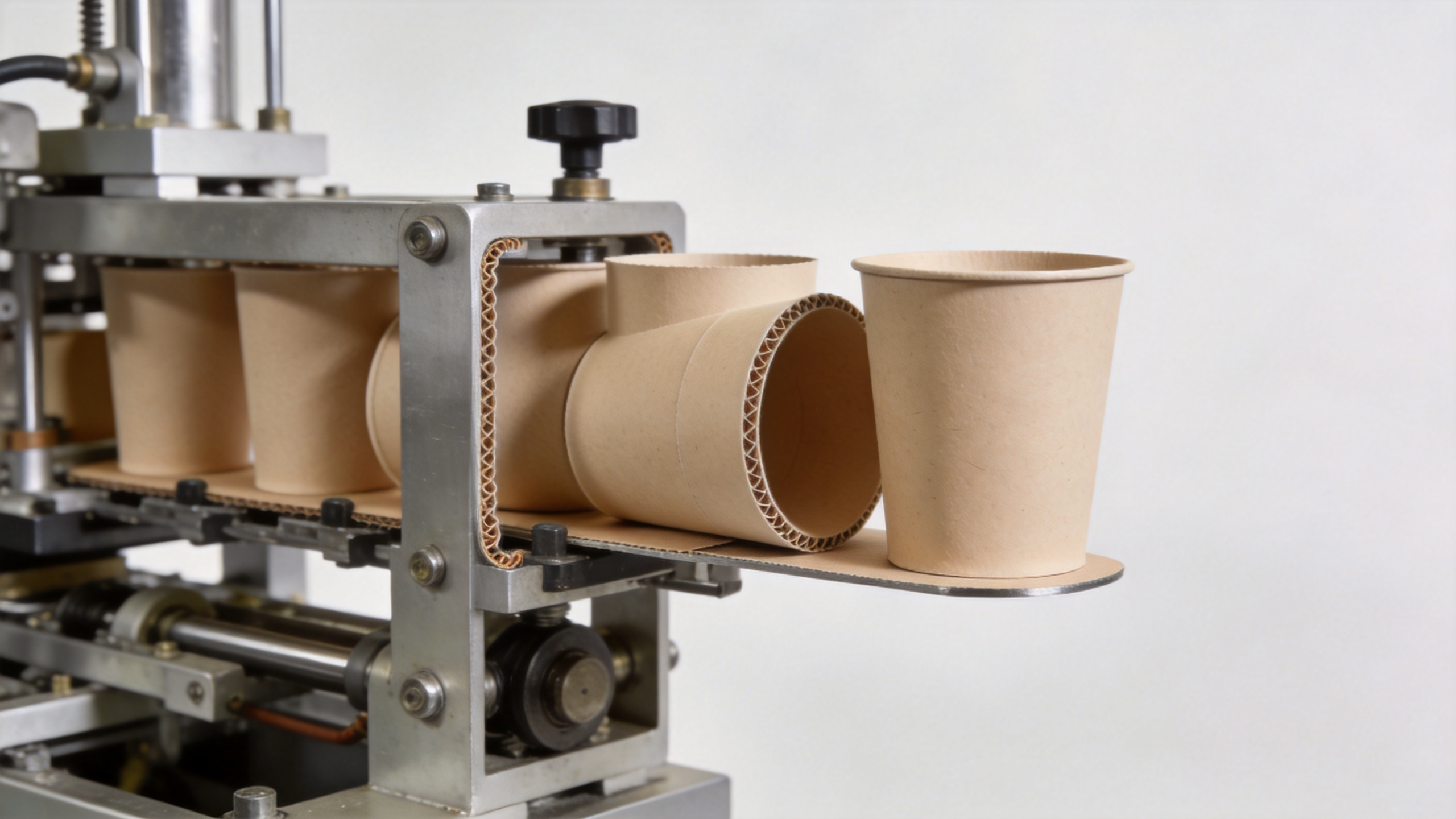
More precisely, not every defect comes from the machine. Paper batches, cup geometry, coating or lining choices, setup, tooling condition, and operator practice can all influence the result. That is why an automatic sequence is valuable: it creates a structured way to verify conditions rather than a promise that conditions no longer matter.
Material and cup-format compatibility still decide the fit
A common procurement mistake is to begin with nominal capacity and treat paper compatibility as a detail. For disposable cups, the paperboard, coating or lining system, blank dimensions, cup height, rim shape, and bottom design affect the forming discussion. Before selecting a disposable paper cup making machine, document the target cup range and ask how the proposed process addresses the actual material configuration.
This is especially important for food-contact applications. ISO 22000:2018 is a food-safety-management-system standard relevant across the food chain, including food-contact-material contexts; it is not proof that a particular machine, cup, or supplier is certified. For an export or regulated application, the buyer should separately verify the applicable destination rules, material documentation, test responsibilities, and records required for the finished cup.
A more useful question is not “Which machine sounds most attractive?” It is “Under our paper, cup, and market requirements, which conditions must be demonstrated before we approve the configuration?” That framing prevents an equipment claim from being confused with material or compliance evidence.
Compare production rhythm, not only maximum speed
Buyers often see output figures first. They should also ask what happens before, during, and after normal operation. A stable single-format program may prioritize a predictable running rhythm. A converter serving many customers may give more weight to changeover planning, setting control, and verification after adjustments. In either case, a disposable paper cup making machine dominates the conversation because it concentrates the work into a controllable process—but the right configuration still depends on how that process will be used.
| Decision area | What to clarify | Why it matters |
|---|---|---|
| Cup program | Sizes, shapes, rim requirements, and planned format changes | These affect configuration and changeover discussion. |
| Paper system | Paperboard structure, coating or lining, blank quality, and batch variation | Material conditions influence forming and sealing verification. |
| Production rhythm | Target schedule, staffing, inspection points, and downstream handling | It shows whether a nominal output figure is meaningful in the full workflow. |
| Acceptance plan | Sample criteria, records, training, spare parts, and service boundaries | It turns a quotation into a more complete operating decision. |
Where does an automatic paper bag making machine fit?
An automatic paper bag making machine belongs in a related packaging discussion, but it should not be treated as a substitute for cup-forming equipment. Bags and cups have different forming geometries, sealing needs, and end-use conditions. Some manufacturers or converters may operate both categories, so comparing their automation logic can be useful at a planning level. Still, the technical evaluation for a paper cup must return to cup blanks, seams, bottoms, rims, and material suitability rather than transferring bag-machine assumptions into the cup project.
This distinction also improves supplier communication. State the product type, target format, paper specification, and downstream use explicitly. It reduces the chance that a broad packaging inquiry receives a configuration that is adjacent to, rather than aligned with, the intended cup line.
What to verify before choosing a machine
- Define the cup formats, paper system, and expected mix of production runs.
- Map the forming sequence and identify the checkpoints that matter for your cup design.
- Ask for a configuration discussion tied to those conditions, not only a generic catalogue description.
- Agree how samples, acceptance criteria, operator training, maintenance access, and spare parts will be handled.
- For food-contact or export projects, confirm documentation and destination requirements with the appropriate parties before release.
During a review, look at the edge and rim condition, bottom area, feeding continuity, and the clarity of changeover actions. These observations are discussion inputs, not stand-alone performance guarantees. If the paper stock and target cup are already confirmed, they make the equipment comparison much more meaningful.
Conclusion: dominance comes from coordinated decisions
The disposable paper cup making machine dominates many production plans because it organizes multiple forming steps into a single, manageable workflow. Its value comes from coordination, repeatability, and a clearer basis for checking the process—not from a one-size-fits-all promise. Buyers get a stronger result when they start with the cup application, paper system, format changes, and production rhythm, then compare configurations against those conditions.
Before requesting a proposal, prepare the cup drawing or sample, material details, expected production plan, and questions about acceptance and support. That small amount of preparation can make a machine for paper cup production easier to evaluate and can keep an automatic paper bag making machine from becoming an irrelevant comparison.
 ONLINE