
 EN
EN

How Factories Implement Paper Cup Forming Machine?
Implementing a paper cup forming machine is not simply a matter of positioning one machine on the production floor and turning it on. A factory has to connect paper blanks, heat-sealing conditions, cup geometry, inspection, and packing into one repeatable flow. From a packaging-equipment technical selection perspective, the first question is not “How fast is the machine?” It is whether the cup size, paper structure, and planned production rhythm can be controlled together.
A practical implementation plan treats the former as one station in a line. The paper cup forming machine shapes the cup body and joins the key features, but incoming material quality, tooling setup, operator routines, and downstream handling all influence the finished cup. If the paper stock and cup format have already been confirmed, this sequence gives a clearer starting point for factory teams.
Start with the cup specification, not the machine brochure
Before installation, document the cup’s top diameter, bottom diameter, height, capacity, intended contents, paperboard construction, coating type, printing layout, and tolerance expectations. These details determine whether the forming path and tooling are suitable. A paper cup body forming device may look capable of a given size range, yet the seam, bottom, and rim still need to be evaluated against the actual blank and material behavior.
For food-contact applications, the factory should also assign responsibility for verifying material and destination-market requirements. For example, US requirements for paper and paperboard in contact with aqueous or fatty foods are addressed in 21 CFR §176.170. That reference is not a machine certification, and it does not replace a project-specific review. It is a reminder to keep material documentation and compliance checks separate from equipment claims.
Map the forming sequence before commissioning
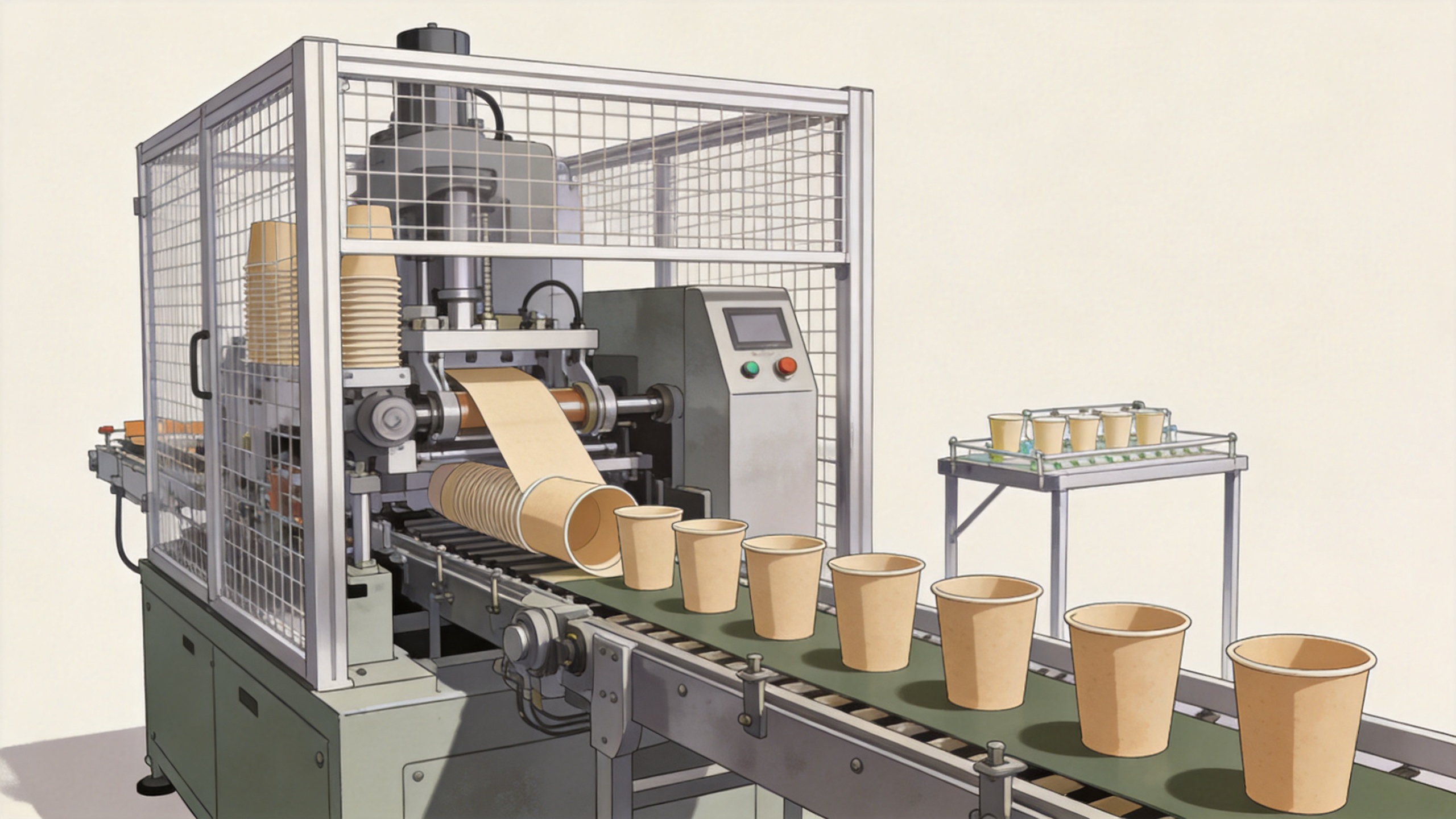
A factory can implement a paper cup forming machine more reliably when the team maps each handoff from blank to finished cup. The exact station arrangement varies by configuration, but the following flow is a useful commissioning framework:
- Blank preparation and feeding. Die-cut, printed blanks are counted, protected from moisture and contamination, then delivered consistently to the feed system.
- Body wrapping and side-seam sealing. The blank is wrapped around the forming mandrel and the side seam is joined using the applicable heating or sealing method for the selected material.
- Bottom insertion and joining. A bottom blank is positioned, attached to the body, and checked for alignment before the joint is finalized.
- Knurling and rim curling. Bottom knurling helps create a stable liquid-retention joint, while rim curling produces the finished drinking edge and supports stacking behavior.
- Discharge, inspection, and packing handoff. Cups move to collection, sampling, counting, and packing processes without creating a backlog at the outlet.
This map helps distinguish the work of the paper cup shaping equipment from the work of the full line. A cup former can complete its forming cycle while the overall factory output still suffers if blanks arrive inconsistently or finished cups accumulate at discharge.
Prepare utilities, layout, and ownership around the machine
Installation should include more than floor space. Confirm power requirements, compressed-air needs where applicable, ventilation around heated stations, access for cleaning and maintenance, safe guarding, and material movement paths. The operating team also needs a clear owner for each condition: production should own startup checks, maintenance should own preventive tasks, and quality should own the sampling and acceptance routine.
It is useful to walk the planned path with actual containers and racks before production begins. Can an operator refill blanks without reaching across a guarded area? Can finished cups be removed without interrupting the discharge path? Can change parts be stored and identified near the correct station? These small layout questions often matter more than a headline speed figure.
Commission the paper cup forming machine in controlled stages
Commissioning is more reliable when handled as a sequence of controlled confirmations rather than a single output trial. Begin with dry motion and safety checks, then run material at a conservative setting. Verify blank feeding, body alignment, seam appearance, bottom engagement, rim condition, and cup release at each stage. Only increase the planned rhythm after the prior condition remains stable.
The key is to record the operating conditions with the sample results. If a seam opens, a bottom leaks, or a rim deforms, the response should examine paper, coating, blank dimensions, tooling condition, temperature or sealing settings, and timing together. More accurately, not every defect is caused by the machine itself; material variation and setup can create the same visible symptom.
Build quality checks into the operating routine
A paper cup forming machine needs a repeatable quality routine, not just a final visual check. Define what operators inspect at startup, at planned intervals, after a material roll or blank batch change, and after any parameter adjustment. Typical observations include side-seam appearance, bottom integrity, cup roundness, rim finish, print orientation, and the absence of contamination or crushing.
For cups intended to hold liquids, agree on a suitable leak-test method and acceptance boundary before production. The test method, sample size, dwell time, and handling conditions should be documented by the factory and confirmed for the actual product. Avoid treating a general process reference as proof that every cup design will pass under every condition.
Plan changeovers and maintenance as part of capacity
A factory that runs one format continuously will organize the line differently from a factory that changes cup size or artwork frequently. Before comparing speed, write down the expected number of changeovers, the parts that change, the adjustment points, and who is authorized to approve the first-off sample. This is where a paper cup body forming device becomes a production system rather than an isolated asset.
Preventive maintenance should cover cleaning, lubrication where specified, fastener and guard checks, wear observation on tooling, and review of sensors or heating components according to the manufacturer’s instructions. Do not promise a maintenance interval without the equipment documentation; instead, build the schedule from the actual configuration, operating hours, paper dust conditions, and the factory’s risk controls.
Use a factory acceptance checklist
Before the implementation is considered complete, the project team can review a simple checklist:
- Does the chosen paper cup forming machine match the approved cup drawings and material samples?
- Are the feeding, forming, sealing, bottom, knurling, curling, and discharge steps observed and documented?
- Have safe access, utilities, cleaning, and spare/change-part storage been checked on the installed layout?
- Are startup, sampling, defect escalation, and first-off approval responsibilities assigned?
- Has the downstream packing pace been tested with the former’s planned operating rhythm?
- Have material and market compliance responsibilities been documented without making unverified certification claims?
Conclusion
Factories implement a paper cup forming machine successfully by treating the equipment as part of a controlled manufacturing flow. Start with the cup and paper specification, map every forming and handoff stage, commission with recorded conditions, and turn the lessons into daily checks. The final configuration should still be confirmed against the real paper stock, target cup geometry, and acceptance requirements, but this framework gives engineering, production, and quality teams a shared way to move from installation to stable output.
 ONLINE