
 EN

How Machine For Paper Cup Production Operates?
A machine for paper cup production turns prepared paper blanks and bottom discs into finished cups through a timed sequence of feeding, forming, sealing, finishing, and discharge. It is easy to focus on a headline speed, but the more useful question is whether every station in the forming line can handle the chosen cup geometry, paper stock, coating, and production rhythm. From an operator-focused viewpoint, stable output comes from repeatable handoffs between stations rather than from one setting alone.
Start with the input material and cup specification
Before the forming line starts, the production team confirms the side-wall blank, the bottom blank, the print direction, and the intended cup size. The blank must enter the machine in the orientation expected by the feeding system. If graphics are required, printing is usually planned upstream; a flexo label printer may be part of a separate print workflow, but it is not automatically part of every cup-forming line.
Paper and coating behavior matter at every later stage. Material stiffness affects how the side wall wraps around the forming mandrel, while the coating and sealing method influence the heat or pressure conditions needed at the seam. For that reason, the line should be evaluated with the actual blank material and cup design whenever possible, not only with a generic sample.
The operating sequence inside the forming line
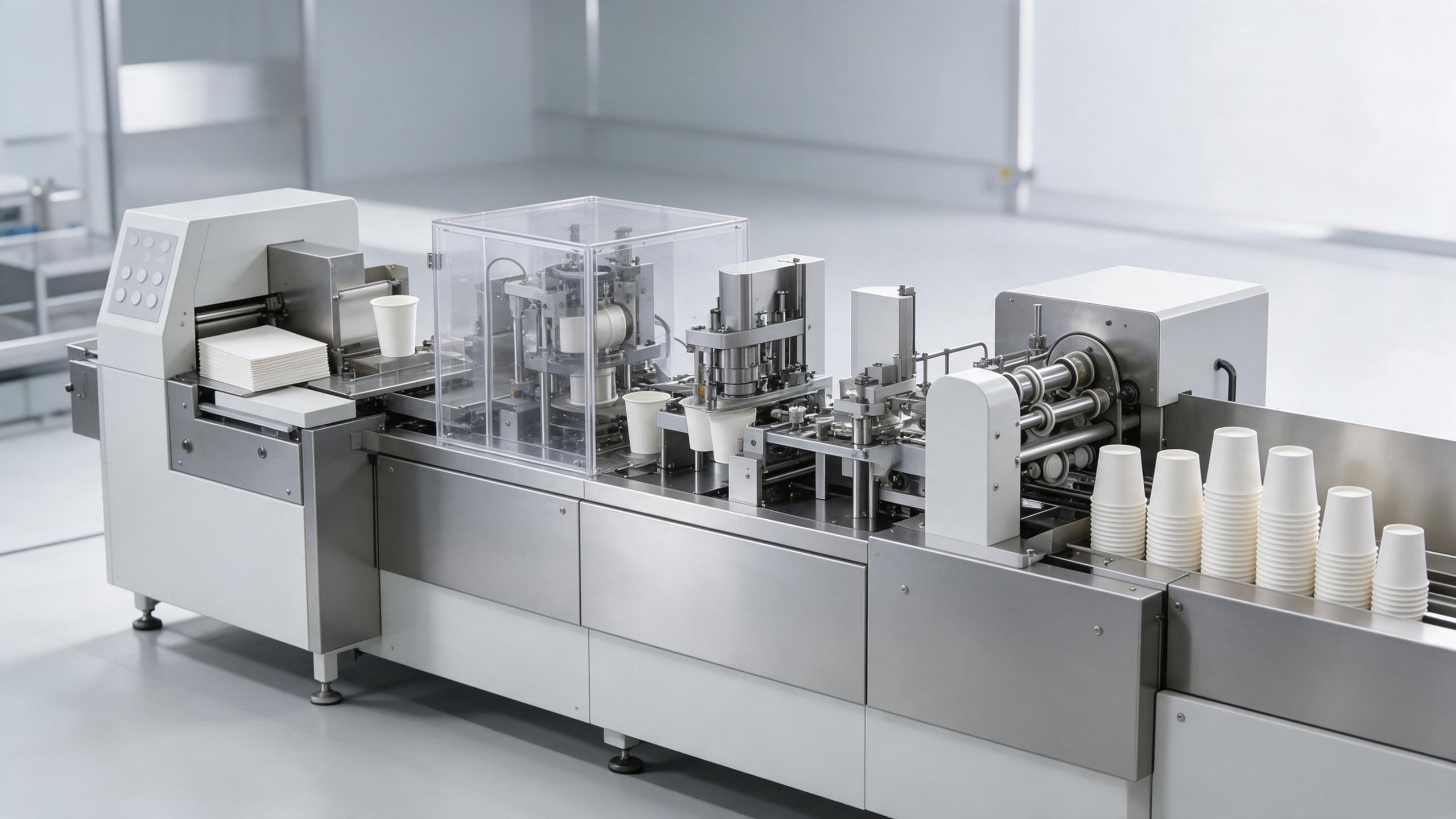
A typical cup-forming machine coordinates several stations in a fixed order. Equipment layouts differ, yet the workflow below gives buyers and operators a practical way to follow the process.
- Blank feeding: The feeder separates side-wall blanks and delivers them to the next position. Reliable separation helps avoid missed blanks, doubled blanks, or skewed entry.
- Side-wall forming: The blank is wrapped around a mandrel or forming tool to create the cup body. The overlap is positioned for a side seam.
- Side-seam joining: The seam is joined using the method designed for the material and machine configuration. Operators watch alignment and seam appearance because a poor seam affects the rest of the cup.
- Bottom feeding and insertion: A bottom disc is introduced into the formed body. Timing between the body and bottom feed is a central control point in the line.
- Bottom forming and sealing: The machine shapes, presses, and seals the lower edge. This stage needs the paper, coating, tooling, heat, and dwell conditions to work together.
- Rim finishing and discharge: The upper edge is curled or rolled to create a usable rim, then the finished cup is collected for inspection or downstream packing.
Which controls keep a machine for paper cup production stable?
The control panel synchronizes motions, but it cannot compensate for every upstream variation. A sound operating routine for the forming line starts by checking blank dimensions, bottom-disc condition, and material storage. Next, the team confirms feeding, seam placement, bottom insertion, and rim shape at a safe trial pace. Only then does it assess whether the proposed production rhythm remains stable.
In practice, the forming system needs consistent registration between mechanical movement and the material path. A change in paper batch, cup height, taper, or coating can alter the adjustments required. More accurately, not every forming defect originates in the machine: blank cutting, printing registration, material condition, and operator setup can all contribute. That is why a stated output should be treated as a condition to validate rather than a promise detached from the cup specification.
How printing connects to cup forming
For branded cups, the artwork is applied before the cup body enters the forming sequence. A flexo label printer can be relevant where a production plan uses flexographic printing for compatible paper-web or blank preparation. The important handoff is not simply whether a flexo label printer is available; it is whether the finished blanks retain the correct cut shape, print orientation, drying condition, and stack quality for the forming line.
This same logic applies to a machine for coffee paper cup production. Coffee cups may have particular requirements around the intended beverage use, cup format, and material construction. A machine for coffee paper cup production should therefore be discussed with the actual paper structure and target cup dimensions. If the project includes frequent size changes, ask which tooling, settings, and verification steps are needed before comparing nominal capacity.
Daily checks that protect production flow
Operators can make the forming line easier to manage by using a short, repeatable checklist. At startup, inspect feed guides, forming tools, heating or sealing areas, and collection paths for cleanliness and correct positioning. During a run, sample cups for side-seam placement, bottom shape, rim consistency, and obvious visual defects. When a problem appears, trace it back through the sequence instead of changing multiple settings at once.
- Record the cup size, paper specification, and setup changes used for the run.
- Check whether blanks feed singly and arrive in the expected orientation.
- Verify the side seam and bottom area before increasing the run pace.
- Keep wear parts and routine inspection points in the maintenance plan.
- Document the acceptance samples and the conditions under which they were made.
Questions to answer before selecting a machine
Whether the goal is a general machine for paper cup production or a machine for coffee paper cup production, begin with the application rather than the speed figure. What cup diameters, heights, taper angles, paper grades, coatings, and print requirements will be used? How often will specifications change? What evidence will show that the seam, bottom, and rim meet the project’s acceptance criteria?
A useful supplier discussion connects those answers to tooling, feeding, forming, sealing, operator training, spare-parts planning, and test conditions. This approach helps the buyer see the equipment as a coordinated process rather than an isolated piece of equipment. If paper stock and cup format are already defined, prepare sample blanks and a written acceptance checklist before final configuration discussions.
Conclusion
A machine for paper cup production operates by moving each cup through controlled blank feeding, body forming, seam joining, bottom work, rim finishing, and discharge. The practical result depends on how well material, tooling, controls, and operating checks fit together. For branded or beverage-specific projects, coordinate the printing workflow, paper construction, and cup-forming validation early so that the planned line can be assessed against real production conditions.
 ONLINE