
 EN

How Paper Machinery Operates in Lines?
Paper machinery is easiest to understand as a coordinated line rather than a row of independent machines. Material, moisture, web tension, speed signals, and finished-roll handling all move together. When one section changes pace, the sections before and after it must respond. That is why a line that looks straightforward on a layout drawing can be demanding to run steadily.
From an operator’s viewpoint, the practical question is not simply whether paper machinery can make a sheet. It is whether each handoff gives the next section a stable, usable input. A good review starts with the product, the furnish or paperboard, the target basis weight, the required finish, and the planned production rhythm. Only then does it make sense to discuss line configuration.
The line begins with prepared material and a controlled feed
At the upstream end, paper machinery receives prepared fibre stock, pulp, recycled furnish, or a supplied paperboard web, depending on the process. The stock must be mixed, cleaned, and delivered consistently enough for the next operation. Variations in concentration, contaminants, or flow can appear later as uneven formation, breaks, or unstable converting.
In a sheet-making process, the wet end distributes the fibre suspension onto a moving forming surface. Water drains away while fibres begin to interlock into a continuous web. In a converting-oriented line, the incoming roll instead enters through an unwind and web-guiding section. These are different starting points, but the control principle is similar: paper machinery needs a predictable feed before downstream sections can produce repeatable results.
Operators commonly watch feed rate, consistency, alignment, and edge condition. A change in one variable should not be treated in isolation. For example, a faster feed may require a coordinated adjustment to draw, tension, drying capacity, or winding settings. The useful mindset is to move from single-machine parameters to whole-line rhythm.
Forming, pressing, and drying create a stable web
For paper-production paper machinery, forming is where the wet web is established. The goal is not merely to remove water; it is to create a web that can survive the transfer to the next section. The formed sheet remains fragile, so support fabrics, vacuum, rolls, and transfer geometry need to work together.
The press section follows by removing more water mechanically between rolls and felts. This handoff matters because excessive moisture raises the burden on drying, while uneven pressure can affect sheet uniformity. A line controller therefore has to keep the section speeds and web path aligned. If the web is pulled too hard, breaks become more likely; if it is too slack, tracking and transfer can suffer.
Drying then uses controlled heat and web contact to bring the sheet toward its intended moisture condition. The major paper-machine sections are commonly described as forming, pressing, and drying, but they should be viewed as one material-and-energy sequence. Paper machinery is more reliable when changes at the wet end, press, and dryer are coordinated rather than corrected after a problem reaches the reel.
Finishing and converting turn the web into usable paper
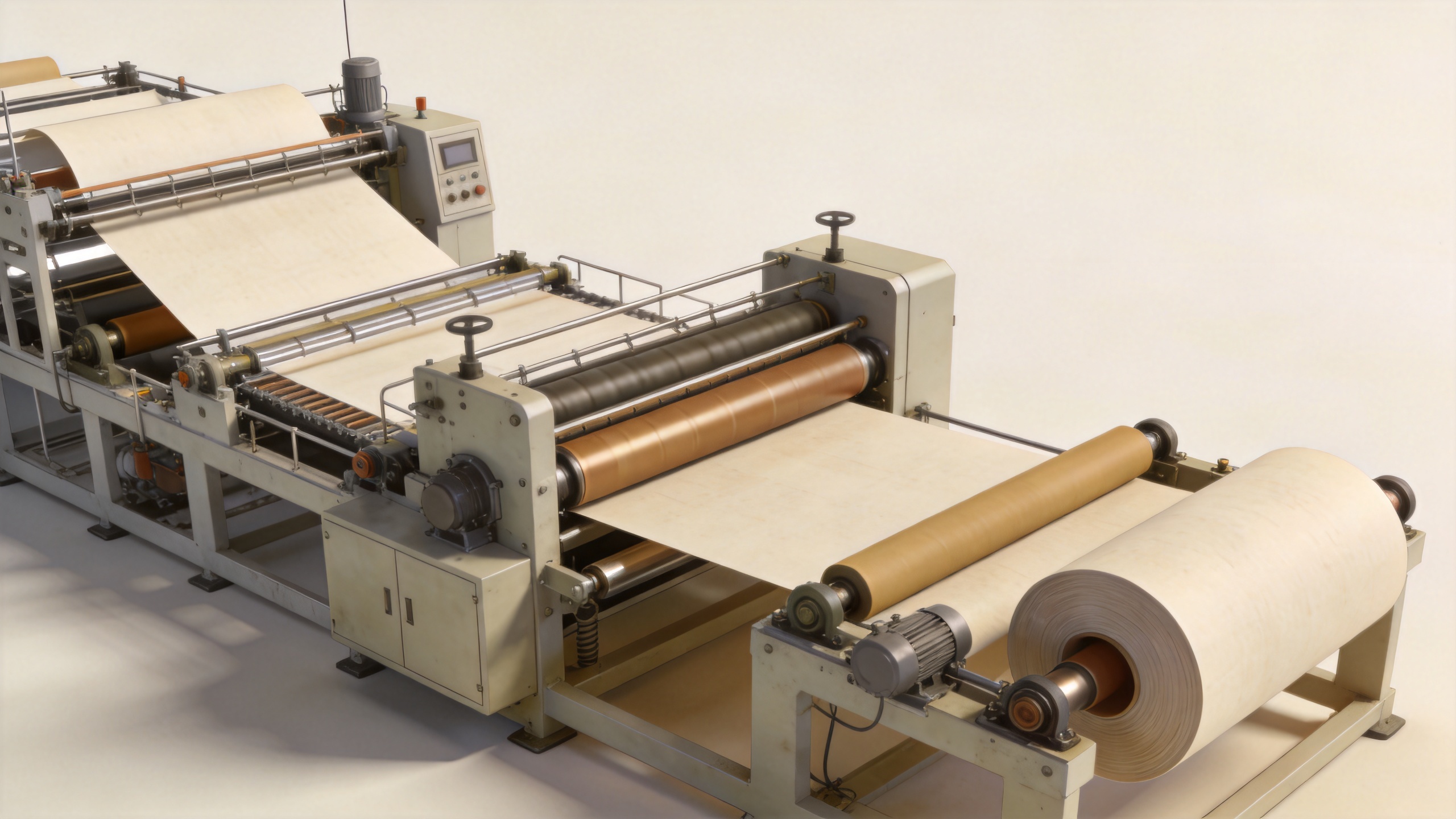
After the main web is stable, paper machinery may include sizing, coating, calendaring, slitting, sheeting, printing, embossing, forming, or packing. The exact sequence depends on the product. A tissue line, a paper-roll operation, and a food-packaging converting line each place different demands on the web and on the final inspection step.
For paper machine paper destined for later converting, roll build and edge quality can affect the next process as much as the basic sheet properties do. A winder or rewinder must maintain suitable tension while building a roll that can be transported, unwound, and processed without avoidable defects. The finished unit is therefore part of the line, not an afterthought.
Where printing and packaging operations are connected, paper machinery may transfer a web directly into a flexographic press or a separate converting machine. That can reduce handling, but it also means that registration, tension, drying, and downstream speed limits must be planned together. It is more accurate to ask which section sets the safe operating window than to ask which machine has the highest nameplate speed.
What keeps paper machinery synchronized?
Line synchronization combines mechanical design, sensors, drives, and operating procedures. Paper machinery typically relies on speed references, draw control, tension feedback, web guides, fault signals, and interlocks. A master speed may establish the line rhythm, while individual drive zones maintain the relationships needed for their own process conditions.
- Material flow: upstream supply must meet downstream consumption without starving or flooding a section.
- Web handling: rolls, guides, and tension zones keep the material centered and supported through each transfer.
- Process condition: moisture, heat, pressure, and dwell time need to remain compatible with the selected grade.
- Quality feedback: checks at the reel, cutter, or packing stage show whether upstream adjustments are needed.
- Safety logic: emergency stops and guards must be understood as part of the workflow, especially around rotating rolls and nip points.
Safety cannot be added only at the end of a commissioning checklist. In paper machinery, a stop condition in a downstream winder may need to slow or stop upstream equipment quickly enough to prevent a web wrap, roll damage, or exposure near moving parts. Site-specific safeguarding must be reviewed against the applicable rules and the actual layout.
Where does a semi automatic paper machine fit?
A semi automatic paper machine can fit well where product changes, operator-led loading, or smaller production batches make full automation unnecessary. The phrase does not mean that coordination disappears. A semi automatic paper machine still needs defined start-up, feeding, transfer, inspection, and shutdown procedures so that people and equipment do not work at cross-purposes.
The main difference is often the number of manual decisions between stages. An operator may load material, approve the first pieces, remove finished units, or reset a station. For this reason, the pace of a semi automatic paper machine should be measured against the real handling time around it, not just the cycle time shown by one station. If upstream output exceeds what an operator can safely inspect or move, the line will accumulate delays.
A practical way to review a paper machinery line
- Define the input material, target product, quality checks, and expected changeover pattern.
- Map every transfer point, including buffers, unwind or rewind steps, and operator interventions.
- Identify the section that limits throughput under normal conditions and during changeover.
- List the signals that trigger a controlled slowdown or stop across the line.
- Confirm how inspection findings travel back to the relevant adjustment point.
This review prevents a common mistake: comparing paper machinery only by individual capacity. The better comparison asks whether material handling, controls, maintenance access, and the intended paper product support a stable sequence. If paper type, roll size, or product shape is still undecided, those conditions should be clarified before treating any configuration as a final answer.
Conclusion
Paper machinery operates in lines by passing a material or web through connected stages with coordinated speed, tension, process settings, quality feedback, and safety controls. Whether the line makes a continuous sheet or converts paper into finished packaging, each section depends on the quality and timing of the one before it. A well-planned line focuses on reliable handoffs, not isolated machine claims.
For buyers and production teams, the next useful step is to document the material, output, changeover, and inspection requirements. That makes it easier to evaluate paper machinery as a working system and to decide where automation, manual handling, or additional control points are genuinely needed.
 ONLINE