
 EN

How Paper Making Machine Processes Pulp?
A paper making machine turns prepared pulp into a continuous web by controlling fiber dispersion, drainage, pressing, drying, and finishing. It sounds linear, but each section affects the next: poor stock preparation can show up as uneven formation, while weak dewatering can add a costly drying burden. From an operator’s viewpoint, the useful question is not simply “does the paper making machine run?” but whether the pulp arrives at each stage in a condition that the next stage can handle.
This overview follows the pulp from the stock system to the reel and explains where teams usually check consistency, water removal, and web stability. The exact layout varies with grade, furnish, speed, and mill design, so the points below are a process framework rather than a promise of a particular output.
Start with stock preparation, not the machine chest
Before pulp enters the wet end, a paper making machine depends on a stable furnish. Virgin fibers, recycled fibers, or a blend are first slushed, cleaned, screened, refined, and mixed with water. These operations separate contaminants, develop fiber properties, and prepare a suspension that can form a sheet. Additives may be introduced according to the target grade, but their selection and dosage must be confirmed against the actual furnish and product specification.
The key idea is dispersion. Pulp must be mixed evenly enough that fibers can distribute across the width of the paper making machine rather than arrive as clumps or streaks. A mill also watches consistency, flow, pressure, and cleanliness because variation here can complicate every later adjustment. More accurately, a sheet-quality issue is not automatically a machine issue; it may begin with stock condition, chemistry, or incoming recycled material.
How the headbox delivers pulp to the forming section
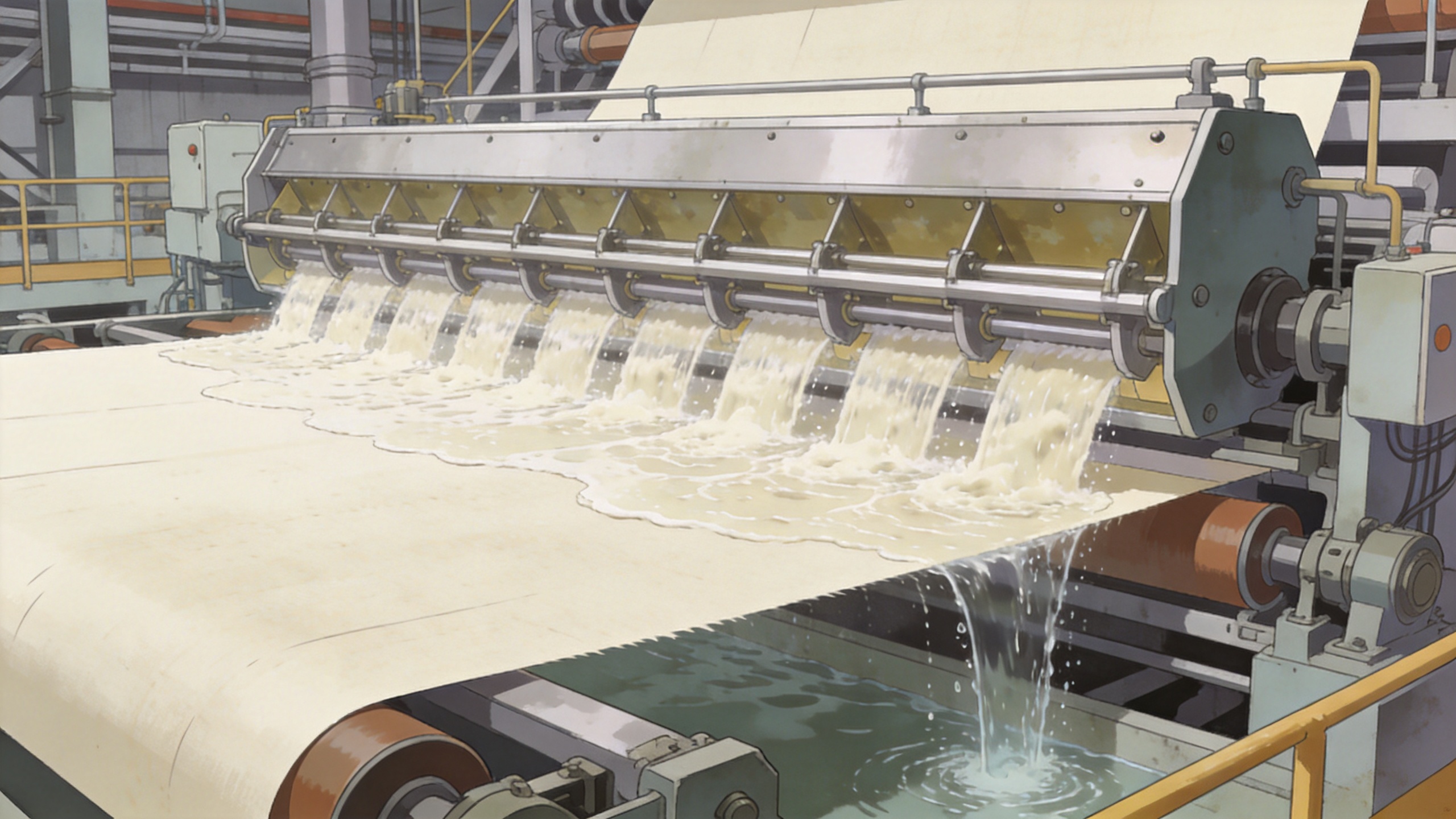
After approach-flow equipment conditions the stock, the paper making machine sends a very dilute pulp suspension to the headbox. The headbox spreads that suspension across the machine width and delivers it to a moving forming fabric. Its purpose is not merely to feed pulp forward. It helps create a controlled, even jet so fibers can begin forming a uniform web.
At this point, most of the mixture is still water. As the suspension lands on the fabric, drainage elements remove water while the fabric supports the emerging sheet. Some white water collected in the wet end can be reused for dilution in the approach-flow system, so water handling is part of both process control and resource management. On a paper making machine, cross-direction uniformity matters: changes in flow distribution or drainage can affect basis weight, moisture profile, and appearance downstream.
Forming: turning pulp suspension into a fragile web
The forming section is where a paper making machine begins to transform pulp into paper. Gravity, vacuum, foils, suction boxes, and the moving fabric work together to drain water without losing control of the fibers. The web that leaves this area has shape, but it is still wet and delicate. Operators therefore balance drainage against formation: removing water too aggressively or unevenly can affect the sheet structure, while insufficient drainage shifts more work to later sections.
This is a useful place to move from a single-machine view to a line view. A paper making machine does not gain stability by maximizing one drainage setting alone. The headbox jet, stock consistency, fabric condition, vacuum profile, and running speed need to work as a system. When troubleshooting, record the visible symptom, the section where it appears, and the conditions before changing several settings at once.
Pressing removes more water before thermal drying
Next, the paper making machine carries the wet web into the press section. Here, rolls and felts apply controlled pressure to squeeze out water and support web transfer. Pressing is especially important because mechanical water removal is generally less energy-intensive than evaporating the same water later in the dryer section. In educational process references, a web may leave the press section at roughly 40–45% consistency, although the practical result depends on grade, furnish, press design, and operating conditions.
The press section is also a practical checkpoint for web handling. Felt condition, nip loading, roll surfaces, and draw settings can all influence moisture uniformity and sheet integrity. A paper making machine may appear mechanically sound while a worn fabric or poorly matched felt creates a process limitation. For that reason, maintenance planning should include consumables and condition checks, not only major machine components.
Drying, sizing, and surface treatment
Once pressing has done as much as practical, the paper making machine moves the web through drying. Heated cylinders and controlled steam systems evaporate remaining water while the sheet is carried through a planned drying profile. Drying must be managed carefully because uneven moisture can contribute to curl, breaks, or variation in later converting. The goal is not simply a dry sheet; it is a sheet at the required moisture and stability for the intended grade.
Depending on the product, a paper making machine may also include size-press, coating, calendering, or other treatment stages. These steps can adjust surface strength, printability, smoothness, absorbency, or other grade-specific characteristics. They are not universal features, so buyers and production teams should first confirm the end-use requirements rather than assume a standard configuration suits every product.
Reeling and quality checks close the production loop
At the dry end, the paper making machine winds the finished sheet into a parent reel. Inspection and process measurements can help teams observe basis weight, moisture, defects, and profile consistency. The parent reel may then go to slitting, rewinding, sheeting, coating, or other converting equipment. Keeping the paper-machine process separate from later converting is important when discussing tissue and hygiene products.
For example, a facial tissue paper making machine focuses on producing the tissue base paper with the softness, strength, and absorbency required by the grade. A wet tissue manufacturing machine, by contrast, is usually part of the downstream wet-wipe converting and packaging workflow; it works with nonwoven or prepared substrate material, lotion handling, folding, cutting, and packing rather than replacing the pulp-to-paper wet end. The two phrases can be related in a hygiene-product supply chain, but they describe different process roles.
What to verify when evaluating a paper making machine
Whether you operate or source a paper making machine, begin with the paper grade, furnish, target basis weight, width, expected production rhythm, and downstream converting needs. Then examine the process path: stock preparation, approach flow, headbox, forming, press, drying, finishing, and reel handling. Ask which variables are measured, where water is recovered, how fabric and felt changes are planned, and what training is needed for normal adjustments and fault response.
A paper making machine processes pulp successfully when every section supports the next one. Start with a stable fiber suspension, form an even web, remove water mechanically before relying on heat, and keep quality checks connected to actual end-use requirements. That sequence gives a more reliable basis for operating discussions and technical evaluation than comparing isolated machine specifications.
 ONLINE