
 EN

How to Choose Paper Making Machine for Mills?
Choosing a paper making machine is less about finding the highest catalog speed and more about proving that a line fits the paper you plan to sell. A mill may be evaluating tissue, packaging, writing, or specialty grades, yet the same purchasing sequence applies: define the finished sheet, quantify the operating target, check furnish and utilities, then verify the configuration in an acceptance plan. From a B2B buyer’s perspective, that order prevents a quotation from becoming a collection of impressive but disconnected options.
A tissue paper machine needs particularly careful matching because softness, absorbency, strength, basis weight, and converting needs all influence the production route. The practical starting point is not a brand comparison. It is a one-page requirement brief that every shortlisted supplier must answer on the same basis.
Start with the paper grade and customer specification
Write down what the mill must deliver before discussing machine modules. Include the target grade, basis-weight range, trim width, roll format, required surface feel, strength priorities, and downstream process. For tissue, clarify whether the product will become toilet rolls, facial tissue, napkins, towels, or parent reels for a converter. These products can share a broad category while demanding different balances of bulk, softness, tensile properties, and reel handling.
This step also keeps the conversation honest. A paper making machine configuration that suits a robust packaging grade is not automatically suitable for a low-basis-weight tissue product. In practice, furnish, forming, pressing, drying, winding, and downstream conversion must be considered as a system. If the intended grade is still undecided, treat capacity and price as provisional rather than as selection criteria.
Turn capacity into an operating-basis calculation
Ask suppliers to state the basis behind every capacity figure. A useful comparison sheet includes design speed, expected operating speed, trim width, basis weight, moisture target, planned efficiency, and scheduled operating hours. Design speed alone does not tell a mill what it can sell. It is a ceiling under specified conditions, not a guarantee of annual output.
Use the same assumptions for each proposal. Then compare the throughput of stock preparation, the paper making machine, winding, and converting or packing. The narrowest section defines the practical line rate. This is especially important when assessing the best tissue paper making machine for a growing mill: a fast parent-reel section can create a bottleneck if rewinding, embossing, cutting, or packaging cannot keep pace.
- State output as saleable product, not just machine-side tonnage.
- Separate routine changeover time from unplanned downtime assumptions.
- List startup waste, trim loss, and rejected reels separately.
- Ask which conditions must be met for the proposed performance range.
Match stock preparation and furnish to the intended sheet
The wet end begins with the furnish, so raw material cannot be treated as a purchasing detail to solve later. Confirm the planned fiber sources, pulp form, recycled-content policy, contaminant control, and any additives that affect drainage, strength, softness, or surface properties. A mill changing furnish frequently should make that reality visible in its request for proposal.
For tissue grades, a tissue paper machine selection should connect fiber choices to the final product objective. Shorter fibers may support softness while longer-fiber content can help maintain strength; the appropriate balance is a product-development and trial question, not a universal recipe. Ask how the proposed approach handles the actual furnish and what trial materials, water quality, and chemical program assumptions apply. That creates a much more useful technical discussion than asking for a generic “high-speed” line.
Review the line section by section
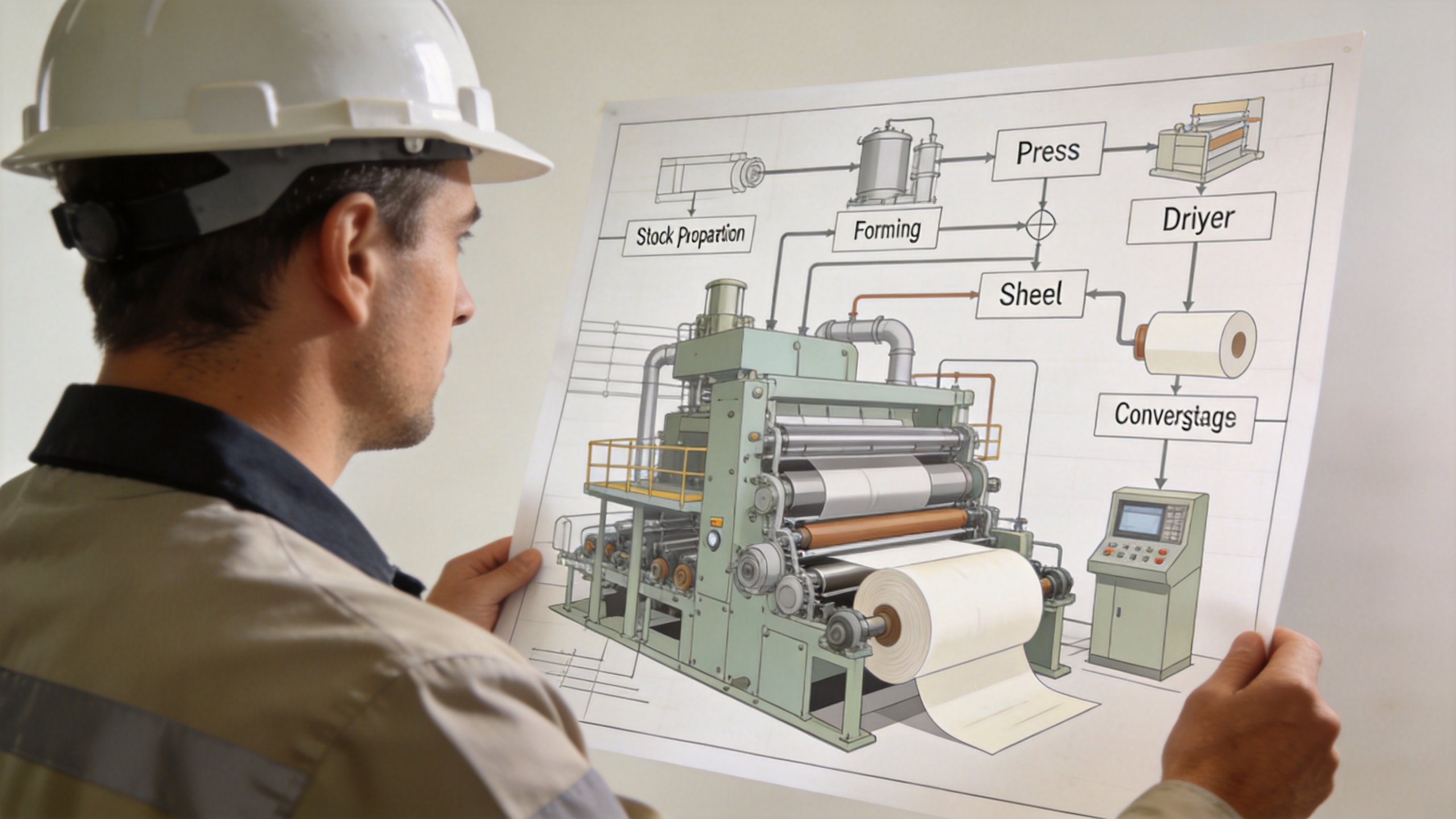
A conventional paper making machine route typically moves from stock distribution and the headbox through forming, pressing, drying, finishing, and reel handling. Each section has a different job, so each deserves a different acceptance question.
| Line area | What to confirm | Why it matters |
|---|---|---|
| Approach flow and headbox | Furnish consistency, flow control, cleanliness, and grade-change needs | These conditions influence sheet formation and stability. |
| Forming section | Target basis-weight range, drainage behavior, and sheet-support arrangement | Formation and runnability begin here. |
| Press section | Dewatering path, felt plan, access, and grade-specific operating window | Mechanical water removal affects the drying load. |
| Drying and ventilation | Steam, condensate, hood, heat recovery, and moisture-control interfaces | Utilities and control strategy shape energy use and final moisture consistency. |
| Calender, reel, and conversion interface | Finish target, winding quality, reel dimensions, and handoff requirements | The machine must deliver a reel that downstream equipment can use. |
The exact scope changes by grade. For example, a tissue paper machine may use a different forming and drying concept from a board machine. Rather than specifying a feature because it appears in a brochure, ask the supplier to explain which customer requirement it addresses and what conditions limit its benefit.
Check utilities, civil readiness, and maintenance before comparing price
Utilities often decide whether a technically suitable paper making machine can be commissioned on schedule. Build a site-readiness list for electrical supply, steam, condensate return, water treatment, compressed air, vacuum, ventilation, drainage, foundations, lifting access, and spare-parts storage. Also identify the interfaces that remain the mill’s responsibility and the interfaces included in the supplier’s scope.
Compare total ownership requirements alongside the initial quotation. This means planned consumables, critical spares, training, remote support boundaries, routine inspection access, and the skills needed to maintain controls and mechanical systems. A lower entry price can be difficult to defend if it produces unclear acceptance conditions or a maintenance burden the site cannot support.
Use automation to make the process repeatable
Automation should be judged by the operating decisions it makes easier, not by the number of screens. Ask how the controls support recipe management, grade changes, process alarms, trend review, quality records, and operator permissions. A mill with frequent grade changes may value repeatable settings and guided checks; a mill with a stable single grade may prioritize reliable measurement and straightforward recovery after an upset.
Request a clear division between supplied controls, site instruments, utilities signals, and any integration with converting or plant systems. The goal is a manageable operating workflow. More automation is useful only when the mill has the data, maintenance discipline, and training to sustain it.
Make acceptance testing part of the purchase decision
Do not leave performance verification until installation. Define a factory acceptance test and site acceptance test early, including the agreed product, furnish, utilities, measurement method, run duration, quality criteria, exclusions, training deliverables, documentation, and remedy process. Where the paper grade or furnish is new, agree what must be trialled and which assumptions require validation.
A practical selection package for any paper making machine should therefore include a requirement brief, a line-balance worksheet, a utilities matrix, a scope boundary list, and an acceptance-test protocol. These documents make quotations comparable and give engineering, production, maintenance, and procurement teams a common decision record.
Final selection checklist
- Confirm the finished-paper grade and downstream reel or converting requirement.
- Compare each proposal using identical width, basis-weight, uptime, and operating-hour assumptions.
- Validate furnish compatibility and identify trials needed for the intended quality target.
- Review every line section, from stock preparation to reel handoff, against the mill’s actual scope.
- Verify utility capacity, civil interfaces, controls, maintenance access, training, and critical spares.
- Put test conditions and acceptance criteria into the commercial and technical agreement.
The right paper making machine is the one whose configuration, operating assumptions, and support scope can be verified against your mill’s product plan. By making those conditions explicit before purchase, teams can compare options on long-term fit rather than on a headline speed or a single price.
 ONLINE