
 EN

Paper Making Machine Applications in Industry
A paper making machine is more usefully understood as part of a production system rather than as one interchangeable piece of equipment. It turns prepared fibre stock into a continuous paper web, but the right configuration depends on the grade being made, the fibre mix, the required surface and strength properties, and what happens after the reel. For a B2B buyer, that distinction matters: an industrial line for packaging paper has a different job from a compact tissue-focused setup, and neither should be confused with downstream converting equipment.
This article maps the main industrial applications of a paper making machine and the questions that help teams match a line to their process. The objective is not to promise a universal configuration. It is to make the application, the operating conditions, and the verification points visible before a specification is compared.
What a paper making machine does in an industrial line
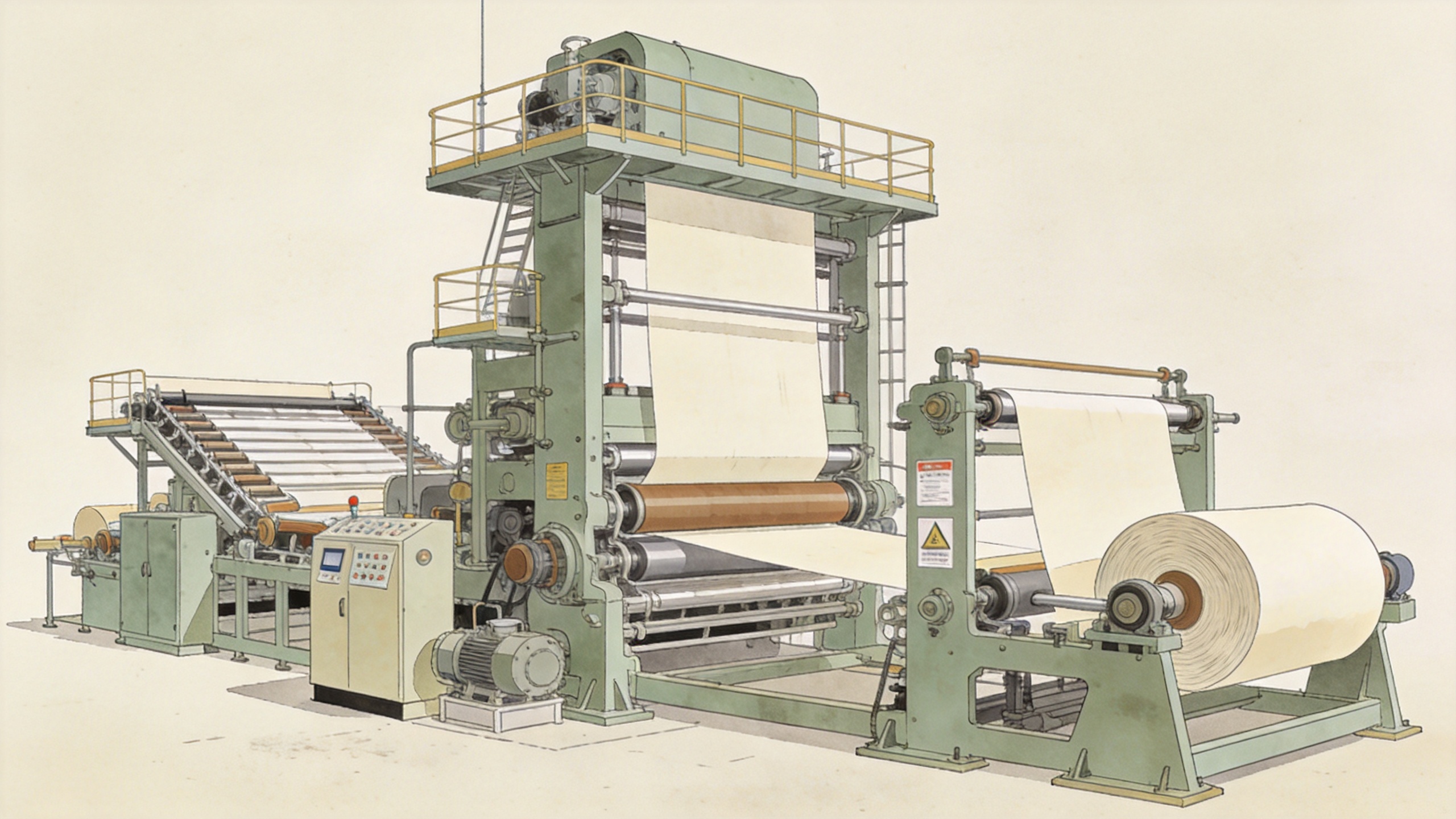
At its core, a paper making machine forms a fibre-and-water suspension into a continuous sheet, removes water, dries the web, and winds it for subsequent handling. Typical process sections include the forming or wet end, press section, dryer section, calendering where a finish is required, and the reel. Stock preparation and utilities sit around those sections and can be just as important to stable operation.
Each section influences the next. Formation affects sheet uniformity; pressing reduces water mechanically before thermal drying; drying brings the web to its target condition; and calendering can change smoothness and thickness. A line should therefore be evaluated as a connected process. Looking only at a nameplate speed or a single component can hide a mismatch in furnish, drying capacity, finishing, or reel handling.
Packaging paper and board applications
Packaging grades are one of the broadest applications for a paper making machine. Depending on the product, the line may be designed around strength, basis-weight control, printability, stiffness, or a combination of these requirements. Corrugating medium, liner-type papers, cartonboard, and other packaging substrates do not all impose the same demands on stock preparation, forming, pressing, or finishing.
For teams planning packaging output, begin with the end use: Will the sheet be converted into boxes, food-contact packaging, bags, or protective wraps? Then document the target grade range, furnish, required surface characteristics, trim width, and the downstream conversion process. Material variation deserves attention as well. A line that is workable with one furnish may require different refining, drainage, or drying decisions when the fibre mix changes.
It is also useful to separate paper production from paper converting. The paper making machine produces the parent web or reel; cutting, coating, printing, die-cutting, or forming may be separate operations. This boundary helps buyers avoid treating an entire packaging workflow as if it were supplied by one machine.
Tissue and hygiene-product applications
Tissue is another major application, but it illustrates why application language must be precise. A tissue paper making machine produces a parent roll with properties needed for the intended tissue grade. Finished toilet tissue, kitchen towels, and similar consumer products normally require converting operations after the parent roll is made. Those operations can include embossing, perforation, rewinding, cutting, and packaging.
Searches for a small toilet paper making machine often blend these two stages. Before comparing offers, clarify whether the need is for making tissue parent rolls, converting purchased jumbo rolls, or both. The answer changes the material flow, utilities, controls, space planning, and operator tasks. It also changes the acceptance criteria: a parent-roll line is assessed differently from a finished-roll converting line.
For tissue projects, useful early questions include the desired softness and strength balance, the fibre source, target sheet format, parent-roll handling, and the intended converting sequence. If these conditions are not confirmed, an apparent capacity comparison may not be meaningful.
Printing, writing, and specialty-paper applications
Printing and writing grades make surface quality, formation, opacity, and runnability relevant considerations. A paper making machine for these applications may need a process route that supports controlled formation and an appropriate finish for the intended printing or writing use. Specialty papers add further constraints because their function may depend on a specific furnish, coating path, basis-weight window, porosity, or surface treatment.
The practical point is that the product definition must lead the conversation. Instead of asking only for a general paper machine, provide representative samples or a detailed grade brief where possible. Include the intended use, fibre inputs, target properties, expected grade changes, and downstream equipment. This gives technical and procurement teams a clearer basis for deciding which process sections need flexibility and which conditions should be validated through trials.
Recycled-fibre and circular-material applications
Industrial paper production can also be organized around recycled fibre. In this case, stock preparation and contamination management become part of the application decision, not an afterthought. The recoverable fibre stream, contaminant profile, cleanliness requirements, and target grade all affect what preparation and screening steps may be needed before the stock reaches the paper making machine.
It would be inaccurate to assume that one recycled-fibre setup suits every grade. Packaging papers, tissue-related grades, and specialty products can have different tolerance for furnish variation and different quality expectations. A useful project brief records incoming-material conditions, proposed cleaning stages, expected rejects handling, and the quality checks required at the reel. That approach turns a broad sustainability goal into process questions that can actually be reviewed.
Small-scale and development uses: define the boundary
The phrase home paper making machine may refer to educational, craft, pilot, or very small-batch equipment. Such use cases are not automatically comparable with an industrial paper making machine. Industrial lines are evaluated around sustained production, process integration, safety planning, maintenance access, utilities, and consistent output under defined conditions. A home or demonstration setup may instead prioritize learnability, compactness, or manual involvement.
That distinction is valuable even for industrial buyers. Pilot and development work can help teams explore materials or product concepts, while a production line must be specified around repeatable operation. Do not use a small-scale reference as evidence of industrial throughput or quality performance. Define the required operating model first, then compare equipment within that scope.
How to match the machine to the application
A reliable evaluation starts with the application and works back through the line. From a procurement perspective, the following checklist helps separate useful comparisons from generic ones:
- Define the product: state the paper or board grade, intended end use, target property range, and whether multiple grades are planned.
- Describe the furnish: identify virgin, recycled, or mixed fibre inputs and the expected variability that the process must manage.
- Map the process boundary: distinguish stock preparation, paper making, finishing, and downstream converting or packaging.
- Set operating conditions: document target production rhythm, changeover needs, utility constraints, available floor space, and operator capability.
- Agree verification criteria: list the samples, trials, quality checks, documentation, training, and acceptance conditions required before final selection.
This sequence supports better technical discussions because it moves the decision from a catalogue comparison to a condition-based review. If flexibility and output are both priorities, write down the trade-off rather than assuming that the highest stated speed is automatically the right answer.
Questions to resolve before requesting a proposal
Before a supplier is asked for a detailed solution, consolidate the information that shapes a viable configuration. The most useful questions are usually practical: What product grades will run first? How often will they change? Which fibre sources and material tests are available? Which finishing steps are in scope? What service access, spare-parts plan, and operator training are needed? And what must be demonstrated during acceptance?
These questions also protect against a common mistake: treating a quotation as the full project scope. Installation boundaries, utilities, material trials, downstream interfaces, and maintenance planning can materially affect whether a paper making machine fits the intended operation. The final configuration should follow a technical review of the documented conditions, not a generic promise.
Conclusion
Paper making machines serve packaging, tissue, printing and writing, specialty, and recycled-fibre applications, but the machinery only makes sense when it is tied to a defined process and product. Start with the grade and end use, distinguish paper production from converting, and make the furnish, quality criteria, and acceptance conditions explicit. That creates a more credible basis for comparing a paper making machine and for deciding where a compact, pilot, or full industrial solution belongs in the wider workflow.
 ONLINE