
 EN

How Paper Production Machine Runs Smoothly?
A paper production machine runs smoothly when the whole line—not just one drive or forming station—stays in balance. Material condition, web tension, water removal, control settings, operator routines, and downstream handling all affect the result. From a maintenance-planning perspective, the useful question is not whether a paper production machine can run at its top nameplate speed. It is whether it can repeat stable production at the required grade, with manageable adjustments and clear checks when conditions change.
That distinction matters in a mill or a paper-packaging operation. A disposable paper production machine may have a different converting sequence from a pulp-to-sheet line, yet both depend on steady material feed, matched machine sections, and timely preventive work. When these basics are planned together, small deviations are easier to see before they become breaks, rejects, or unplanned stops.
Start with a stable process, not a speed target
The first job of a paper production machine is to turn a variable raw material into a controlled process. For a traditional paper web, that begins with reasonably consistent furnish preparation and stock delivery. For a converting-oriented application, it begins with paper-roll quality, roll loading, registration, and the material path through forming or packaging equipment. In either case, the paper production machine needs a defined operating window: the material specification, moisture or stock condition where relevant, target output, acceptable product variation, and changeover rules.
A common mistake is to treat a short-term speed increase as proof of smooth operation. More accurately, a paper production machine is running well when operators can hold the intended settings without constant correction. If a line needs frequent tension changes, heat adjustments, or manual clearing, the root cause may be upstream material variation, a worn component, or poor synchronization—not simply an operator setting.
Keep material flow and web tension predictable
On a continuous line, the paper production machine depends on a stable handoff from one section to the next. The forming zone establishes the web or product shape; pressing, drying, coating, printing, converting, or packing stages then add their own requirements. Each stage must receive material at a rate it can handle. A mismatch can show up as wrinkles, edge damage, unstable tracking, jams, or inconsistent finished pieces.
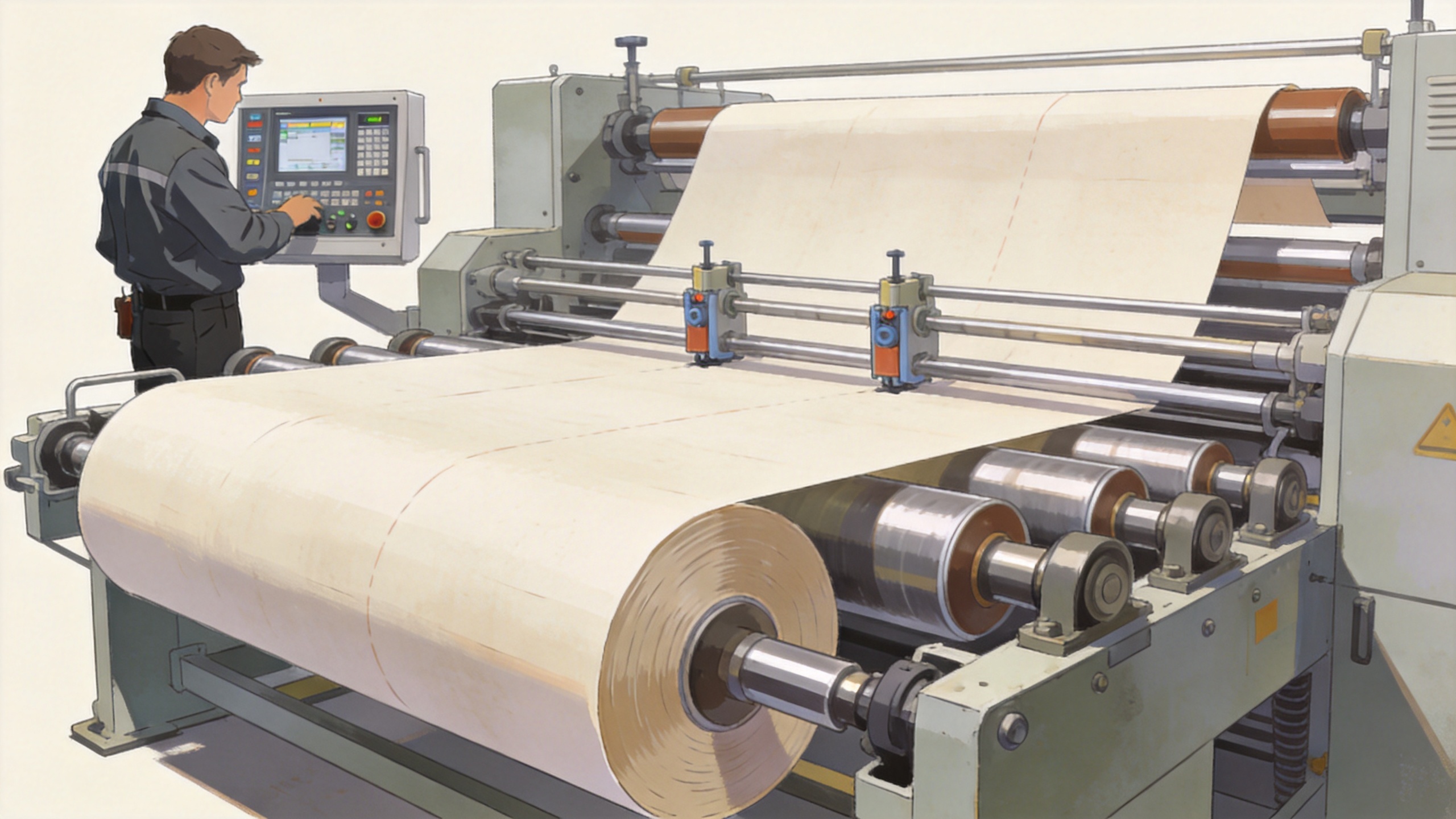
For web-based processes, check the practical basics: roll alignment, guide response, tension feedback, nip condition, and the cleanliness of contact surfaces. In the press section of a paper machine, water removal and felt condition are especially relevant because press felts help carry water away from the web. That is why a paper production machine should not be judged only by the final reel or stack. Tracking recurring issues by section makes the next inspection more focused.
For a disposable paper production machine, material feeding and tooling timing deserve the same attention. Paper blanks or rolls must arrive consistently, while forming, sealing, and discharge actions must stay coordinated. The same principle applies when an automatic paper cup packaging machine is connected after cup forming: downstream accumulation, counting, and packing should not force irregular starts and stops upstream.
Use preventive maintenance to protect the running window
Preventive work gives a paper production machine a better chance of staying inside its operating window. A practical maintenance plan combines routine observation with planned inspection. Operators can look for noise, vibration, abnormal heat, leaks, tracking drift, buildup, loose fasteners, and changes in product appearance. Maintenance staff can then schedule deeper checks before a small symptom becomes a line interruption.
Roll maintenance commonly includes alignment, balancing, surface condition, and lubrication review. These are not isolated tasks: an alignment issue can influence tracking, tension, bearing load, and web quality at the same time. For that reason, a paper production machine benefits from records that connect a symptom to the section, material grade, shift condition, and corrective action. A repeated pattern is more useful than a one-off repair note.
Lubrication should follow the equipment supplier’s interval and lubricant guidance rather than a generic rule. Too little, too much, or contaminated lubricant can all create problems. Likewise, cleaning plans should focus on locations where dust, coating residue, adhesive, or paper debris can alter sensing, traction, sealing, or discharge. A clean machine is not automatically a stable machine, but it makes abnormal conditions easier to identify.
Make controls useful for operators
A paper production machine with automation still needs an understandable operating routine. Sensors, drives, temperature controls, tension systems, and alarms can help stabilize the process only when their limits are set for the actual material and product. Before a new grade, roll source, cup size, or packaging format is introduced, document the settings that are expected to change and the checks needed after the changeover.
Operators should also know which alarms require an immediate stop, which call for a controlled adjustment, and which need maintenance support. This reduces the temptation to override a warning without understanding it. In a paper production machine, a safe escalation path often protects both uptime and product consistency.
Coordinate upstream and downstream equipment
Smooth production is an end-to-end condition. Upstream preparation must supply material at a consistent rate, and downstream equipment must accept it without creating back pressure. If a paper production machine feeds a finishing line, rewinder, stacker, or automatic paper cup packaging machine, review the transfer point during normal production and during brief interruptions. Buffer capacity, sensor placement, and restart logic often determine whether a minor downstream pause becomes an upstream jam.
This is also where maintenance planning shifts from single-machine thinking to line thinking. Instead of asking only whether one station is available, ask whether its condition causes the next station to compensate. The paper production machine may appear to run, while the line is quietly losing stability through repeated corrections and short stops.
Build a simple daily-to-monthly routine
A workable routine for a paper production machine does not need to be complicated. It needs ownership and consistent records.
- Each shift: verify material condition, guards, guides, alarms, unusual sound, visible buildup, and product appearance.
- Weekly: review lubrication points, tension and tracking behavior, fasteners, wear parts, and recurring stop reasons.
- Monthly or at planned intervals: inspect alignment, drive condition, sensors, tooling, bearings, rolls, and control calibration according to the equipment plan.
- After changeovers: compare the first acceptable output with the agreed process settings and note adjustments for the next run.
The intervals should be adapted to the actual machine design, duty cycle, and supplier documentation. What matters is closing the loop: observe, record, correct, and verify. If the same fault returns, review the underlying condition rather than only resetting the machine.
Conclusion
A paper production machine runs smoothly when material, mechanics, controls, and people work to the same operating plan. Stable feed and tension, clean and aligned components, sensible preventive maintenance, clear alarm responses, and compatible downstream handling all support reliable production. For a disposable paper production machine or a line linked to an automatic paper cup packaging machine, confirm the real material, format, changeover frequency, and line interfaces before deciding which controls and maintenance tasks deserve the closest attention.
 ONLINE