
 EN

Paper Production Machine Market Trends
The market conversation around a paper production machine is changing from “How fast can it run?” to “How reliably can the whole line turn the intended fiber mix into saleable paper?” That is a useful shift for mill teams, converters, and project buyers. A headline speed is easy to compare; the conditions behind stable output are not. They include furnish quality, stock preparation, moisture control, automation, operator routines, energy use, and the downstream process that receives the reel.
From a B2B purchasing perspective, the most practical trends are not slogans. They are the changes that alter a project brief: more demand for measurable uptime, more attention to resource losses, more interest in flexible grades, and more scrutiny of whether an alternative-fiber plan has been tested. This article separates those decisions from the broader—and often confusing—market language around paper machinery.
First, define which market a paper production machine serves
A paper production machine can mean a pulp-to-sheet line, but search results for the term also blend in tissue rewinding, thermal-roll equipment, paper cups, and other converting applications. Those are related markets, yet their investment logic differs. A forming section, press section, dryer section, winding system, and stock-preparation train are evaluated as a process chain. A downstream converter is usually evaluated around format, cycle time, tooling, and finished-packaging requirements.
Before comparing suppliers or forecasts, write down the intended product: grade, basis-weight range, roll or sheet destination, planned furnish, and the limiting step in the current operation. If the project is actually a converter, a paper-production-line comparison may produce the wrong questions. If it is a mill-scale line, a single-machine comparison can hide the parts of the process that constrain output.
Trend 1: Automation is moving toward operating consistency
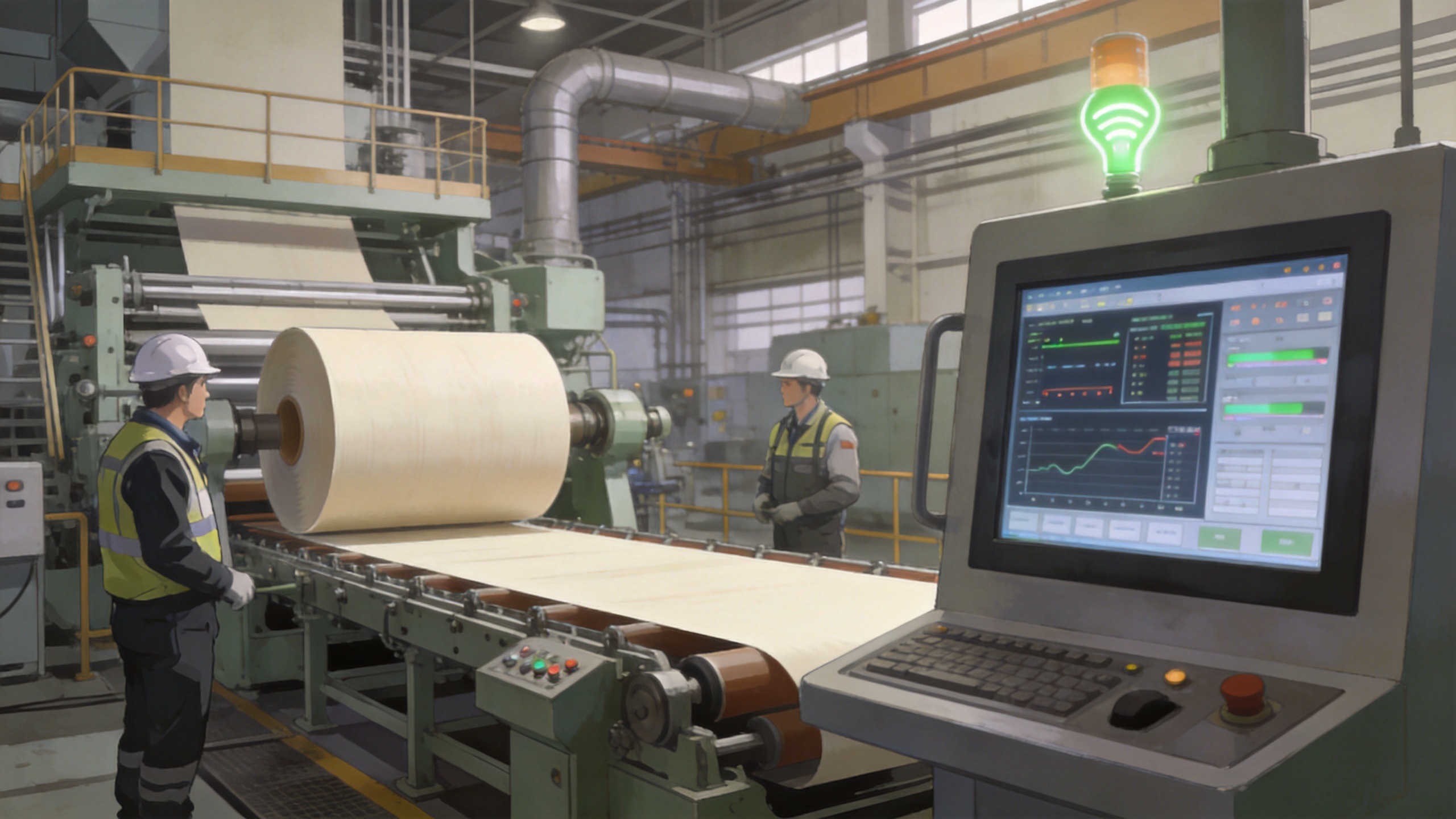
Automation remains a visible market theme, but the useful question is not simply whether a paper production machine has a modern control system. Buyers increasingly ask what the controls help people verify and act on: approach-flow stability, moisture variation, breaks, roll quality, alarms, recipe changes, and maintenance priorities. A dashboard does not remove process variation by itself. It makes the variation easier to see, discuss, and respond to when the underlying instruments and operating practices support it.
For an upgrade project, define a small set of decisions that automation must improve. Examples include identifying repeat break patterns, keeping grade-change settings traceable, or showing when a deviation originated upstream rather than at the reel. That approach is more useful than requesting every available feature. It also makes factory acceptance and site acceptance discussions clearer.
Trend 2: Resource efficiency is becoming an uptime question
Energy, steam, fresh water, and fiber losses have long mattered in papermaking. The current trend is to treat them alongside availability rather than as a separate sustainability checklist. Industry materials on capacity rebuilds commonly emphasize fewer breaks, shorter break duration, and tighter management of electricity, steam, water, and raw materials. The exact improvement potential depends on the line and must be validated locally, but the decision logic is sound: a paper production machine that reduces avoidable losses can protect both cost control and production rhythm.
During an inquiry, ask suppliers to explain the measurement boundary behind any efficiency statement. Which section is included? Which grade and furnish were used? Are planned stops excluded? What utilities are being measured? This does not require a supplier to promise a savings figure. It gives the project team a basis for comparing proposals without turning a general claim into a site-specific guarantee.
Trend 3: Flexible furnish increases the value of stock-preparation discipline
Recycled fiber, grade changes, and interest in agricultural residues are driving more attention to fiber handling before the web reaches the machine. The trend is not that every mill should switch to a new furnish. It is that a paper production machine project needs a more explicit material-validation plan. Screening, cleaning, refining, consistency control, drainage behavior, and finished-paper targets should be reviewed together.
The auxiliary term rice straw paper making machine reflects this interest in alternative fibers. Rice straw can be a potential feedstock, but it should not be treated as a drop-in substitute for every product. Published research discusses its relatively short fiber length and the possible implications for strength properties. For a real project, the better next step is to define the intended grade, blending strategy, contaminant control, chemical program, and trial criteria before selecting equipment changes.
Trend 4: Specialty surfaces need a different market conversation
Some search demand points toward niche applications such as an emery paper machine. That term should not be folded into general paper-production claims. Abrasive paper relies on a specific backing, coating, and converting context; the relevant questions may center on substrate consistency, coating compatibility, winding behavior, and downstream quality control. It is a reminder that “paper market trends” should be translated into the product requirements of the target segment, not copied across unrelated grades.
For specialty work, the purchasing team should list the finished product’s critical properties first. Then trace each property back through the process: furnish, sheet formation, drying, surface preparation, reels, and converting interface. This reverse path often reveals whether the next investment belongs in the base-paper line, the coating/converting stage, or the quality-control system.
Trend 5: Rebuilds compete with greenfield projects on a clearer basis
Market discussions sometimes frame the choice as old equipment versus a new paper production machine. In practice, a rebuild can be appropriate when the bottleneck is identifiable and the supporting sections can accommodate the change. A greenfield line may make more sense when product requirements, capacity goals, utilities, layout, or operating model have moved beyond the existing platform. Neither route is automatically lower risk.
Compare options using the same evidence sheet: target grade mix, verified bottleneck, planned output range, downtime window, civil and utility constraints, spare-parts strategy, controls integration, operator training, and acceptance criteria. More accurately, do not compare a new-machine nameplate figure with a rebuild’s historical average. Compare each option under documented operating conditions.
A practical checklist for reading market trends
- Start with the product: state the grade, furnish, and finished format before using broad market labels.
- Separate line performance from component claims: assess the interaction among stock preparation, forming, press, dryer, winding, and downstream handling.
- Request conditions, not promises: ask how speed, efficiency, quality, and utility figures were measured.
- Plan trials for nonstandard fiber: define blend limits and acceptance tests before committing to an alternative-fiber configuration.
- Make uptime visible: include break causes, changeover behavior, maintenance access, and operator response in the investment case.
- Keep scope honest: distinguish a paper machine, a specialty process, and a converting machine so the supplier comparison stays relevant.
What these trends mean for buyers
The strongest paper production machine market trend is a more disciplined purchasing process. Buyers are connecting automation to operating decisions, resource efficiency to avoidable losses, and alternative fibers to validation rather than assumptions. That does not eliminate uncertainty. It gives engineering, operations, and procurement a shared way to document it.
For the next project review, build a one-page brief that names the target product, the current constraint, the proposed measurement method, the fiber assumptions, and the acceptance conditions. With those items in place, market trends become useful inputs to a decision—not a substitute for one.
 ONLINE