
 EN

How Plants Utilize Machine For Paper Cup Production?
A machine for paper cup production is rarely a stand-alone answer to a plant’s needs. In a working factory, it sits between material preparation, print control, blank handling, inspection, and packing. A buyer gets a clearer basis for comparison when the line is viewed as a connected system rather than as a single machine.
From an operations viewpoint, the important question is not simply whether a machine for paper cup production can form a cup. It is whether the machine, paperboard, coating, tooling, staffing, and quality checks can run together at the required rhythm. That distinction becomes especially important when a plant produces more than one cup size or uses printed stock.
Start with the product specification, not the machine rating
Before choosing a machine for paper cup production, plants normally define the cup’s size, shape, intended contents, paperboard, barrier treatment, artwork, and packing format. These inputs influence tooling, feeding, heating or sealing settings, and the inspection plan. A published output rate can be useful for comparison, but it is not a production promise unless the cup specification and trial conditions are known.
For food-contact applications, the material conversation should include the destination market and intended use. For example, US requirements include provisions for paper and paperboard that contact aqueous or fatty foods under 21 CFR 176.170. That reference does not certify a finished cup by itself; it reinforces the need to confirm the applicable material documentation, coatings, inks, and customer requirements for the actual market.
How printed stock enters the paper-cup line
When branded cups are required, a flexo printing press may be positioned upstream of the forming area. It applies artwork to suitable paper stock before the stock is converted into blanks. The plant should verify artwork version, color consistency, registration, and the position of the future side seam. A small registration issue can become highly visible after forming, so printing inspection belongs in the production plan rather than at the end of it.
The printed material is then cut into sidewall blanks and bottom pieces. This handoff deserves a practical checkpoint. Operators need to confirm that blank dimensions, cut edges, and stacking quality suit the feeding system of the machine for paper cup production. Poorly prepared blanks can create feeding interruptions that look like a machine fault but actually began earlier in the workflow.
What the machine does during cup forming
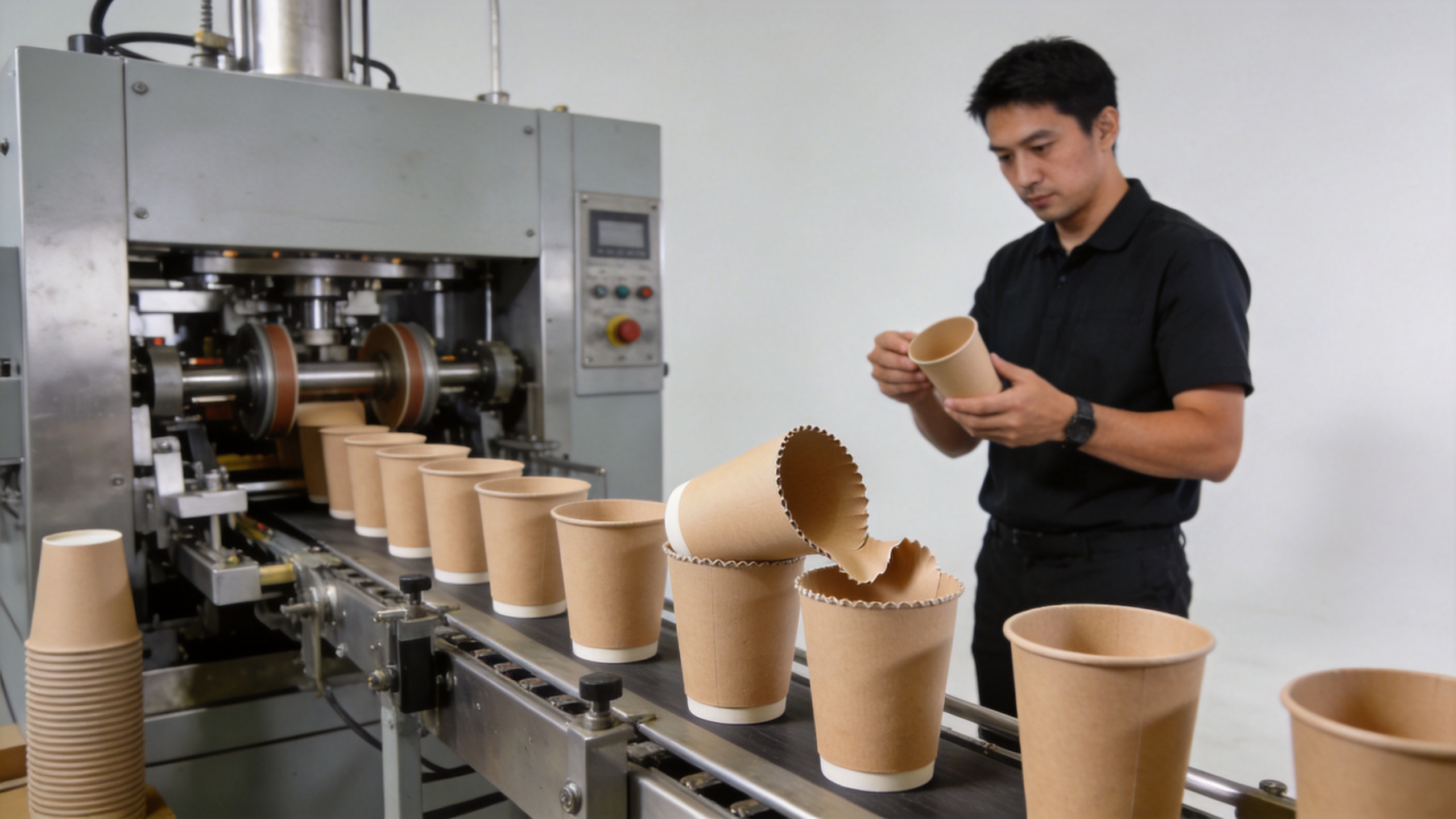
At the forming station, the machine for paper cup production turns prepared material into a cup through a sequence of controlled motions. The sidewall blank is wrapped and joined, a bottom piece is introduced, and the base is secured by the machine’s forming and knurling actions. The rim is then curled to create a safer, more rigid drinking edge. The exact arrangement varies by design, but the core production logic is consistent: the material must arrive in the correct orientation, be formed consistently, and leave the station without damage.
A machine for paper cup production therefore depends on more than its mechanical cycle. Paperboard stiffness, coating behavior, blank accuracy, tool condition, heating or sealing settings, and operator adjustments all affect the result. If a cup leaks, loses shape, or has an uneven rim, the investigation should trace the problem through material, preparation, forming, and handling instead of assuming that one setting is responsible.
Where a plate and cup making machine fits
The term plate and cup making machine is sometimes used broadly when buyers are exploring disposable food-packaging equipment. In practice, plates and cups can require different tooling, material formats, forming methods, and quality criteria. A plant evaluating a plate and cup making machine should separate the product families in its requirements list: target dimensions, material construction, output rhythm, changeover frequency, and packing expectations all need individual review.
That review prevents an over-simplified comparison. A machine for paper cup production may be well suited to a defined cup specification, while a mixed product plan may call for separate equipment, additional tooling, or a different workflow. The productive next step is to supply samples, drawings, material information, and an expected production schedule for technical confirmation.
Build quality control into every stage
Reliable plants do not wait until shipping to inspect cups from a machine for paper cup production. Incoming checks can confirm paperboard and coating documentation. Printing checks can cover artwork, registration, color, and visible defects. During forming, operators can monitor side seams, bottom seals, rim curl, dimensions, cup shape, and intermittent defects. Final inspection can verify packing count, cleanliness, and shipment readiness.
The checks also give the team useful feedback. If a forming issue follows a material batch change, the team has a basis for reviewing stock and settings together. If print placement moves relative to the seam, the upstream conversion step can be reviewed. This is more actionable than relying only on a final reject count, and it helps the machine for paper cup production run within documented conditions.
Plan the line around real production rhythm
A plant should map how material enters, how operators replenish supplies, where rejected cups are collected, and how good cups reach packing. The machine for paper cup production may cycle continuously, but the line’s usable output can still be limited by blank availability, inspection capacity, changeovers, or packing delays. Space, utilities, maintenance access, and spare-parts planning should be discussed before installation.
For a flexo printing press, the same planning principle applies. Print jobs, drying conditions, stock handling, and changeovers should be coordinated with the forming schedule so that the forming area receives approved blanks rather than rushed material. A workable workflow is one that makes exceptions visible early.
A practical evaluation checklist
- Define the cup drawings, materials, coatings, artwork, and market requirements.
- Ask how the proposed machine for paper cup production handles the required blank and bottom format.
- Review trial conditions rather than treating a rated speed as a fixed output commitment.
- Confirm the inspection points for seams, bases, rims, dimensions, printing, and packing.
- Discuss tooling, changeover work, operator training, maintenance access, and spare parts.
- For a plate and cup making machine inquiry, separate plate and cup requirements before comparing configurations.
Conclusion
Plants utilize a machine for paper cup production most effectively when it is treated as one part of a verified process. Printing, blank preparation, forming, quality checks, and packing all influence the finished cup. By documenting the product specification and testing the complete workflow, a plant can make more informed equipment decisions and build a line that is easier to control over time.
For an equipment discussion, prepare cup samples, dimensions, paperboard and coating details, artwork needs, target markets, and expected operating schedule. Those details make it possible to evaluate a machine for paper cup production against the conditions that matter in the plant, rather than against a generic claim.
 ONLINE