
 EN

Introduction to Paper Cup Making Machinery Line
Buying or planning a paper cup making machinery line starts with a useful shift in perspective: it is not only a question of selecting one former. It is a question of matching cup design, paperboard construction, material handling, forming steps, inspection, and the daily production rhythm. From a packaging-equipment selection viewpoint, those conditions should be clear before a configuration discussion begins.
A line may be compact or include several upstream and downstream activities, but the decision logic is similar. The cup needs a body blank, a bottom blank, a forming sequence, reliable sealing, rim finishing, and a way to separate and check finished pieces. If the intended cup type and paper material are still open, a quoted output figure alone is not enough to define the right paper cup making machinery.
What a paper cup making machinery line does
In general, paper-cup production moves through paperboard preparation, printing or decoration where required, die cutting, cup-body forming, bottom insertion and sealing, rim curling, and inspection. The forming machine is the central station, yet it operates most consistently when surrounding material and handling steps support a consistent feed. A project may purchase pre-cut blanks from another supplier, for example, while another may plan printing and die cutting as part of the wider workflow.
That distinction matters. A forming unit can only process blanks that fit its tooling and operating method. Before comparing an industrial paper cup making machinery proposal, list the cup diameters, heights, capacities, sidewall shapes, paperboard grades, barrier coatings, and expected changeover pattern. This brief turns a broad equipment inquiry into a technical conversation with useful boundaries.
The core forming sequence
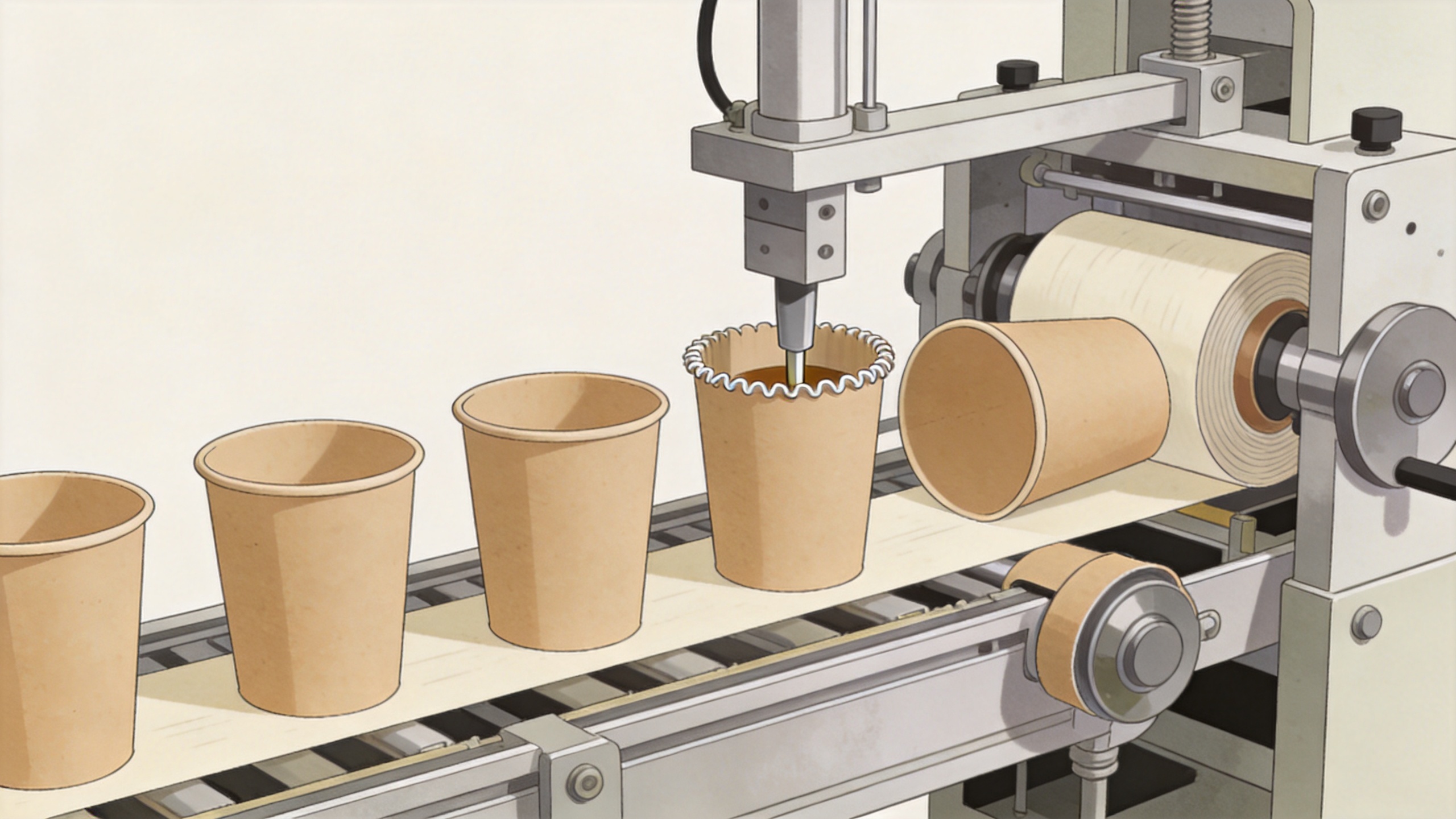
Although layouts differ, the basic path is easy to understand. Prepared sidewall blanks are fed into the machine and shaped around a forming tool. The side seam is joined according to the paper and coating system. A bottom blank is introduced, attached, and sealed; then the upper edge is curled to create a comfortable, stronger drinking rim. Finished cups are discharged for collection and inspection.
Each node affects the next one. A poor fit between blank geometry and tooling may show up as inconsistent body shape. Paperboard behavior, coating type, temperature control, and setup discipline can influence seam formation. In other words, a paper cup making machinery line should be reviewed as a connected process rather than as a list of isolated components. Not every issue comes from the machine itself; incoming materials and operating practices also need to be checked.
Line choices begin with the cup and paper
The most productive first questions are practical:
- Which cup sizes and shapes will be produced first?
- Will the line run one stable format or change formats regularly?
- What paperboard, barrier, and print treatment will the blanks use?
- How will blanks, bottoms, and finished cups move between work areas?
- What inspection points will be used for seams, bottom attachment, rim quality, and appearance?
These questions keep the discussion grounded. For a stable, high-volume format, the priority may be repeatable operating conditions and a straightforward material flow. For a converter that changes cup sizes often, tooling planning, adjustment steps, and operator clarity may carry more weight. A latest paper cup making machine may introduce updated controls or layouts, but “latest” is not a substitute for confirming compatibility with the actual cup program.
How to discuss capacity without oversimplifying it
Machine listings often emphasize pieces per minute. That number can be useful as a reference, but it is conditional. It can vary with cup geometry, paper characteristics, coating behavior, forming conditions, changeovers, operator routines, and the definition of acceptable output. A responsible comparison separates a stated machine capability from the production conditions needed to validate it.
Ask suppliers to explain the proposed test conditions and the acceptance method. For example, the project team can agree on the cup specification, approved material sample, run duration, visual checks, and criteria for seam and bottom quality. This approach changes the conversation from “What is the fastest number?” to “What result should this paper cup making machinery line demonstrate with our materials and cup design?”
Supporting equipment and workflow planning
Depending on the project boundary, supporting equipment may include blank preparation, printing, die cutting, conveying, collection, counting, packing, and material storage arrangements. These functions do not need to sit in one physical line to be part of one operating plan. What matters is that their handoffs are clear: who checks blank quality, where material waits, how finished cups are protected, and how operators respond when a forming issue appears.
For an industrial paper cup making machinery project, it is worth mapping the workflow before installation. Follow one batch from incoming paperboard through forming and final inspection. Note points where materials change hands, where a format change is made, and where a defect can be detected. This simple exercise often exposes questions that a specification sheet does not answer.
Food-contact and destination-market checks
Paper cups are commonly intended for food and beverage use, so equipment planning should connect with the material documentation required for the destination market. Regulation (EC) No 1935/2004 is one example of a general food-contact framework in the European context. It does not mean that every machine or cup automatically meets every market requirement. The applicable materials, declarations, test evidence, labeling, and responsibilities should be verified for the specific project and destination.
This is especially important when paperboard, coatings, inks, adhesives, or cup use conditions change. The machinery supplier, material supplier, converter, and buyer may each hold different information. Put document responsibilities and verification steps into the project plan rather than treating compliance as a generic equipment feature.
A practical inquiry checklist
- Describe the planned cup range, including size, shape, and intended use.
- Provide paperboard and barrier details, plus sample blanks if available.
- State the expected production rhythm and likely changeover frequency.
- Ask how tooling, feed, forming, sealing, curling, and discharge relate to that cup program.
- Agree on a test and acceptance approach that uses defined materials and observable quality criteria.
- Clarify operator training, routine inspection, wear-part planning, installation scope, and support communication.
Start with a line-level conversation
An introduction to paper cup making machinery is most useful when it leads to better questions, not a rushed purchase. Begin with the cup, the paper, and the required production rhythm. Then examine how each process node supports the next, where quality will be checked, and which details need to be validated during testing. ZheJiang RUIDA Machinery focuses on paper-cup and food-packaging equipment discussions and can use this type of requirement list to structure an initial technical exchange.
If your project is still at an early stage, write down the cup specification and material assumptions first. That makes it easier to assess whether an industrial paper cup making machinery configuration is appropriate and what further information is needed before an order is finalized.
 ONLINE