
 EN

Unveiling New Paper Glass Machine Engineering
When buyers discuss a paper glass machine, the first question is often about output speed. That matters, but it is not where reliable engineering starts. A disposable paper glass is a formed package: paper stock, barrier coating, blank geometry, side-seam method, bottom curl, and collection rhythm all have to work together. From a packaging-equipment technical-selection perspective, the useful sequence is to confirm the cup specification and material first, then review the forming configuration, and only then compare the stated production rate.
For converters serving cafés, beverage brands, events, or takeaway channels, a new paper glass machine should be evaluated as part of a repeatable process, not as an isolated piece of hardware. ZheJiang RUIDA Machinery Co.,Ltd works in automatic paper cup machinery and food-packaging equipment, so the questions below are designed to make early technical conversations clearer. They are not a substitute for a sample trial, a material review, or an agreed acceptance plan.
Start with the cup, not the nameplate speed
“Paper glass” can describe several disposable drink-cup formats. A cold-drink cup may have different stiffness, rim, bottom, and coating requirements than a hot-drink cup. That is why a cold drink paper glass machine discussion should begin with the finished cup and the supply material rather than a generic capacity figure.
- Capacity and profile: confirm the target volume, top and bottom diameter, overall height, and taper.
- Paper stock: identify the board grade, thickness, print treatment, and barrier structure proposed for production.
- Coating and seam behavior: clarify whether the paper’s coating and seam design are suitable for the planned sealing method.
- Product use: distinguish cold beverages, ice-containing drinks, and short or longer holding periods, because these conditions affect the validation plan.
- Changeover need: define whether one cup format or several formats will be run, and how frequently tooling changes are expected.
This requirement-first approach avoids a familiar purchasing mistake: comparing two machines by nominal cups per minute when their quoted conditions are based on different cup blanks or different levels of operator intervention. If the paper stock and cup geometry are already confirmed, speed comparisons become more meaningful. If they are still open, a supplier should explain what needs testing before a firm production target is accepted.
How paper glass machine engineering connects each forming station
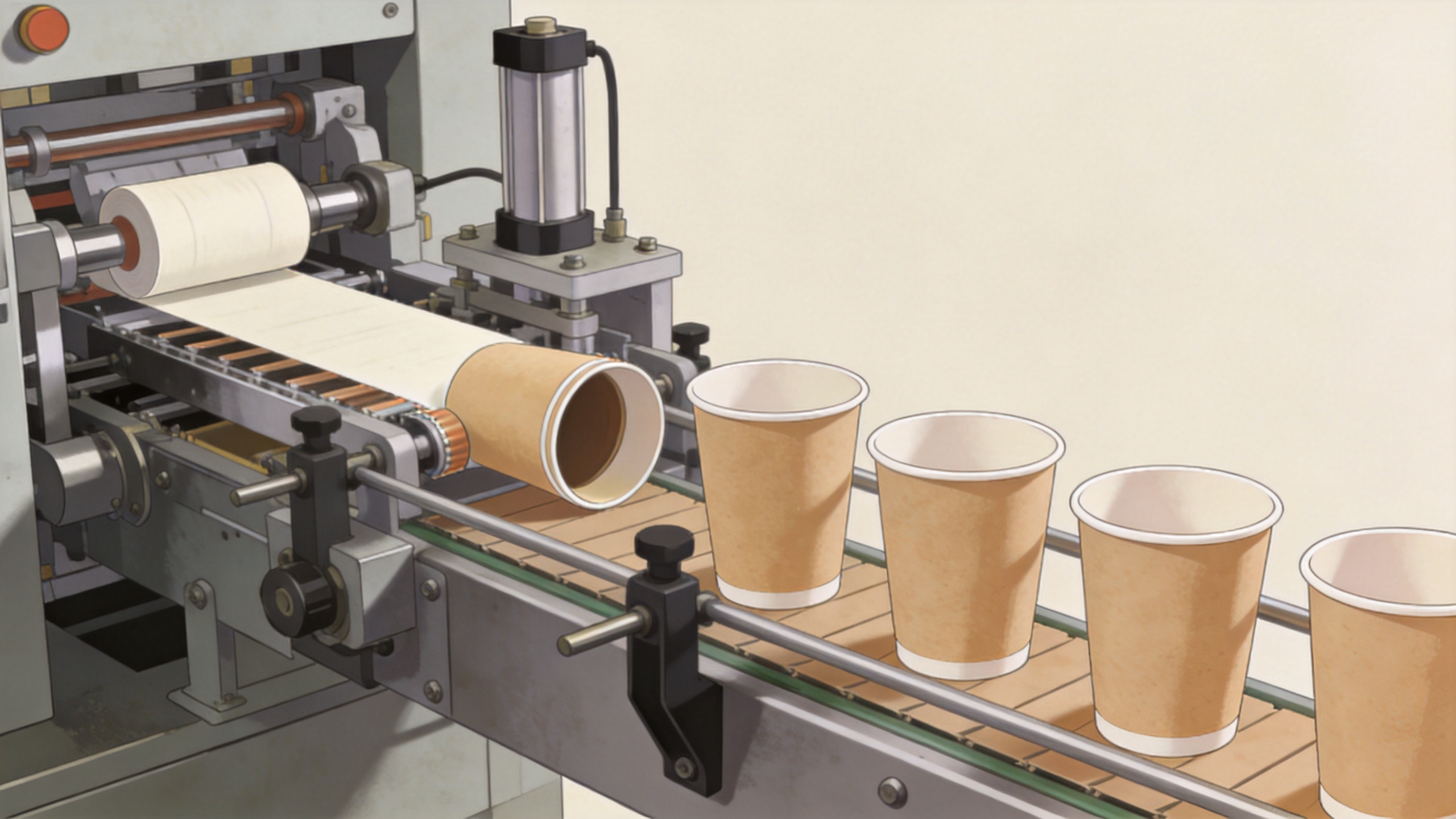
A paper glass machine typically coordinates blank feeding, side-seam preparation and sealing, cup-body forming, bottom insertion, bottom sealing, curling, and cup collection. The details vary by design, but the engineering objective is consistent: each station must deliver a stable input to the next one. A small variation in blank feeding or seam alignment can become a leak test failure or an inconsistent rim later in the line.
During a technical review, ask the supplier to map each station to a measurable quality check. For example, blank feeding can be linked to misfeed and orientation observations; side-seam work can be checked against seam appearance and leak performance; curling can be linked to rim consistency and stacking behavior. This does not require a buyer to prescribe the machine design. It gives both sides a shared language for defining what “stable production” should look like.
Why sealing deserves its own review
Sealing is not a generic checkbox. Technical literature and industry search results repeatedly point to sealing consistency as a key factor in liquid-tightness and finished appearance. The appropriate method depends on the paper construction, coating, seam arrangement, cup size, and run conditions. Conventional heating may be appropriate in one material setup, while an ultrasonic paper glass machine may be considered for another.
An ultrasonic paper glass machine uses high-frequency mechanical energy at the sealing interface. It can offer a fast bonding action, but it is not automatically the right answer for every blank. Buyers should request trials using the proposed production paper and print treatment, then review seam uniformity, visual finish, and leak-test results. Treat a statement about ultrasonic capability as a starting point for validation, not as proof that every coated stock will run identically.
Configure a cold drink paper glass machine around real operating conditions
A cold drink paper glass machine should be discussed in the context of condensation, ice, beverage temperature, handling, and the route from production to filling. A cup may look acceptable immediately after forming yet require additional checks after transport, stacking, or contact with a cold beverage. That is why the process team should agree on practical samples and test conditions before approval.
- Provide representative cup artwork and finished-dimension drawings.
- Share the intended paperboard and coating details, including any alternatives under consideration.
- Define the sample quantity and the inspection method for seams, bottoms, rim quality, and visual defects.
- Set a trial plan for the intended drink-use scenario, including any necessary liquid-hold or leak checks.
- Document what counts as an acceptable changeover when multiple cup formats are planned.
This checklist also makes quotation comparison more disciplined. A low initial price can be hard to compare if one proposal includes a clearer tooling scope, trial process, spare-parts discussion, or commissioning boundary than another. As a B2B buyer, it is sensible to compare total ownership questions alongside the headline equipment price: what needs to be confirmed, who supplies consumables, what training is included, and which acceptance conditions are written down?
Choose between thermal and ultrasonic sealing with evidence
The practical decision is not “new versus old technology.” It is whether the selected sealing method is compatible with the chosen blank and production objective. In an engineering review for a paper glass machine, ask for the conditions behind the recommendation:
| Question | Why it matters |
|---|---|
| Which paper and coating are being evaluated? | Material structure affects how a side seam and bottom seal respond during forming. |
| What cup sizes and shapes are included? | Geometry changes blank handling, bottom fit, and station timing. |
| What sample checks will be used? | Defined checks prevent vague claims about sealing quality. |
| What happens during a format change? | Changeover requirements influence tooling planning and operating rhythm. |
| Which results are acceptance criteria? | Written acceptance criteria keep production trials aligned with the purchase decision. |
For an ultrasonic paper glass machine, include the paper sample, seam design, and target cup appearance in that evidence set. For a thermally sealed configuration, ask the same question in a different form: how will the stated paper and coating be verified under the intended operating conditions? Both paths benefit from the same discipline—test the actual material, record the conditions, and agree on the quality outcome before scale-up.
Build food-contact documentation into procurement planning
Machine selection and food-contact compliance are related but different. The forming machine does not by itself make a cup compliant; the paperboard, coating, inks, adhesives where relevant, and finished-cup use all need to fit the rules of the destination market. Buyers should identify the market early and request the applicable material documents from their supply chain. A good paper glass machine project keeps this documentation work visible rather than leaving it until after tooling and samples are approved.
Ask the project team to maintain a short verification file containing the selected material specification, cup drawing, intended beverage use, sample-test records, and the destination-market documentation to be checked. This is especially useful when a cold-drink format, a revised barrier structure, or an ultrasonic-sealing option is being introduced. It provides a controlled handoff from technical evaluation to purchasing and production.
Turn a supplier discussion into a workable acceptance plan
Before releasing an order for a paper glass machine, convert the conversation into a simple acceptance plan. State the cup format, paper specification, planned sealing method, trial samples, inspection points, and responsible contacts. Then distinguish confirmed requirements from assumptions that still need a test. This makes the project easier to manage and prevents a general catalog description from being mistaken for a site-specific commitment.
RUIDA can support early technical communication for automatic paper cup and food-packaging equipment projects. When preparing an inquiry, bring the cup drawing, material information, intended beverage application, production target, and changeover expectations. With those inputs, the discussion can move from a broad search for a paper glass machine to a configuration and validation plan that is appropriate for the actual job.
 ONLINE