
 EN

What Buyers Note About Paper Production Machine?
Buying a paper production machine is less about finding the longest feature list and more about defining the job the line must do. The search term can describe very different equipment: stock preparation, a paper-making line that forms a web from fiber slurry, or downstream converting such as a toilet roll manufacturing machine. If those scopes are mixed in one request for quotation, the quotations may look comparable while covering entirely different work.
From a B2B buyer’s viewpoint, the useful question is not “Which paper production machine fits every situation?” It is “What must this equipment accept, produce, prove, and hand off at our site?” That framing makes technical discussions clearer and gives purchasing, operations, and maintenance teams a common checklist.
1. Start by fixing the production boundary
A complete paper process can include fiber preparation, pulping, cleaning, refining, forming, pressing, drying, winding, slitting, rewinding, and packaging. A supplier may use the phrase paper production machine for a single section or for a coordinated line. Before comparing capacity or price, write down where the supplier’s responsibility begins and ends.
- Input: virgin fiber, recovered fiber, prepared pulp, or parent rolls.
- Output: a paper web, jumbo roll, finished tissue roll, sheet, or another converted product.
- Included sections: stock preparation, paper machine, controls, drives, winding, converting, utilities, and packaging.
- Excluded interfaces: building services, pulp supply, wastewater handling, civil work, and downstream logistics.
This matters especially when a buyer is considering a pulp digester machine alongside a paper machine. A digester prepares pulp; it does not by itself make a saleable roll of paper. Likewise, a toilet roll manufacturing machine normally refers to a converting stage and may require parent rolls from an upstream source. Asking each supplier to mark the process boundary on a simple flow diagram prevents an expensive misunderstanding later.
2. Compare production claims with the actual operating conditions
Output figures are meaningful only with their conditions attached. When reviewing a paper production machine, request the operating window behind every quoted number. That means grade, basis weight or product specification, sheet or web width, furnish condition, moisture target where relevant, speed, shift pattern, and planned changeover frequency.
It is tempting to compare the highest stated speed. However, a line that reaches a peak speed under a narrow test condition may not be the right fit for a plant with frequent grade changes or limited operator coverage. More accurately, buyers should ask what stable production looks like after normal setup, cleaning, splice handling, and routine checks. This is not a request for a promised site result; it is a request to make the supplier’s assumptions visible.
3. Treat material compatibility as a purchasing requirement
Paper equipment is tied to material behavior. Fiber source, contamination level, additives, paper grade, and finished-product requirements can all change the required configuration. For a paper production machine, buyers should provide representative material information early and ask which items must be verified through trials, drawings, or samples.
| Buyer question | Why it changes the comparison |
|---|---|
| What material arrives at the line? | It affects preparation, cleaning, screening, and wear considerations. |
| What product leaves the line? | It determines whether the scope is paper-making, winding, or downstream converting. |
| How many grades or formats are planned? | It affects changeover procedures, tooling, controls, and training needs. |
| Which quality checks are required? | It defines what should be demonstrated during testing and commissioning. |
For tissue-related projects, terminology and test methods should be agreed rather than assumed. ISO 12625-1:2019 provides common vocabulary and general principles for tissue paper and tissue products, but buyers should confirm the applicable edition, product category, and any customer-specific test requirements for their own project.
4. Look beyond the machine body: controls, utilities, and maintenance
A paper production machine does not operate in isolation. Buyers commonly benefit from listing the required electrical supply, compressed air, water, steam or thermal systems, ventilation, drainage, consumables, and operator access before a final quotation is approved. The list should distinguish what the supplier provides from what the buyer must prepare.
Maintenance deserves the same attention as initial output. Ask for routine inspection points, recommended spare-parts categories, lubrication needs, access clearances, fault-alarm descriptions, and the skills expected of local operators. The lowest initial quotation can be misleading if basic service work requires difficult access, uncommon parts, or long stoppages. In other words, shift the discussion from a single purchase price to the practical cost of keeping the line ready for production.
5. Request a documented acceptance plan before shipment
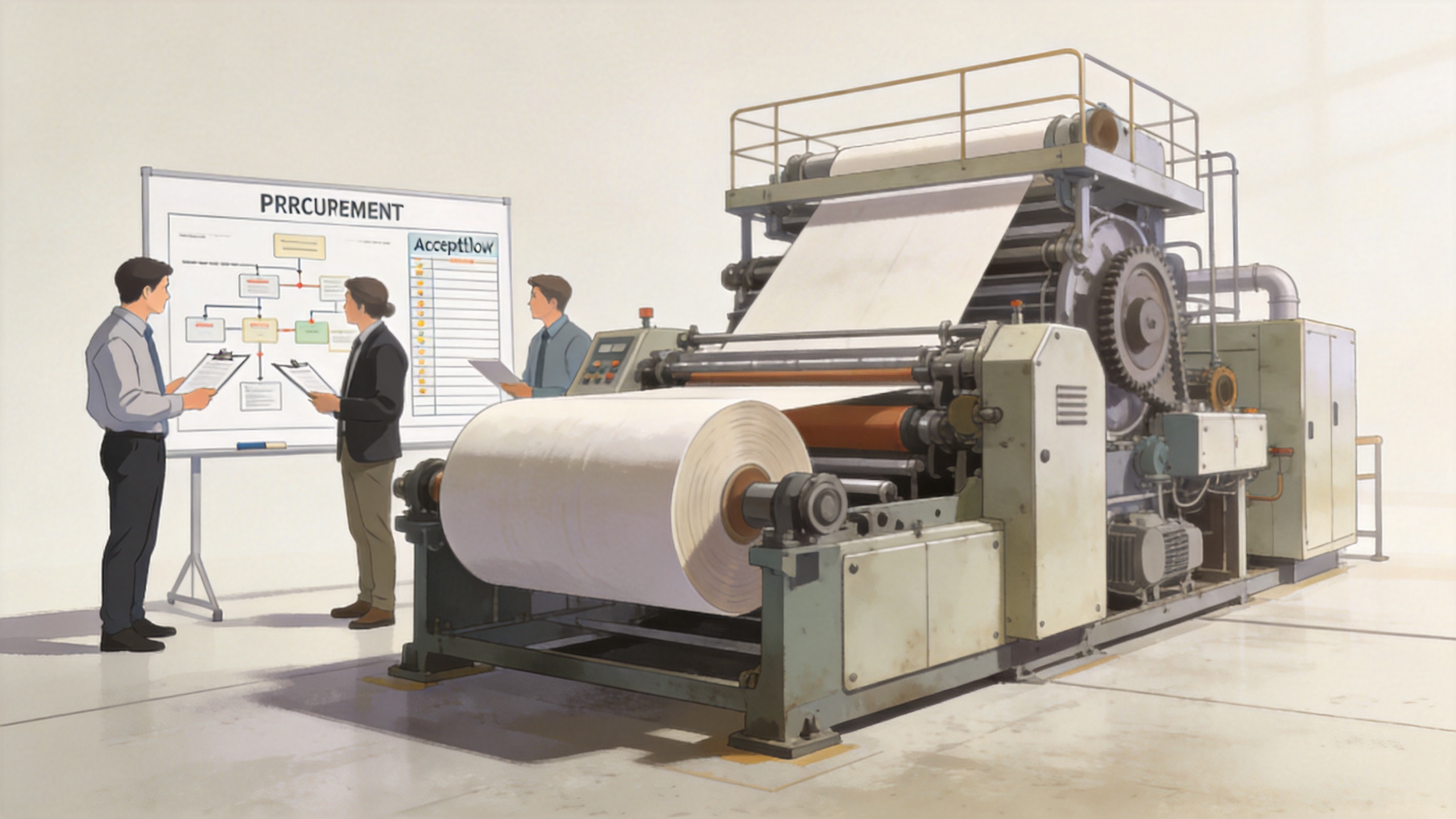
A strong buying process turns the specification into evidence. Factory acceptance testing is commonly used to check industrial equipment against the agreed purchase documents, technical specification, and confirmed configuration before delivery. For a paper production machine, the acceptance plan should say what will be inspected, what material or simulation will be used, what records will be provided, and which deviations require action.
- Freeze the agreed scope, drawings, component list, and control functions.
- List the functions that can be demonstrated at the factory and the items that must wait for site commissioning.
- Define measurements, tolerances, sample handling, and record formats in advance.
- Assign who may witness the test and who can approve a deviation.
- Link packing, manuals, spare parts, and training materials to the acceptance checklist.
Not every result can be duplicated before installation. Site utilities, incoming material, and local operating practices affect final performance. A useful acceptance plan therefore separates factory-verifiable functions from site-dependent targets instead of treating a short factory run as proof of every future operating condition.
6. Make quotations comparable on a total-cost basis
When two offers for a paper production machine differ, put both into the same comparison sheet. Include scope, delivery terms, commissioning support, consumables, recommended spare parts, training, controls, documentation language, warranty boundaries, and expected buyer-supplied utilities. This approach is particularly important when comparing a paper-making line with a toilet roll manufacturing machine or a pulp digester machine: the equipment may be connected in a broader project, yet they solve different parts of the process.
It also helps to ask suppliers to state open assumptions. A transparent “to be confirmed” list is often more useful than a polished proposal that silently assumes ideal material, uninterrupted utilities, or a production format that the buyer has not finalized.
7. A practical buyer checklist
- Can the supplier show the process boundary of the proposed paper production machine?
- Are input material and finished-product requirements documented?
- Do quoted outputs include the operating conditions and changeover assumptions?
- Are utilities, controls, safety interfaces, and buyer-supplied items clearly assigned?
- Does the quotation identify routine maintenance access and spare-parts needs?
- Is there a written factory and site acceptance plan with measurable records?
- Are the commercial comparison and technical comparison based on the same scope?
Final thought
Buyers get better information from a paper production machine supplier when they provide a precise process brief and ask for equally precise evidence in return. Start with the product and process boundary, test the material assumptions, and make acceptance criteria visible before equipment is shipped. That approach does not guarantee a particular output; it gives the project team a more reliable way to identify what must be verified before committing to a line.
 ONLINE