
 EN

What Drives Efficiency in Cup Machine Operations?
In a paper-cup plant, efficiency is not the speed printed on a brochure. It is the number of saleable cups that leave the line during planned production time, with predictable quality and without exhausting the people who run the equipment. For a production supervisor, the useful question is not “How fast can this cup machine run?” but “What lets this cup machine keep producing good cups at the planned rhythm?”
That distinction matters when a line makes multiple sizes, uses changing paper stocks, or needs frequent format changes. A double wall cup machine may add handling and forming considerations compared with a single-wall line. An ice cream cup machine may face its own format, stiffness, and application requirements. In each case, the most dependable gains usually come from controlling the operating conditions around the cup machine, not from chasing a short burst of maximum speed.
Use three measures to see where cup machine efficiency is lost
A practical starting point is the familiar OEE framework: availability, performance, and quality. Applied to a cup machine, availability asks whether the line was running when it was scheduled to run. Performance asks whether the cup machine held the planned cycle pace while it was running. Quality asks how many cups passed inspection the first time. Looking at all three prevents a high displayed speed from hiding stops, slow cycles, rejected cups, or rework.
- Availability: record planned time, breakdowns, material waits, setup, cleaning, and unplanned adjustments separately.
- Performance: compare actual output with the validated line rate for that cup size, paper grade, and tooling condition.
- Quality: track rim, side-seam, bottom-seam, shape, and print-alignment defects at the point where they first appear.
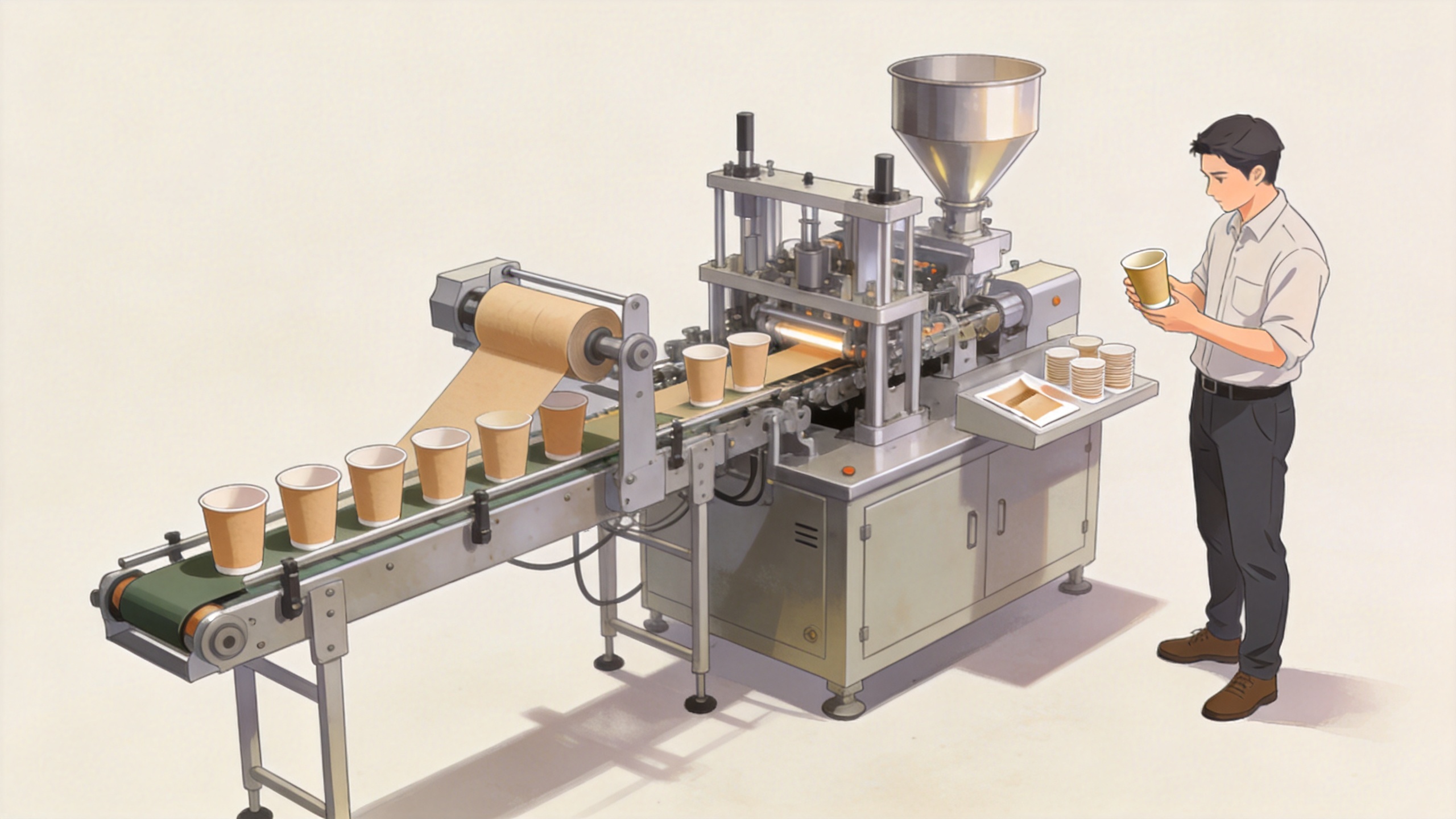
This does not require a complicated dashboard on day one. A shift log that distinguishes a five-minute paper-feed stop from a five-minute heater adjustment is more useful than a single “downtime” bucket. It helps the team see whether the cup machine itself needs attention or whether the loss began upstream in material preparation, tooling setup, or operator handoff.
1. Stable material feeding protects the cup machine rhythm
Paper blanks and rolls are part of the process, not just inputs. Variation in paper stiffness, moisture condition, cut accuracy, coating behavior, or blank orientation can change how a cup machine feeds, wraps, heats, and forms a bottom. When the material changes, operators often compensate with repeated small adjustments. Those micro-stops are easy to overlook, yet they reduce productive time across a shift.
Build a simple material-to-setting record for each proven job: cup size, paper specification supplied by the customer or mill, blank dimensions, relevant forming settings, and the first quality checks. The goal is not to assume that one setting works for every paper batch. It is to establish a controlled starting point, then document the adjustment if the line requires one. This is especially useful when a double wall cup machine has to coordinate inner and outer cup components.
2. Heating and forming conditions determine first-pass quality
A fast cup machine that creates seam failures is not efficient. Heating, dwell, pressure, and cooling must work together with the paper and cup design. The right settings are site-specific, so they should be verified through trial production and acceptance criteria rather than copied from another job. The key operational signal is stability: if operators repeatedly correct the same defect, the team should examine the condition that causes the correction.
RUIDA’s published maintenance guidance notes that sealing-zone temperature fluctuations above ±5°C can be associated with adhesive failures in one out of eight production batches. Treat that as a maintenance prompt rather than a universal rule: validate the relevant tolerance against the actual paper, coating, and line conditions. For every cup machine, recording temperature-related observations alongside defect counts makes troubleshooting more specific and helps separate a thermal issue from a material issue.
3. Changeovers can consume more capacity than the rated speed suggests
Format changes affect the real output of a cup machine whenever production includes several diameters, heights, or wall constructions. The most common mistake is to judge a changeover only by the time between the last cup of one order and the first cup of the next. A better measure includes the time needed to reach stable, acceptable production after the change.
Before a planned changeover, prepare the verified tooling, material, job sheet, inspection sample, and clear ownership for each task. Afterward, note the first-pass approval time and any corrections. Over several jobs, this creates evidence about which combinations are straightforward and which need more setup time. It is a more useful basis for scheduling than assuming every cup machine changeover behaves the same way.
4. Operator workflow turns capability into consistent output
Even a well-configured cup machine loses efficiency when routine checks exist only in someone’s memory. A concise shift-start routine should cover guarding and safety checks, lubrication points, fastener observations where appropriate, material loading, heater readiness, cup sample inspection, and the previous shift’s unresolved issues. During the shift, operators need an agreed escalation path for recurring defects rather than pressure to keep adjusting alone.
For an ice cream cup machine, the job sheet should identify the exact cup format and acceptance points before production begins. For a double wall cup machine, it should also clarify the checks that confirm component alignment and bonding. These are not generic paperwork exercises; they protect the line from avoidable trial-and-error.
5. Link maintenance work to loss data
Preventive maintenance is most effective when it responds to actual recurring loss patterns. If a cup machine repeatedly loses time at feeding, look beyond the immediate reset and review the relevant guides, alignment, wear parts, cleanliness, and material interface. If defects cluster around a forming station, compare the defect record with heating, pressure, and tooling observations.
A useful weekly review asks four questions: Which stops happened most often? Which stops lasted longest? Which defects drove the most rejected cups? Which issue returned after an adjustment? The answers give maintenance and production teams a shared priority list. They also make it easier to plan spare parts and maintenance windows before a minor issue becomes a longer interruption.
6. Validate speed against the entire line, not one station
The cup machine is only one part of the production rhythm. Material supply, inspection, cup collection, packing, and operator coverage can all limit the practical pace. A line that occasionally reaches a high cycle rate but creates queues, missed inspections, or frequent stops may deliver less useful output than a line running slightly slower and consistently.
During a trial or production review, capture the planned cup format, material condition, target rate, actual good count, stop reasons, and quality results. This gives buyers and production teams a structured way to discuss capability without treating a nominal rating as a promise for every application. It also helps identify whether an efficiency project should focus on the cup machine, the workflow around it, or both.
A practical efficiency checklist
- Define the good-cup target for the specific format and material.
- Track availability, pace, and first-pass quality separately for each cup machine.
- Keep a verified material-and-setting record for recurring jobs.
- Measure changeover through stable approved output, not only mechanical setup time.
- Use defect and stop records to direct maintenance work.
- Review the whole line before asking one cup machine to run faster.
Efficiency improves when the operating team can explain why a loss occurred and test one controlled response. That is more sustainable than relying on a headline speed. For paper-cup projects, RUIDA can use the application, cup format, material, output target, and changeover needs as a starting point for a technical discussion. The result should be a verified operating plan, not an unqualified performance claim.
 ONLINE