
 EN

What Functions Anchor Paper Cup Glass Making Machine?
A paper cup glass making machine turns pre-cut paper blanks and bottom discs into finished disposable cups through a linked set of forming stations. For a buyer, the useful question is not whether a paper cup glass making machine is “automatic,” but whether every station suits the target cup, paper structure, coating, and production rhythm. From a packaging-equipment technical adviser’s perspective, those conditions should be confirmed before comparing configurations.
What does a paper cup glass making machine do?
At its core, a paper cup glass making machine feeds a sidewall blank, shapes it into a cylinder, joins the side seam, adds a bottom, seals and knurls the bottom seam, curls the rim, and releases the finished cup. The functions are sequential: a weak or poorly aligned step can show up later as a leaking base, an uneven rim, or unstable stacking. A fully automatic paper cup glass making machine coordinates these actions through mechanical and control systems, but the exact stations and tooling depend on the cup design.
“Paper glass” is commonly used for a taller disposable paper cup. Whether the product is called a cup or a glass, the paper cup glass making machine must keep the blank, bottom paper, heat-seal condition, and forming tooling in the correct relationship.
The main functions, station by station
1. Blank feeding and orientation
The feeding section separates sidewall blanks and presents each one to the forming path. Its function is to keep the printed or coated blank in the intended orientation and to avoid double feeding. Equipment that handles a given blank reliably is working with the actual blank dimensions, stiffness, curl, and surface condition—not only a nominal cup size. This is why paper samples matter during technical discussions.
2. Body forming and side-seam sealing
The body-forming station wraps the fan-shaped blank around a mandrel to create the cup wall. The side-seam station overlaps and seals the seam, often with heat when the material structure is designed for heat sealing. At this station, the process establishes the cylindrical shape and the seam’s resistance to handling and liquid contact. If the paper or coating is not compatible with the sealing method, changing a speed setting alone may not correct the result.
3. Bottom feeding, insertion, and sealing
A bottom disc is fed, placed into the formed body, and joined to the lower edge. This function turns an open cylinder into a container. The paper cup glass making machine must keep bottom placement, heat or mechanical pressure, and timing consistent. Buyers should ask which bottom diameter range, paper structure, and cup geometry the tooling is intended to handle, especially when a project includes several formats.
4. Bottom knurling
Knurling presses the lower seam into a patterned or compressed joint after the bottom is joined. In practical terms, this lower-seam function supports bottom-seam integrity and helps define the cup’s finished appearance. It should be evaluated together with sealing conditions and material behavior. A visually neat knurl is useful, but it is not a substitute for checking samples for leakage under the relevant use conditions.
5. Rim curling and finishing
The rim-curling station rolls the top edge into the familiar lip of a paper cup. This paper cup glass making machine function improves handling feel and prepares a more uniform top profile. Curl quality can be affected by blank height, paper stiffness, tooling condition, and adjustment. For that reason, cup samples should be examined for a consistent rim rather than judged solely by a machine demonstration.
6. Discharge, counting, and process monitoring
Finally, the machine discharges finished cups for collection, inspection, and packing. Depending on the configuration, a control system may also coordinate timing, fault indications, or counting. The practical aim is to keep the forming sequence traceable and manageable for operators. A well-planned line considers downstream packing and quality checks, not just the machine’s forming cycle.
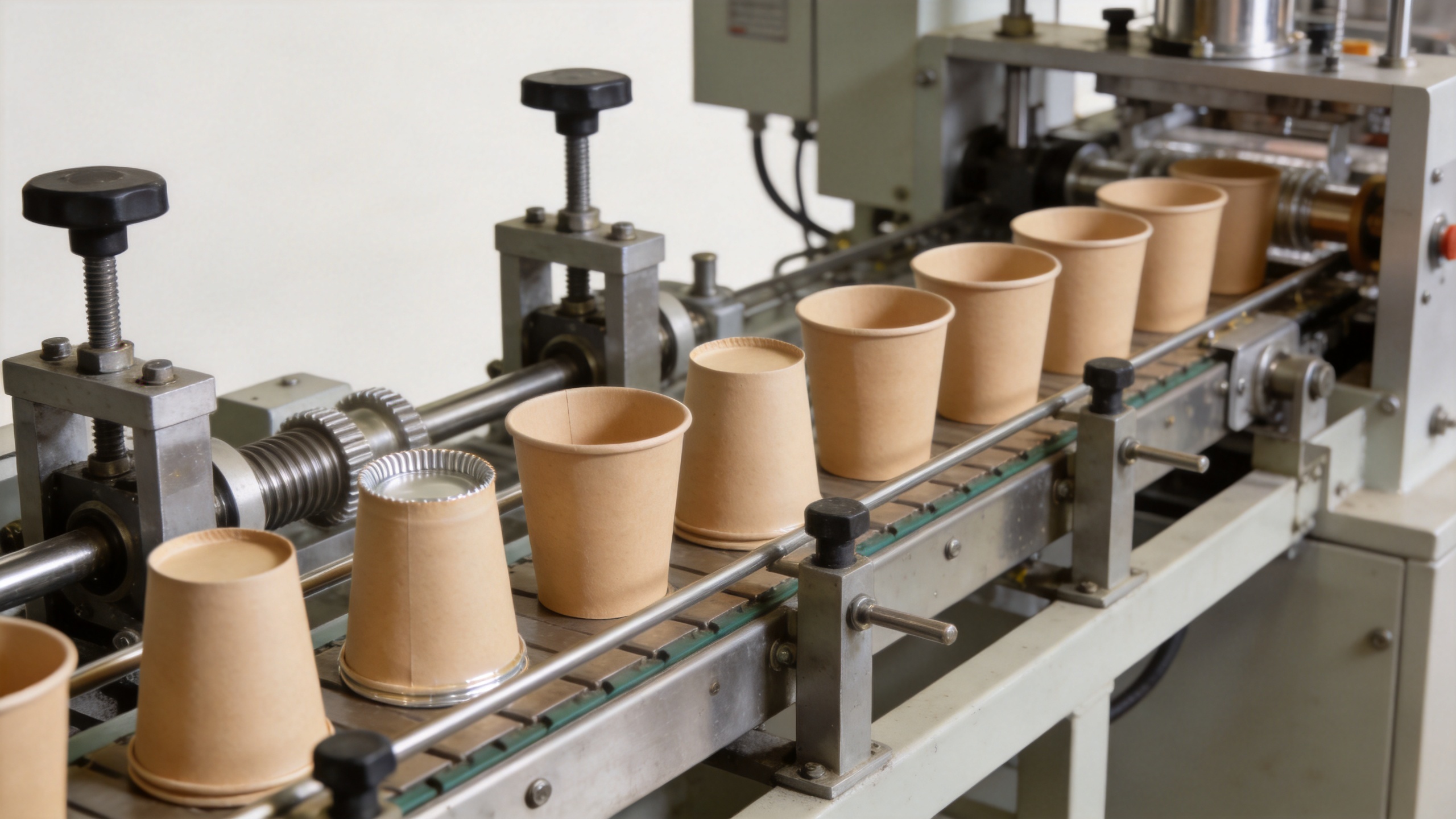
Why the functions must work as one process
This equipment is not a group of unrelated modules. Feeding affects body forming; body forming affects bottom fit; bottom sealing affects knurling; and material behavior can influence every step. More accurately, not every cup-quality issue originates in the machine. Paperboard, coating, blank conversion, environmental conditions, and operator setup can also matter.
That is why a fully automatic paper cup glass making machine should be assessed against a written process brief. Include the cup drawing, capacity target, paperboard and coating details, bottom-disc specification, print orientation, destination market, and expected changeover needs. Where cups contact food or beverages, material compliance should be verified for the destination market. For example, United States requirements include provisions for paper and paperboard components used with aqueous and fatty foods; the applicable material documentation remains a project-specific matter.
What should a paper cup supplier verify?
A paper cup supplier coordinating with a machinery buyer can make the evaluation more useful by sharing real blank and bottom samples. The paper cup supplier should clarify whether the cup is for hot or cold use, its diameter and height, the material structure, and print-registration needs. Those details allow the machinery discussion to focus on fit rather than generic claims.
- Run the proposed cup blank and bottom disc, not only a demonstration sample.
- Inspect side seams, bottom seams, rim curls, dimensions, and cup appearance after forming.
- Agree on how leakage, stacking, and reject samples will be checked during acceptance.
- Confirm the tooling and changeover boundary for each planned cup format.
- Document utilities, operator training, maintenance access, and spare-parts expectations.
A practical way to compare equipment
When comparing a paper cup glass making machine, start with the finished cup and work backward through every function. Do not begin only with a headline production rate. Ask how the feeder handles the actual blank, how the side seam and bottom joint are formed, how the rim is finished, and how the machine signals an abnormal condition. Then compare those answers with the line’s staffing, maintenance, and changeover plans.
ZheJiang RUIDA Machinery focuses on automatic paper cup machines and servo paper cup formers for food-packaging applications. A focused technical discussion can help a buyer map cup requirements to a forming workflow while keeping unverified project details open for confirmation. The durable decision is the one supported by samples, acceptance criteria, and a clear view of what each paper cup glass making machine function must accomplish.
Conclusion
The essential functions of a paper cup glass making machine are feeding, body forming, side-seam sealing, bottom insertion and sealing, knurling, rim curling, discharge, and coordinated control. Each function contributes to the finished cup, and each should be checked against real materials and cup geometry. If your priority is stable output for a specific cup design, begin with the process brief and sample test plan before selecting a configuration.
 ONLINE