
 EN

What Is Disposable Paper Cup Making Machine?
A disposable paper cup making machine is industrial equipment that converts prepared cup paper into finished single-use paper cups through a controlled forming sequence. In practical terms, it takes printed or plain fan-shaped blanks and bottom discs, shapes them into cups, seals the sidewall and base, then forms the rim so the cup can be stacked, filled, and handled. For food-packaging buyers, the practical question is not simply whether a machine makes cups. It is whether its forming process, tooling, and operating setup fit the intended cup size, paper structure, coating, production rhythm, and inspection requirements.
That distinction matters because a paper cup is a paper-and-barrier package, not just a folded sheet. Cupstock may use a liquid-resistant coating, and the appropriate material depends on the beverage, temperature, local rules, and disposal route. For example, U.S. food-contact paper and paperboard applications are addressed under 21 CFR 176.170; that is a compliance reference point, not a blanket approval for every finished cup or market. Buyers should confirm the applicable material documentation and destination-market requirements before production begins.
What does a disposable paper cup making machine do?
A disposable paper cup making machine automates the core steps needed to turn die-cut cup blanks into three-dimensional containers. Depending on the model and configuration, the work sequence normally includes blank feeding, sidewall forming, side-seam sealing, bottom insertion, bottom heating or sealing, knurling, rim curling, discharge, and counting. Some stations use mechanical, hot-air, ultrasonic, or other sealing approaches according to the paper coating and machine design.
The equipment does not create cup paper from pulp and usually does not print the cup artwork. Those upstream tasks are handled by paper suppliers and printing/converting equipment. The cup former begins once the appropriate blanks and bottoms are ready. That makes material compatibility a central part of machine selection: a machine setting that works with one paperboard and barrier combination may need validation before it is used with another.
How the paper-cup forming process works
- Feed the cup fan: A magazine supplies a pre-cut sidewall blank, often called a cup fan, into the forming area.
- Form and seal the sidewall: The blank is wrapped into a cone or cylinder and its overlap seam is sealed. The seal method must be compatible with the coating and process conditions.
- Insert the bottom: A circular bottom disc is placed into the formed sidewall.
- Seal and knurl the base: Heat, pressure, and knurling create a mechanical and sealed joint between the base and sidewall. This stage deserves close inspection because poor setup can affect leakage resistance.
- Curl the rim: The upper edge is rolled into a smooth rim that improves stiffness and the drinking experience.
- Inspect, discharge, and pack: Cups leave the machine for counting, sampling, packing, or transfer to a downstream handling process.
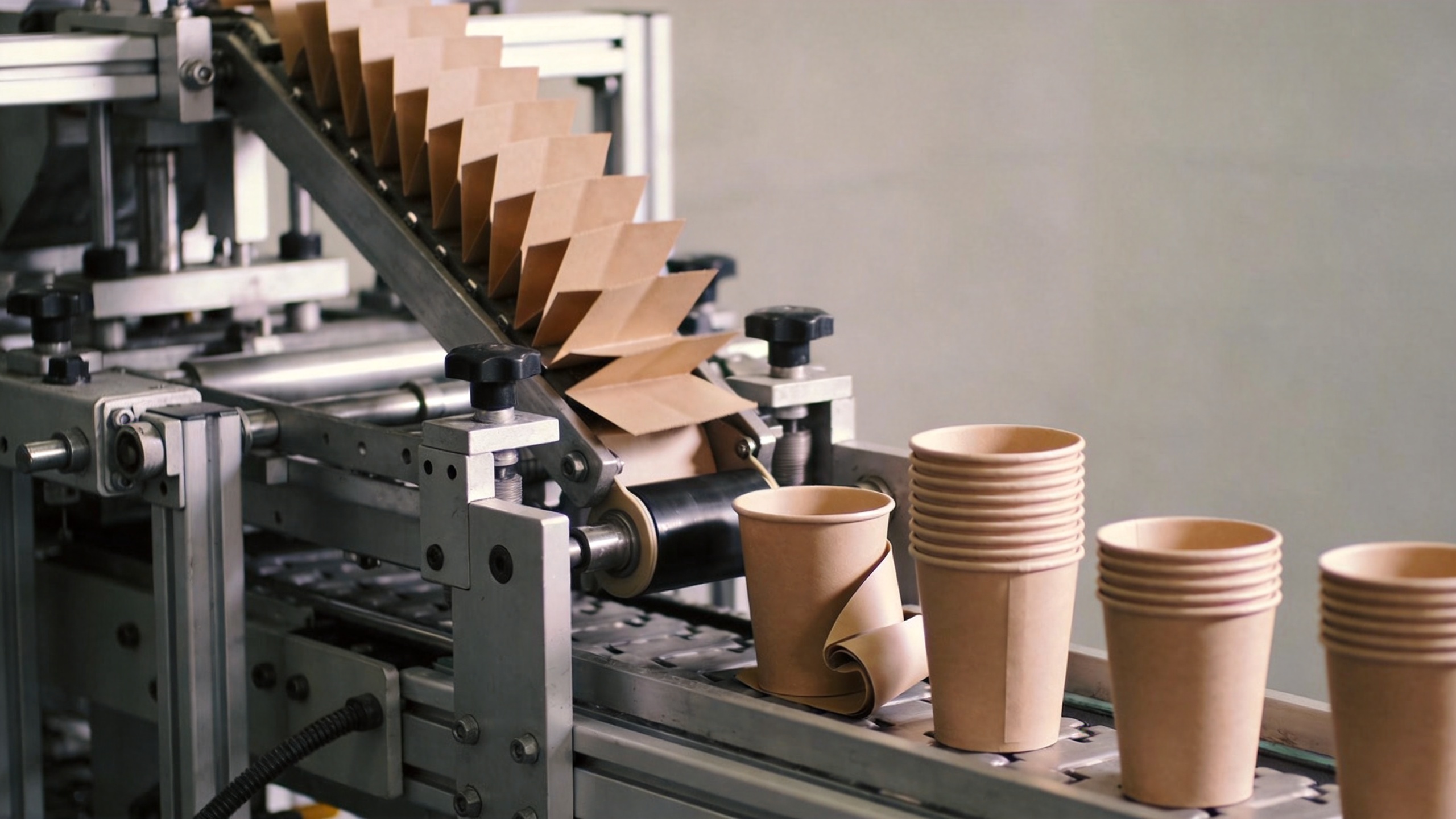
It is tempting to judge a disposable paper cup making machine by a headline speed alone. A more reliable approach is to evaluate stable output under agreed conditions: cup diameter and height, paper grade and coating, seam quality, operator workflow, reject handling, and the actual changeover plan. A stated rate has real value only when those conditions are written down.
What components usually matter most?
Although layouts vary, buyers commonly review the blank-feeding system, forming molds, sealing section, bottom-feeding mechanism, knurling station, curling station, drive system, control interface, guards, and cup collection arrangement. Tooling is particularly important because cup diameter, height, taper, and rim design affect what the machine must form. Ask which parts are format-specific and what is involved when moving from one cup specification to another.
For beverage applications, the seal and heat-management areas deserve equal attention. The correct setup depends on the paper and barrier layer, so a supplier should be able to discuss the material samples, the intended drink temperature range, and the trial or acceptance method. This is more useful than assuming that a generic machine description guarantees a particular cup performance.
Automatic, semi-automatic, and application-specific options
Machine categories are often described as semi-automatic, automatic, or high-speed. These labels are only a starting point. A semi-automatic setup may suit a limited production plan where labor, floor space, and simpler operation are priorities. An automatic disposable paper cup making machine generally integrates more of the feed, forming, and discharge process to support a repeatable workflow. A high-output system may add configuration choices intended to sustain a faster production rhythm, but it still needs suitable materials, trained operators, and defined maintenance routines.
A tea disposable paper cup making machine is not necessarily a separate machine class. The phrase usually points to cups intended for tea service, where the buyer should clarify cup volume, hot-drink temperature, required rigidity, lid interface if relevant, and the material compliance evidence required in the destination market. The machine must be matched to these specifications rather than chosen by the beverage name alone.
How to select the right disposable paper cup making machine
Start with the finished cup, then work backward through the process. This prevents a common purchasing mistake: comparing equipment lists before the cup specification and verification criteria are clear.
- Define the cup range: Record diameter, height, volume, paper weight, coating or barrier type, artwork, and whether multiple sizes will be produced.
- Set the production rhythm: Estimate demand by shift and include planned downtime, sampling, changeovers, and packing capacity rather than treating rated speed as net output.
- Confirm material trials: Provide representative blanks and bottoms where possible. Check seam appearance, base sealing, rim quality, cup shape, and leakage performance using an agreed procedure.
- Review format changeover: If several cup sizes are required, ask which molds and parts change, how setup is verified, and what training is needed.
- Plan quality checks: Establish incoming material checks, visual inspection points, leak testing where applicable, and traceability records before commercial production.
- Clarify support and spares: Identify routine wear parts, maintenance intervals, documentation, remote or on-site support scope, and the acceptance conditions.
The same logic applies when a project also evaluates a paper carry bag making machine. Both machines are used in paper-based packaging workflows, but they process different materials and form different products. Shared purchasing topics—material trials, format changes, operator training, and maintenance planning—can be coordinated, while the technical specifications and tooling should be assessed separately.
Questions to ask before placing an order
Before requesting a proposal, give the supplier a short, precise brief: What cup sizes and paper structures will be run? Which coating or barrier material is expected? What conditions define an acceptable side seam and base seal? How will cups be tested during trial and acceptance? What change parts are included? Which electrical, compressed-air, space, and packing interfaces are required? And what maintenance tasks should an operator complete each shift?
From a food-packaging perspective, it also helps to separate equipment capability from material compliance. The machine forms the cup; the buyer and material supply chain still need to verify that the selected paperboard, inks, coatings, and finished package meet the requirements relevant to the intended market and use. That boundary keeps the project technically realistic.
Conclusion
A disposable paper cup making machine is a forming system for producing paper cups from prepared blanks and bottoms. Its value lies in creating a repeatable workflow for the specified cup design—not in a universal speed number or a generic feature list. When you define the cup, paper structure, production rhythm, quality checks, and changeover needs first, you can compare machine configurations on conditions that matter. For a proposed project, share representative material samples and an acceptance checklist so the forming process can be evaluated against the cups you actually plan to make.
 ONLINE