
 EN
EN

What Makes Paper Machine Suppliers Trustworthy?
Choosing among paper machine suppliers is not mainly a search for the lowest quotation. It is a decision about whether a supplier can turn a stated process requirement into a machine, a documented test, and a support plan that hold together after shipment. That distinction matters whether the project involves a converting line, a paper cup former, or another part of a paper-packaging workflow.
For an export project, trust should be treated as something a buyer can verify. A credible supplier makes its scope understandable, asks precise questions about the application, and is willing to put important assumptions into drawings, test criteria, manuals, and commercial terms. A polished brochure can start a conversation; it cannot replace that evidence.
Trust starts with a clear fit, not a broad promise
Reliable paper machine suppliers first narrow the project. They should ask what paper or board will be processed, the finished product, target output, operating pattern, changeover needs, utilities, and the destination-market requirements. Those questions may feel slow at the RFQ stage, but they prevent a generic configuration from being presented as a proven answer.
A useful comparison method is to give every supplier the same written requirement sheet. Include the material range, product dimensions, required speed or cycle expectations, quality criteria, operator experience, layout limits, and expected delivery scope. Then compare each response against that sheet. If one response changes the assumptions, ask it to identify the change rather than allowing a vague “suitable for your application” statement to stand.
This is especially important when evaluating high speed paper machine suppliers. A high-speed claim is meaningful only when the test conditions are visible. Buyers should ask which material, product format, operator level, running duration, and quality threshold sit behind the stated figure. The better question is not “What is the maximum speed?” but “What output can be demonstrated under conditions that resemble our own?”
Look for engineering transparency before production capacity claims
Trustworthy paper machine suppliers can explain the path from requirement to configuration. That normally includes a preliminary layout, utility list, process sequence, major-component list, control concept, and a statement of exclusions. The documents do not need to reveal every proprietary detail at quotation stage. They do need to make responsibility boundaries visible.
For example, a supplier should be able to distinguish what it supplies from what the buyer or a third party must prepare: incoming material handling, compressed air, electrical connection, installation labor, commissioning support, or downstream packing. When those boundaries remain verbal, apparent savings in the first quote can reappear as delays or change orders later.
It is also reasonable to ask how design changes are managed. A dependable answer identifies who approves the change, what document is revised, how it affects price or delivery, and how the revised specification is acknowledged. Controlled changes are a practical signal that the project is being managed rather than improvised.
Demand evidence through a written factory acceptance test
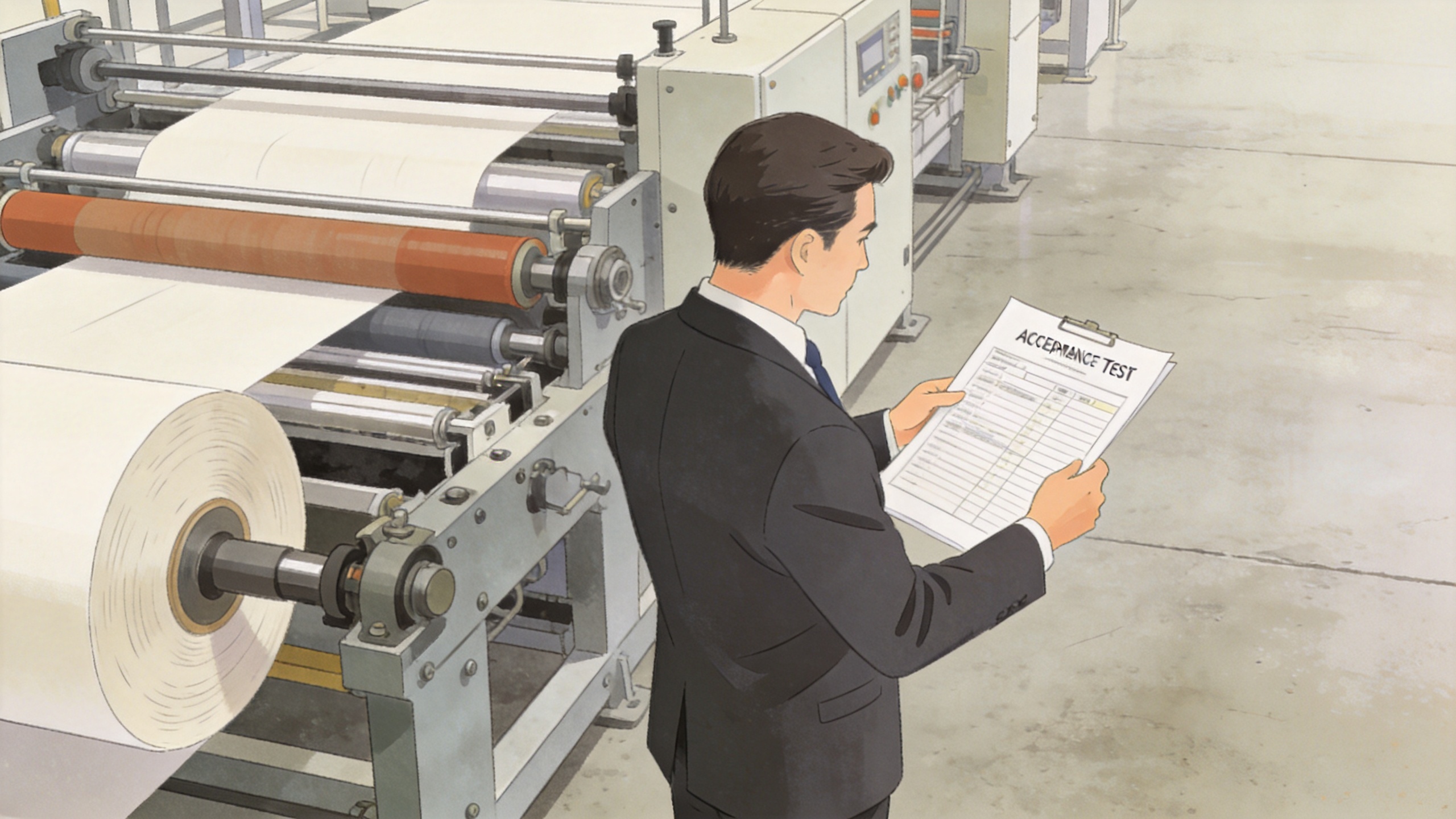
One of the strongest ways to evaluate paper machine suppliers is to agree on a factory acceptance test, often called a FAT, before production is complete. In general industrial practice, the test plan is an agreed inspection and test document tied to the purchase contract. It turns broad performance language into observable checks.
A useful FAT plan names the machine configuration, materials to be used, product specification, safety checks, running duration, output measure, defect criteria, data to be recorded, and the conditions for retest. It should also state what happens if the machine is ready but the buyer cannot attend. A remote review can be helpful, but it should not be an undefined substitute for agreed evidence.
- Ask for the test sequence and the acceptance record template before the FAT date.
- Confirm which measurements are taken and who signs the results.
- Clarify whether samples, videos, parameter records, and punch-list items will be retained.
- Link open issues to a named corrective action and an agreed closure method.
This approach is more useful than relying on a supplier’s claim that a machine has been “tested.” It gives both parties a shared reference when there is a question about scope or readiness.
Documentation shows whether support can continue after shipment
Documentation is not administrative clutter. It is how a buyer can see whether paper machine suppliers have converted technical knowledge into repeatable support. In quality-management practice, documented information is used to communicate what was planned and provide evidence of what was done. For a machinery project, that principle should appear in the documents delivered with the line.
Before placing an order, request a proposed documentation list. Depending on the scope, it may include electrical drawings, pneumatic diagrams, operation and maintenance instructions, a recommended spare-parts list, safety information, troubleshooting guidance, software or parameter-backup arrangements, and packing records. The exact list should be matched to the equipment; the key is that it is agreed rather than assumed.
For ODM paper machine suppliers, this discipline becomes even more important. Custom work should have a frozen specification, an approval path for drawings or samples, and traceable records of modifications. “ODM” should not mean that the buyer discovers the final interpretation only at delivery. It should mean that the supplier can adapt a solution while controlling the decisions that affect function, service, and acceptance.
Evaluate service as a process, not a slogan
Every supplier says it provides service. The useful comparison is how service is organized. Ask who will handle technical questions, which language and time-zone arrangements are available, what information is needed to diagnose a fault, and how spare-parts identification works. A vague promise of “24-hour support” is less useful than a named route for submitting photos, alarms, serial information, and operating conditions.
Also examine the first year of ownership. What commissioning support is included? What training is planned for operators and maintenance staff? Which wear parts should be held locally? What is the process for an urgent shipment? A supplier does not need to guarantee an outcome it cannot control, but it should explain its response path and the buyer’s responsibilities clearly.
Use a weighted comparison instead of a yes-or-no shortlist
A practical way to compare paper machine suppliers is to score evidence rather than marketing language. Give higher weight to requirements that would be costly to correct after shipment. For many projects, that includes application fit, engineering clarity, FAT readiness, documentation, service workflow, and commercial transparency.
| Evaluation area | Evidence to request | Question to ask |
|---|---|---|
| Application fit | Written requirement response and scope assumptions | Which operating conditions are included and excluded? |
| Engineering clarity | Layout, utility list, component scope, change-control method | How will a change be documented and approved? |
| Acceptance readiness | FAT plan, record template, retest procedure | What proves the agreed result before shipment? |
| Documentation | Proposed manual, drawing, and spare-parts deliverables | What information will our team have after handover? |
| Service process | Named contact route, commissioning and spare-parts process | How is an issue triaged and followed to closure? |
| Commercial clarity | Quote exclusions, delivery terms, warranty boundaries | What could create additional cost or delay? |
Final checks before you choose
Shortlisting paper machine suppliers should end with a mutual review of the specification, rather than a last-minute price negotiation. Ask the supplier to restate the application, planned configuration, acceptance criteria, included documents, training, installation responsibilities, warranty boundary, and spare-parts approach in one controlled document. If the answer exposes an uncertainty, resolve it while a design adjustment is still manageable.
ZheJiang RUIDA Machinery Co.,Ltd presents automatic paper cup machines, servo paper cup formers, and flexographic printing presses for food-packaging applications. For a buyer, the sensible next step is to share the actual cup format, paper material, production rhythm, and destination requirements, then request a configuration discussion with the evidence and boundaries above. Trust grows when both sides make the project testable.
 ONLINE